Tuesday, April 26, 2022

Creation, Evolution and Information


Here is the link to my latest interleaved commentary which I have entitled Creation, Evolution and Information.  Nominally, it is a response to the comments of an anti-evolution fundamentalist but it goes a lot further than that.  Below I reproduce the contents. 

Introduction 

01. Fundamentalism 

02. Character assassination 

03. The good but imperfect creation 

04. On Genesis 1 

05. Evolution and dualism 

06. Natural selection 

07. Patent law and invention 

08. Information can be created 

09. Genetic mutation 

10. Genetic drift 

11. Conclusions 

The Epilogue 


Relevant Link:

Epistemology, Ontology, Creation and Salvation

Thursday, April 07, 2022

Concerning Conspiracy Theorism

In this document I use my interleaved commentary format to counter Covid 19 vaccination conspiracy theories. My host in this case is someone I shall call Agent-Y. Agent-Y may (or may not) be a fiction or partly a fiction from my imagination, an agent provocateur invented to act as a sounding board for anti-conspiracy theory theory. I preproduce  the introduction to "Concerning conspiracy theorism" below.  


Introduction

This small book concerns the modern day phenomenon of conspiracy theorism. The layout of this book takes the form of an email discussion with someone I shall call Agent-Y. I think of Agent-Y as having projected themselves into the psyche of an advocate for conspiracy theorism and thereby giving us a window into their world view. But I must caution here that Agent-Y may or may not be a fictional or partially fictional character. That is, Agent-Y could be a figment of my imagination created in order to bring out the errors of the conspiracy theorist world view.

Conspiracy theorists seek to make sense of social reality with their “join-the-dots” explanatory narratives, narratives whose chief feature are shadowy and malign agencies who, it is alleged, subtly direct the course of history from behind their cover. These nefarious agencies, we are told, are hidden deceivers whose all but omniscient information and control is a major source of social angst.  The true motive of these hidden agencies is not always clear but the old-fashioned lust for power, wealth & glory is often implicated. But “glory” is problematical if power & wealth isn’t public. As we shall see this is just one aspect of conspiracy theorism which cuts across what we know about human nature.


This book starts with the Loveworld  news item which appeared in the January 21 edition of Premier Christianity magazine (See left). Loveworld is a Christian satellite TV channel that was airing false conspiracy theories about the Covid-19 virus. This group believed that the social dynamic surrounding Covid-19 to be the planned product of mysterious conspirators who have such exquisite information and control that they can both effectively rule and at the same time remain almost completely undercover to most us, except of course to the enlightened conspiracy theorists who can pride themselves in having cracked the code of appearances and seen behind the façade to the underlying secret of the “deep state” illuminati.

I have written articles criticising the “Fearlosophy“ behind conspiracy theorism elsewhere, but in this short book I enlist the help of the capable Agent-Y who has succeeded in getting into the psychology of the conspiracy theorist and reveals their inmost fears and thoughts that drive them.  Without the help of Agent-Y this work would not have been possible. The identity of Agent-Y is above top secret and this means that I can’t even reveal whether (s)he is real or just a fiction created by myself or someone else’s imagination. Agent-Y may or may not be my alter ego or the alter ego of someone who is working with me.

This book then, like conspiracy theory itself, may be a creative artistic license, a fiction, but which integrates itself into reality with probing tentacles. To quote H G Wells’ Time Traveler in chapter 16 of his book The Time machine……

Consider I have been speculating on the destinies of our race until I have hatched this fiction. Treat my assertion of its truth as a mere stroke of art to enhance its interest. And taking it as a story, what do you think of it?

Thursday, February 10, 2022

Science and Religion. Part I


True, but I would want to add that religion can also suffer from idolatry & false absolutes
...and science can be infected by error and superstition. Let's face it, both are human activities and will therefore suffer from the vagaries & foibles of human behavior.

As I've said many times before, our current grasp of the explanatory objects developed by scientific epistemology explain nothing at all in a intuitive & deeply satisfying way; for those objects are in actual fact descriptive devices (Although I hesitate to say "just descriptive devices"). These devices exploit the highly contingent organization of the created cosmos to arrive at compressed descriptions, descriptions often expressed as succinct mathematical one-liners. Clearly, however, data compression can only go so far before it eventually hits a point of mathematical incompressibility, the compressibility barrier. At that point the progress of scientific "explanation" comes to an end with no real answer to those nagging intuitively sensed questions which arise when descriptive science has left us at a place of extreme  contingency (albeit succinctly expressed contingency). 

The descriptive laws of physics appear to be arbitrarily selected from the platonic world of mathematical possibility, the only sure constraint on this arbitrariness being the weak anthropic principle. Descriptive laws of this type can never make claim to explanatory completeness in an absolute sense. Moreover contemporary physics seems to be at a stage of diminishing returns as the development of physics logjams over gravity and string theory. This may be an outcome of the fact that further data compression becomes harder on already very highly compressed forms.

The unnatural contingency that scientific epistemology has uncovered is acknowledged in a backhanded way by those  strenuous attempts to minimize the surprisal value of this contingency with multiverse models. The trick of multiverse theories works by immersing cosmic contingency in huge seas of randomness*, thus making the contingent uniqueness of the cosmos no more surprising and startling than if one would find a run of ten heads in a million throws of a coin. Some semblance of explanatory completeness may then be claimed and intuitions that a creator God is the author of cosmic contingency neutralized - at least in the minds of some. The human surprisal instinct is a noteworthy intuition in any case. 

If we leave the curiosity numbing effect of multiverse notions aside we are then left with the enigma of "why" those physical laws are the way that they are and "why" they are so reliable in anticipating and unifying our conscious experience and assimilating that experience into a rational grand narrative. But then what does the question "why" mean in this context? If I am going to claim that descriptive physical laws have an inadequate explanatory status in an absolute sense what other ways can the question "why" be defined and answered? This leads us into theology where the question "why" is best defined and satisfyingly answered in the context of the intentionality and purposes of a creator God. Here the infinities & complexities of the Godhead, unlike the simplicity of natural law, could conceivably hide the concept of aseity, thus ending the search for absolute explanatory completeness, albeit in a way that may well be beyond human understanding. The alternative is to fall back on the irreducible kernel of brute contingency necessarily present in the compressed simplicity of physical law explanations. 

But although the inevitably descriptive role of science is destined to always leave us with an irreducible kernel of unexplained brute fact, the explosive surge of scientific discovery from Copernicus onwards has weighed strangely in the intellectual scales and, let's face it, has been a challenge to theists. Although I'm not a science & cultural historian, in my quest for understanding I've had to come up with my best shot as to the whys and wherefores of the receding sea of faith and why science has generated a challenging intellectual environment for theism. Below is my list of scientific challenges to theism. I have touched on them to a greater or lesser extent in various blog posts & articles but in this post I bring them together into one pen. None of them, in my opinion, are insurmountable problems to theism although some are more tricky to deal with than others, particularly the last three in my list. But they all give rise to intuitive objections to theism that should be addressed.

***

1. Copernicus: This one is well known of course. The "Copernican revolution" is often lauded as the first step in a series of demotions of human kind from that apparently special cosmic status humanity was used to, the multiverse being the most recent step in the history of this series. In fact Copernicanism has become prototypical. Since Copernicus and the demise of the Ptolemaic universe humanity has lost that center stage feel which was once sure evidence that (wo)man had a significant place in the heart of an existing God. But the temple universe with humanity as manifestly centre stage has long since departed and  the belittling effects linger in our cultural consciousness.  For my response to this one see The Cosmic Perspective

2. Localised laws: One of the bugbears with the common concept of "mechanism" is that it is conceived as entirely a matter of local interactions between the parts of the mechanism. Those parts, such as atoms or fundamental particles, have a few relatively simple rules governing their near-neighbor interactions and it is thought that these "mindless" rules are then the source from which all else incidentally and purely fortuitously emerges. It is further assumed that these rules are the fundamental & primary reality of the cosmos and all else is secondary and ephemeral. No further questions are then asked about whether this system of rules, if it supports the development and maintenance of life, must therefore be algorithmically pre-biased.  Moreover, it is further assumed that these rules do not include global teleological constraints, constraints which (as they would imply "spooky" action at a distance) would really blow away any semblance of local interaction completeness & primacy. The oft overriding and superficial gut reaction to this picture of local mechanical interactions is that it is clearly entirely mindless in that in and of themselves these interactions obviously have no sentient apprehension of what they are doing and therefore any complex development built on them (such as life) is purely accidental and incidental. But this reaction misses the fact that a randomly chosen set of laws are very unlikely to favour the generation of life as is the case in our cosmos. This tends to prompt a retreat into multiverse ideas in order to neutralize the surprisal of cosmic contingency. 

3. Mechanism & Deism: The discovery of those quasi-localized laws governing the cosmos superficially made it look like a clock, an object which maintains its motions without human supervision. It was a metaphor only but nevertheless this metaphor, I propose, helped prompt a belief that somehow these laws sustain themselves by their own intrinsic animus. Although perhaps at first regarded as inferior to the creative power of God, they set up the initial hint that Deity may have some emerging competition over the question of creative origins and sustenance. Those laws started to assume an independent status and became in the minds of some so-called "natural forces" with not only autonomy, but perhaps themselves an engine of creation. At best the outcome of this drift of thought is deism and at worst belief that the notion of God is redundant in the face of this new creative kid on block. 

But the laws of nature are no engine. Strictly, as I've already said, they are descriptive rather than being explanatory in a deep way and as such only postulate patterns of operation; mostly patterns of high order and rationality which the true underlying cause, whatever that may be, maintains. For the Christian these patterns of operation are God reified everywhen and everywhere; that is, moment by moment and place by place. In that sense they earn the epithet "supernatural forces" rather than mere "natural forces", so perhaps we can expect miraculous output from those laws; they are, after all, the instruments of the cosmic Sovereign.  As descriptive devices those (super)natural laws are without prejudice & don't include any assumption as to the existence of an autonomous internal animus which drives them; that's something we may or may not add in our minds eye: If for example we attribute to them an impersonal internal animus and thereby raise natural law to a level where it has an autonomy of its own the laws of physics are then thought of as "natural forces" rather than "supernatural forces". This raises them to a level where they have the potential to compete with God as creator. 

Some may withdraw completely from the questions surrounding the origins of these contingent descriptive laws and just accept this happens to be the way the world is and that is all there is to it. Beyond us securing these succinct descriptions all other questions are considered to be meaningless or impossible to answer. That's more or less the line Bertrand Russel took in the Coppleston-Russell debate. For Russel the regular ordered world that is amenable to the predict and test epistemic is the only & ultimate reality. The faint signal of the anomalous, the erratic and the apparitional, which are far from epistemically tractable, is discounted out of hand or shoehorned in to the framework of the  knowable and repeatable world. 

However, I don't think contingency, as Coppleston hinted, is proof of God: Rather it's a pointer for the curious to progress further in making sense of the human predicament; in particular the primacy of consciousness.....

4. Absence of consciousness? Close observations on the human brain reveals nothing immediately obvious that one can identify as consciousness; at close quarters the observer only sees a neural dynamic. Conclusion for some: Consciousness doesn't exist and is an illusion worked by the brain; therefore humans are reducible to complex mechanism and as such have no more mystery behind them than any other complex product of "natural forces".  But of course consciousness is not going to be found if you are an observer beyond the person being observed and therefore, by definition, standing outside the experience of the person you are observing; you're just seeing the second person view of the first person. To discover consciousness and the first person perspective you have to look back at yourself to find it. Don't be fooled by an observer's use of third person language, a language which only makes an implicit reference to the fact that all observations on the working brain only make sense if they are carried out by another observer whose observations, of course, trace back to another conscious first person perspective. (See here for more). All third person language has its (implicit) origins in a first person experience. However, my own view is that the first person perspective will only arise if matter is configured in the right way; presumably as the biological brain configures it. Therefore formal complexity alone, such as would be seen in a computer simulation of the brain is insufficient condition for consciousness; the necessary conditions are that the right qualities of matter, along with the right formal configuration  of matter be used in conjunction before consciousness is generated. (I have a lot in common with the views of Philosopher John Searle on this question)

Consciousness has an irreducible place in our reality; in fact without conscious perception the material stuff of the universe has no meaning: In a self affirming loop that material stuff generates consciousness therefore making that stuff register in conscious observation, thus in turn giving matter an existential meaning. That consciousness has such an elemental and irreducible place in the scheme of things is once again another pointer for the curious to follow. That we are in a very contrived universe which generates the first person perspective prompts the search for the ultimate conscious intentionality; i.e. God. No surprise then that those who feel uncomfortable with this prospect, seek to head it off by denying the existence of the first person perspective and get hung up on third person language. 

5. Determinism takes away our humanity: It is unlikely that the laws describing our rational world are deterministic, but even if they were deterministic and moreover fully described the formal structure of human thought, that doesn't mean that "free agents" cannot be defined and be considered responsible for their choices. (See here for more)

6. No observational evidence for God.  This is not actually true: People invoke the concept of God in order to make sense of their life experiences by placing that experience in a theological explanatory framework (or "narrative"; in most cases this theoretical leap is carried out very informally). Experience, after all, is observation. Those theological frameworks (or "narratives") are ways of joining the dots of experience. But, of course this can be done with varying degrees of rigour and moreover some objects are less amenable to "dot joining" and testing than are others. 

With God, as with many other social constructs, we are not talking about simple physical objects like test tube precipitates and Hooke's laws springs whose simplicity, regularity & reliability makes them amenable to elementary predict and test laboratory science; for the objects of the social sciences are much more complex and erratic and therefore of greater epistemic difficulty. To only confer the status of existence to elementary, regular, repeating objects which are amenable to highly controlled laboratory procedures is a form of epistemic self-mutilation. When it comes to those complex social constructs the epistemic keyhole through which we see the world becomes an all too obvious limitation. In short we have great difficulty picking up a strong existential signal from all but the most simple regular objects. It's no surprise then that the social sciences (being the science of hugely complex social objects) are so controversial. But epistemic intractability and erratic behavior doesn't imply non-existence. With God we are well out of the zone of test tube precipitating and spring extending science. I've written many articles on epistemic status. (See here & here for example)

***

So ends those challenges for which I feel reasonably confident in handling the relevant material. But that is not true of the following questions where I have much less confidence.


7Suffering & Evil: VizIf a sovereign loving God exists why does he allow....etc. I have to confess I have not much to say on this question which has consumed gallons of ink. My small offerings on this subject are here & here. Better to consult C S Lewis (among others) on this one. 

8. The Problems of Natural History: For standard evolution to return a realistic probability of generating life it necessarily demands the a priori constraints of a highly organized world and this therefore begs questions about intentional design. However, although at this level evolution looks to be a highly contrived process, at another level, the level of natural history, it looks haphazard, untidy, wasteful, a hit and miss affair subject to a great deal of randomness, suffering and survivalist ruthlessness. In my spongeam model of evolution we see a similar distinction in the difference between the highly constrained channels of the spongeam network (which are evidence of the contingency of an overall bias toward high order) and the random diffusion. It is the random diffusion component which gives the whole of evolution its dynamic.

When we look at the details of natural history we are faced with questions like where was God during those apparently wasteful mass extinction events? The inefficient hit and miss survivalist ethic of natural history seems more pointless than it is meaningful; it doesn't have the touch and feel of an intentional creation by a loving Deity. However, it has been pointed out by Christian Biologist Denis Alexander that the word "good" in Genesis 1 doesn't connote perfection but rather "fit for purpose" whatever that divine purpose may be (presumably ultimately to do with the plan of salvation & restoration). Even in everyday parlance "good" is not strong enough a word to entail perfection ....we can all be merely "good" by human standards even though we know we are far from perfect in our dealings with God and (wo)man; "good" may be, but not "good" enough. 

It is clear that (wo)man (and also Satan) had a propensity to fall and deviate from his/her ordained path of introducing purpose & meaning to the imperfect chaos of the Earth (See the "subduing" of the Earth in Genesis 1:28). The existence of that propensity along with the need to subdue the earth implies creation was not perfect from the first day; it was intrinsically chaotic and had a propensity to go wrong. The emergence of purpose from meaninglessness and the emergence of order from chaos was one of the original aims of creation and in particular the work of its human stewards, but this work was marred by the fall (presumably to be eventually restored by the plan of salvation).

This particular question is a close relation of the problem of suffering and evil.

9. Christian Crackpotism: There are more than enough sectarian and exclusive cultic expressions of Christianity out there along with plenty of bizarre Byzantine thoughts like flat earthism, QAnonism and conspiracy theorism doing the rounds in Christendom to be a serious challenge to any claim that the God of Christian revelation actually exists. The naïve "answers" of say Answers in Genesis which demand a perfect original cosmos, tyrannosaurids with 6 inch fangs eating melons and oranges, men riding dinosaurs, a mere 6000 years of geology and crass solutions to the starlight problem are simplistic treatments which belong to the pages of children's picture books. They have no doubt brought an untold blight upon the Christian witness. All this even before we get started on the worldwide religious situation. 

As with points 7 & 8  I don't have much I can offer as an apologetic on this one (but see my small offering here and also on pages 8 & 9 of  this document).  

***

If you are an atheist and very much against your expectation you one day find yourself at the Pearly gates, but you are barred from entering because of your atheist background, then simply tell them that in your evaluation of Christianity you had ruled out Christ's claims because of the antics of the likes of Westborough Baptist church, the cultic Jehovah's witnesses and personalities like Kent Hovind & John Mackay. On top of that floating about the God-o-sphere you witnessed bizarre notions like Mormon history, pervasive Christian conspiracy theorism, Christian flat earthism, and a gamut of anti-science notions. Mention these items and there's a good chance you'll be able to claim mitigating circumstances and be let in. One word of warning though: You might find Ken "hell and hamnation" Ham there, but please don't let that put you off: It'll give him a really big shock to see you and I for one am looking forward to the look on Ken's face when you enter.

And while you are there you might like to cite issues 7, 8 & 9 above as also being a problem for you. I'll certainly be asking about those myself.

***

In Part II I will be looking at the connotations behind the labels "natural forces" and "materialism" and in particular how they have detrimentally impacted the thought life of Christian fundamentalists and the de facto Intelligent Design community. 


Footnote

*  If we are going to posit the existence of a multiverse that rings the changes of platonic possibility then because disorder has such a high frequency representation (i.e. a high statistical weight) then disordered universes will be overwhelmingly represented in the multiverse ensemble.

Saturday, January 01, 2022

The Transaction Web

Society is a web of connections and transactions

I have to say thanks to my friend James Knight for on so many occasions of getting me out of my shell and dragging me kicking and screaming into the muddled but real world of social, political and economic commentary. The complexity of these subjects and their epistemic intractability  means they are as open ended & contentious as they are significant. Below is my reply to some thoughts James had on using the arborescent and rhizomic networks seen in plant life as social metaphors. I think he will be commenting fully on these matters at a later date. 

***

Hi James,

Here are my comments!

I'm not quite clear how you are applying the arborescent and rhizomic metaphors to society. I think I can just see how you are applying the rhizomic metaphor: it would seem quite a good metaphor for the way people and groups of people and institutions are connected into a very complex network of transactional links through which ideas, information, materials, wealth and resources spread.  If you could map this system of connections visually it would be staggeringly complex. I suppose those visual pictures we see of web connectivity [See above] are a close analogy, showing a power law distribution among the nodes in terms of their number of connections: Viz: there are many nodes with just a few connections and just a few with many, many connections - and that gives us our ~ x-n distribution graph. Such a picture displays a mix of centralized influences and decentralized influences and is evidence that the "market" and government are actually part of one and the same phenomenon and differ only in their degree of connection. (It's like when they discovered that radiant heat and light - apparently two very different phenomena as far as the senses were concerned - were one and the same). Given the way evolution has gone this is no surprise - it too has given us organisms that are a mix of central and decentralized networking and processing 

So I think I can grasp that, but I'm not sure where the arborescent metaphor fits in. The rhizomic metaphor covers both central and decentralized influences - seemingly. Or are you thinking of the difference between very visible and public transactions versus the myriad minor & private transactions that take place between those minor nodes of connection? Ironically, if we take the links between trees themselves in terms of chemical and  gamete connections we end up with a rhizomic looking network. 

As you know I'm pretty anti-Matt Ridley and the kind of "libertarianism" he affects to promulgate: I find fault in his view of evolution which fails to see that given the rhizomal metaphor, informal unplanned evolution covers both government and the market. As I've already said evolution has given us organisms that display both centralized and decentralized processing. It's a straw man to characterize government as a failed or incompetent "planner"; because of chaos all collective identities, whether organic or societal, are forced into the role of being complex adaptive systems - that is they are opportunists who necessarily have to adapt to changing circumstances as those circumstances come up. Apart from God himself there are no long term planners - there can't be in a chaotic reality.  It's clear to me that those centralized highly connected nodes are as much an aspect of evolutionary change as are the broad mass of little folksy nodes with few connections. 

Those highly connected centralized nodes are needed, as is the spider in the middle of the web, in order to respond to systematic threats and changes that decentralized processing cannot respond to fast enough or perhaps even be aware of. Moreover evolution wouldn't work at all were it not for a highly organized regime of physical laws & influences that constrain and regulate what is possible; it is an error to think of evolution as a random process - far from it. In that sense evolution itself requires both centralized and decentralized inputs. As you know I'm very much for the market and its powers of innovation, wealth distribution & creation, but frankly I see subliminal & crypto right-wingers like Ridley misrepresenting the argument for the market. I really fell out with him when he started hobnobbing with conspiracy theorist Glenn Beck (just as Trump did with QAnon and Alex Jones).  He was (perhaps unintentionally) playing into the hands of the far-right.

Political reality seems to be a curved space. As the far-right and the far-left both seek the dismantling of the state in favour of their ideologies which purport to aim for an ultimate decentralized folksy society, they seem unaware of the inevitable lurking opportunists in their midst who may seize on the chaos of social break-down to edge toward totalitarianism, the ultimate authoritarian version of the state, the ultimate "big" government. Thus, far-left and far-right meet each other as they converge from opposite directions. How ironic!

For Queen, Country and the Market!

Tim


***

Some of those ideas I offered above are rather seat-of-the-pants and need a little more developing - in particular the idea that Market and Government are aspects of the same underlying phenomenon of transactional connectivity and an aspect of complex adaptive systems theory.

I had to take a much needed bash at right-winger Matt Ridley: He would likely object to the label right-winger, but that label has got more to do with the people and partisans he identifies with. The result is that it is possible to predict in advance, with a reasonable probability, what stance he will take on certain issues.....

Is he going to be critical of the Greens? Of course he is.
Is he going to favour living and let live re: CO2 emissions? Of course he is.
Is he going to favour theories that Sars-CoV-2 was lab leaked? Of course he is.
Is he going to protest about pandemic lock-downs? Of course he is. 
Is he going to be a Brexiteer? Of course he is.
Is he going to write for the Telegraph? Of course he is.
Is he going write for the Guardian ? Of course he isn't
Is he prepared to go on the show of  conspiracy theorist Glenn Beck? Of course he is. 


I'm not going to comment whether Ridley is right or wrong on these matters (He may or may not be right), but merely point out the predictability of his stance because of the tribes he identifies with. But I will, however, venture to comment that he made a huge mistake in hobnobbing with Glenn Beck - that's the crackpot stamping ground of the Donald Trumps of this world. But then, like Trump, Ridley has got to think of his constituency and audience.

Tuesday, November 30, 2021

Gravity and Thermodynamics

My latest "book" (if such it is) can be accessed here. Below I list the chapter headings

Introduction                                                                     

1.      Wave function collapse and non-locality                                                           

2.      The Macroscopic vs. Microscopic Question                                   

3.      Diffusion field theory of gravity                                                        

4.      Developing an equation for the gravitational constant                            

5.      Interpretation of the equation for the gravitational constant                  

6.      The macroscopic boundary question; initial thoughts                              

7.      The F constant                                                                       

8.      Maintaining the gravitational field energy with quantum collapse                

9.      Equilibrium gravitational field flux.                                               

10   Towards a theory of consciousness


Some words taken from the Introductions:

This book continues to develop my concepts behind gravity and in particular it focusses on the meaning of the gravitational constant G. It also probes the boundary between the macroscopic and microscopic and the question of why we don’t see those ambiguous quantum states at the macroscopic level. I personally think the explanations given for the apparent macroscopic absence of quantum ambiguity supplied by multiverse theories and decoherence theory unlikely (More about that later). This opinion means that I have to tender a criterion for distinguishing between the macroscopic and microscopic; that is, some threshold in terms of material bulk has to be postulated above which quantum ambiguity is not supposed to be observed. To this end I make very tentative steps toward defining this threshold in this book. According to the ideas developed here those so-called “quantum collapses”, that is the discontinuous shifts in the quantum state vector when observations are made on those microscopic quantum systems, are necessary to prevent macroscopic objects linked to those observations correspondingly occupying ambiguous configurational states.

.....And my usual disclaimer:  

Before I go any further I’d better add my usual disclaimer.  This gravity project of mine reminds me of the sort of speculative exercise involved when theories about the colour of dinosaurs are offered. These colours leave little or no evidence in the rocks and so all that can be done in this circumstance, given a dinosaur’s likely life style, is to render the dinosaur in a colour scheme that is at best plausible, but not to be taken too seriously.  That’s how I see me own theory of gravity; I personally I’m not party to either sufficient data or understandings to either confirm or reject my speculations about gravity. At best the picture I’ve painted seems a plausible enough to me and that, I suppose, is the best I can expect. But right or wrong it has nevertheless been an interesting avenue to explore, if only to show that it is probably an avenue with a dead end.....

.....The way I’ve come to terms with the likelihood that my own theoretical renditions of reality are fanciful imaginings is to regard my creation as some other invented reality that, with a nod of respect to the glory of the true reality, makes a feeble attempt to emulate it, but when emulation fails I have to go it alone. I’ll therefore have to be satisfied in producing a reasonable looking & plausible presentation of some unlikely ideas. But you never know it might, perchance, be right for our world. As DNA pioneer Maurice Wilkins said encouragingly when it was clear that Watson and Crick’s first shot at a model of DNA failed badly against the data:

"One might say but why not? It's an exploration to make a model. You make a model and if you make a bit of a fool of yourself in the process why worry? ....you might get lucky!"

…in my case I need to get very lucky. Until then I look on this work as a work of science fiction.                                                                           

Thursday, November 18, 2021

Subliminal deism and the de-facto IDists


Kalam thinking: God posited as a boundary condition in time

I've said it before and I say it again: In many ways I have a lot in common with the de facto Intelligent Design theorists: Viz: Without invoking sentience as a primary force it is, I believe, it is difficult to make intelligible sense of a highly organized universe where the observational experience of human consciousness is so central to the meaning of the reality of the cosmos. The irreducibility & hiddenness of the human first person perspective is the precedence for invoking thoughts of an a priori highly complex sentience underlying the cosmic order. Moreover, accounting for the universe just in terms of simple local interaction between fundamental particles necessarily eventually runs up against a logical hiatus of brute contingency. Therefore I seek aseity & ultimate origins in the complexity of deity and not the localised mindless simplicity of particulate interactions.

But in spite of all that when ever I look at the detail of the de facto IDist's apologetic efforts there is always something I have to take issue with and that issue, if its not to do with their now Trump slanting politics, is their subliminal dualism. This dualism comes out in their habitual use of a "natural forces vs "God" Intelligent Agency" dichotomy. But if it is God who has created and continues to create our world those so called "natural forces"  are far from "natural". In fact the cosmos is most unnaturally miraculous everywhere and everywhen.

This post is about my latest beef with de facto ID thinking.  

***

In a post entitled Astrophysicist Ethan Siegel Tries Banishing The Kalam Constant on the de facto Intelligent Design web site Uncommon Descent, Big Bang theorist Ethan Siegel is criticized for making an attempt to muddy the waters over the question of whether the Big Bang represents an absolute beginning. For as sure as eggs are eggs the de facto IDists are thoroughly committed to the idea that the Big Bang was an absolute beginning. They may well be right about that; in fact as Christian I think it likely they are right. But it is typical of dualist ID, whose "natural forces vs God" dichotomy all but puts created matter on a deistic footing, demands the patching-in of periodic and ad hoc Divine interventions in order to save Christianity. This subliminal deism also leads them to commit to the notion that Big-Bang was the first Big Patch-in.  As we shall see they are on precarious ground because the early nanoseconds of creation fade into epistemic obscurity the further we look back and the ground becomes debatable. Worst of all they commit themselves to the flaky Kalam argument.

***

UNCOMMON DESCENT: Astrophysicist Ethan Siegel Tries Banishing The Kalam Constant. To do that, he posits an “acausal, indeterminate, random Universe”:

 It remains possible that the Universe does, at all levels, obey the intuitive rule of cause-and-effect, although the possibility of a fundamentally acausal, indeterminate, random Universe remains in play (and, arguably, preferred) as well. It is possible that the Universe did have a beginning to its existence, although that has by no means been established beyond any sort of reasonable scientific doubt. And if both of those things are true, then the Universe’s existence would have a cause, and that cause may be (but isn’t necessarily) something we can identify with God. However, possible does not equate to proof. Unless we can firmly establish many things that have yet to be demonstrated, the Kalam cosmological argument will only convince those who already agree with its unproven conclusions.

 Ethan Siegel, “Does modern cosmology prove the existence of God?” at Big Think (November 3, 2021)

MY COMMENT: Given that Siegel is an atheist he's not being unreasonable here and he is giving some leeway to us theists: Yes, from the observational and theoretical data we have it is not yet possible to certainly decide whether the universe had an absolute start, although Siegel does concede above that a fundamental logical discontinuity at the beginning could conceivably be identified with God's action. But he's right, we don't yet have a water-tight proof one way or the other; rather we have, depending on one's worldview, arguments which may or may not compel. He does not posit an acausal, indeterminate, random Universe”. Rather he's being agnostic about the Kalam argument which in my opinion is an argument with cracks in it.  Although I would take issue with Siegel that the use of randomness really "explains" nothing in the deepest sense of the word "explain", I agree with him that randomness does erode the sharpness of the "cause & effect" concept, a concept that only really comes out clearly in classical mechanics. In fact not long after Newton annunciated his laws some enlightenment philosophers interpreted the unbroken chain of Newtonian cause & effect in a self sufficient deistical manner, a manner that has worked against Christianity. This leads very easily into de facto ID's "nature forces vs God" dichotomy with the upshot that IDists are very anxious to show that the otherwise deistical cosmos does from time to time experience divine interventions, thus making good for what they believe to be the cosmos' evolutionary inability to create life by those inferior "natural forces".

One can of course simply relabel randomness as a kind of cause in itself with its effects being seen in disordered patterns, but that is really just a change in semantics.  All in all I would suggest that given his convinced atheism Siegel naturally enough is going to favor the elimination of any awkward origins discontinuity or logical hiatus and would much prefer to establish a cosmic continuity from eternity unto eternity; that is, he sees the cosmos as a self supporting affair not needing the input of God as a sustaining and/or continuously creating agent. There's irony in his appeal to randomness: It's a process where there's a discontinuity every moment, but if you are going to claim that randomness is the forever-cosmic-status-quo then the constant discontinuity randomness becomes the new continuity!

But I'll give Siegel this: He's being fair to theists with his agnosticism about whether cosmic origins entail a logical discontinuity or not. 

UD quotes ID guru Brian Miller who is writing on Evolution, News and Science about Siegel's views:

MILLERSiegel begins his piece by outlining the Kalam cosmological argument for God that Meyer detailed in The Return of the God Hypothesis:

 a) Whatever begins to exist has a cause.

 b) The Universe began to exist.

 c) Therefore, the Universe has a cause to its existence.

 Siegel then attempts to challenge the first premise by arguing that quantum phenomena appear to occur without causes:

“…there is no cause for the phenomenon of when this atom will decay. It is as though the Universe has some sort of random, acausal nature to it that renders certain phenomena fundamentally indeterminate and unknowable. In fact, there are many other quantum phenomena that display this same type of randomness, including entangled spins, the rest masses of unstable particles, the position of a particle that’s passed through a double slit, and so on.”

MY COMMENT:  Leaving aside decoherence and multiverse notions (ideas which attempt to reinstate localised determinism) it's true that quantum mechanics is certainly not so compellingly causal as Newtonian mechanics.  So, apart from the change in semantics I've already mentioned I would accept that Seigel is right in so far as the concept of "causation" in the context of irreducible randomness is a somewhat strained idea. However, where I do differ with Siegel is that my intuitions cannot accept the absurdity of irreducible randomness, an absurdity which tries to convince us "that's the way things are and that is all there is to it. Get used to it!". If Siegel finds he is able to accept that this meaningless logical hiatus is the end of enquiry then I have say I personally find it senseless and God help Siegel! For me the inquiry must go further rather than being left as the absurd logical hiatus of random contingency. As I always say, atheism teeters on the edge of the nihilist abyss.  

In the sense I advance in my previous post on Kalam, the search for a profound "cause" of  the highly contingent cosmic state of affairs, affairs which otherwise seem absurd & meaningless, must go beyond a resigned acceptance of the brute-fact descriptions of an ultimately incompressible kernel of algorithmic information. But the Kalam argument is naïve: It is based on notions of temporal antecedents & sequences of events: Whatever begins to exist has a cause..... And need that "cause" be God? Perhaps it's simply preceding "natural causes"?

I suspect that the Kalam argument finds intuitive support from those gross Newtonian intuitions about an unbroken temporal sequence of cause & effect. I don't share those intuitions myself, therefore Kalam doesn't work for me; it is far from axiomatic as far as I'm concerned. If there is any worthy intuition behind Kalam it is that the cosmos must make anthropic sense.

MILLERThis claim is highly misleading since it confuses determinism with causality. Quantum mechanics is not deterministic since it describes only the probabilities that certain events could occur such as the paths a photon could take in the double slit experiment. But the laws of quantum mechanics act in our universe as the causal agent for all such events.

Brian Miller, “Astrophysicist Ethan Siegel Again Desperately Attempts to Avoid a Cosmic Beginning” at Evolution News and Science Today (November 8, 2021)

Siegel may be confusing the Kalam Constant with the Shazzam! Constant. What’s really interesting is that he thinks he must answer Meyer’s arguments at all.

MY COMMENT: No, Mr. Miller quantum mechanics isn't a "natural causal agent" (as opposed to an "intelligent agent"?); Rather, it's a sovereign God's ordained constraint on the possible patterns of events that our cosmos can generate. The quantum equations are not best thought of as the cause of the individual random events of quantum collapse, but as a kind of "permissive envelope" of possibility within which the statistics  of randomness applies. 

The need for the use of statistics in QM is simply an admission that humanly speaking, beyond  frequency statistics, the individual events of randomness are epistemically unknowable and we really don't know how particular "random" events fit in with God's active and permissive wills.  In referring to quantum mechanics as a causal agent Miller is really engaged in the trivial activity I've already talked about; namely, recycling the word "causal" to cover the role of quantum mechanics as a statistical constraint. Miller is at liberty to engage in this semantic jiggery-pokery, but Miller really should note that the Kalam argument is set very much in the context of time as a sequence of events with one event being the cause of the next event, an event which is regarded as an effect - this concept of cause comes straight out of intuitions that have been formed in the macroscopic world of Newtonian mechanics. Viewing physics as a constraint with divine purposes behind it rather than an old fashioned Newtonian cause & effect scenario is to my mind a much more appropriate nuance.

Miller's subliminal dualism encourages him to hang onto the Kalam argument at all costs. Yes. I agree it is likely that Big Bang does trace back to an absolute logical hiatus. But Miller is part of the ID subculture which has staked so much on the inefficacy of those so called "natural forces" to generate life and therefore has the need to invoke a patched-in intelligent agency. Underlying this, I propose, is a blend of subliminal deism which commits de facto IDists to seek evidence for the existence of intermittent acts of special creation in order to make the epistemic of their explanatory filter to work

Miller goes on to pick up the debate as to whether on not current theory points to an absolute beginning, in particular debates around the Borde-Guth-Vilenkin (BGV) theorem, a theorem I mention in my previous post on Kalam.  This theorem suggests that an absolute beginning is entailed by Big Bang Theory.  But Siegel mentions a paper by Aquirre and Gratton which raises questions over the BGV theorem. Miller counters as follows:

MILLER: And in his extended research notes under Note 6c, Meyer explains why the Aguirre and Gratton model is completely unrealistic. It requires an unimaginable level of fine-tuning in the infinite past for the universe to have contracted to such a special low-entropy, compact state at the transition from contraction to expansion. If the model were even plausible, the level of required fine-tuning would represent even greater evidence of design than it was intended to avoid by removing the beginning. By appealing to it, Siegel is proverbially jumping from the philosophical frying pan into the fire.

MY COMMENT:  Miller does have a worthy point here when he tells us that as one goes backwards in time entropy must decrease: This decrease can't go on forever.  If as the Boltzmann equation asserts entropy is a monotonically increasing function of the number of microstates consistent with a macrostate then there comes a point where the number of possible microstates is so small that the large-number assumptions of statistical mechanics will break down. I see this as yet another example of the potentially pathological epistemic of hopefully extrapolating physical laws (otherwise only tested in normal circumstances) into the unknown to the point of breakdown. 

And another example of extrapolation pathology: As I remarked on my previous post on Big BangThe other baffling [extrapolation] issue is this: As we follow the shrinking exponential of inflation back in time there comes a point where the scales of gravity and quantum theory collide: What happens then?  Gravitational and quantum theory have yet to be united, hence extrapolation beyond the hot big bang period is an extrapolation into the dark unknown. Therefore, apart from speculation on all sides, I guess that is how the situation will remain for some time to come.

In my previous post on the Kalam argument I commented what I believe to be the general import behind the likes of the BGV theorem:

The general mathematical principle being invoked here can be found in algorithmics. The computations inherent in some functions cannot be meaningfully wound back in time indefinitely. There comes a point when the computations prior to a certain time in the past are undefined. So yes, it may well be that the physical computations that run our cosmos have a definite start time. However, it is one thing to hypothesize physical functions that can’t be run back in time indefinitely and quite another to make one’s theology depend on it.

***


Both Siegel and Miller show hints of desperation in desiring to see their respective creation agendas justified, although Siegel can be commended for showing a certain amount of epistemic humility in giving us theists some leeway. Miller however looks to be the more desperate or the two and that, I hazard, is because of de facto ID's philosophical dualism and subliminal deist thinking. For the IDist God must be seen to be overtly "intervening" in what they believe to be the creatively ineffectual "natural" order. Therefore a very contingent logical hiatus at the beginning of things will do nicely thankyou very much; it represents a God starting as he means to go on; namely, as an occasional intelligent "cause & effect" agent when "natural forces" are thought by IDists to be unable to do the job.  Well yes, I can accept that God may well occasionally miraculously dabble with one-off works, but that doesn't mean that the so-called natural order, which I stress once again is also God's work, isn't also capable of the miraculous. What I object to is that for IDists God becomes an ancillary cause to be invoked when "inferior natural forces" are thought not to be up to the job. What are the dualist IDists going say if evolution was proved beyond reasonable doubt? Do they then abandon "The God hypothesis"? 

For IDists "The  God Hypothesis" has become too dependent on an absolute beginning and those occasional one-off interventions; And here's the irony: Deism, which posits the existence of self sustaining "natural forces" is a short step from atheism; all one need do is argue that if the universe has a natural self-sustaining sequence of cause & effect then why is there any need for divine one-off interventions at all if it can be shown that "natural forces" can generate life?  In focusing so exclusively on a jumped up Newtonian time-based cause & effect paradigm IDists have failed to do justice to a cosmos that has a highly contingent logical hiatus everywhere and everywhen.


ADDENDUM  27/11/2021

Business as usual at de facto ID central

In the YouTube video below William Dembski implicitly assumes a natural forces vs intelligent agency dichotomy and perpetuates  the error that evolution, if it were true, doesn't entail the need for an intelligent agent and therefore people like Richard Dawkins can claim to be intellectually fulfilled atheists. As I've maintained before, in terms of the way they think  IDists are not far removed from the thinking of atheists.

William Dembski: Gauging the Success of Intelligent Design - YouTube

And by the way: Dembski concludes that de facto ID has not been successful at least in terms of its take-up.  As long as it continues to perpetuate old errors it doesn't deserve success.

Thursday, November 04, 2021

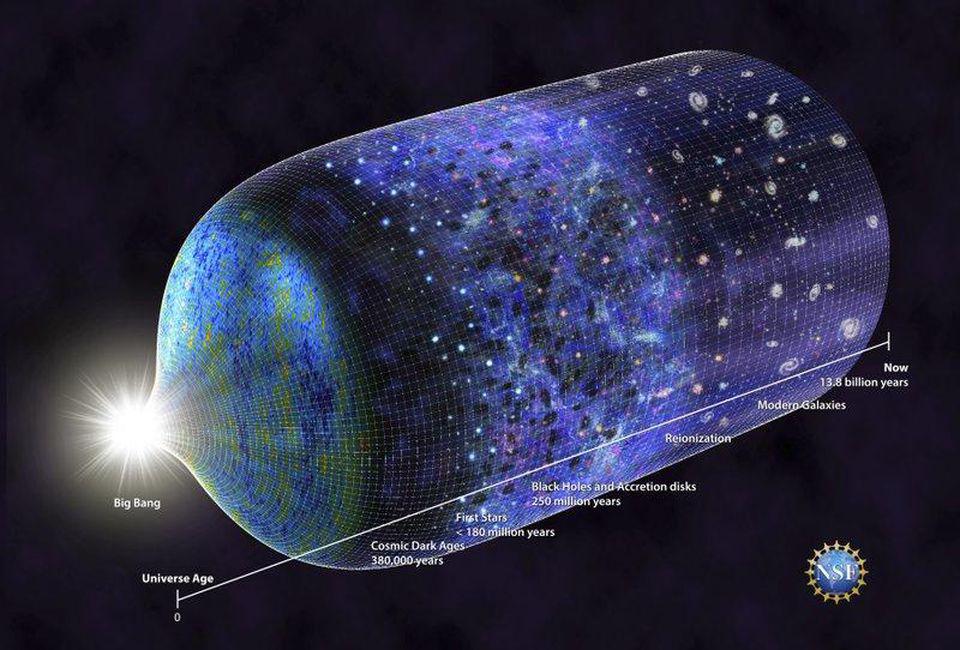
Big Bang Notes II: Ethan Siegel

Picture from Did the Big Bang begin from a singularity?


After the notes I made in my last post on Big Bang Theory I was  fascinated by the following article on "The Big Think" by  Big Bang theorist Ethan Siegel.....

Did the Big Bang begin from a singularity? Not anymore. - Big Think

Below I quote parts of the article and interleave my comments. 

SIEGEL: But extrapolating beyond the limits of your measurable evidence is a dangerous, albeit tempting, game to play. After all, if we can trace the hot Big Bang back some 13.8 billion years, all the way to when the universe was less than 1 second old, what’s the harm in going all the way back just one additional second: to the singularity predicted to exist when the universe was 0 seconds old?

The answer, surprisingly, is that there’s a tremendous amount of harm — if you’re like me in considering “making unfounded, incorrect assumptions about reality” to be harmful. The reason this is problematic is because beginning at a singularity — at arbitrarily high temperatures, arbitrarily high densities, and arbitrarily small volumes — will have consequences for our universe that aren’t necessarily supported by observations.

 For example, if the universe began from a singularity, then it must have sprung into existence with exactly the right balance of “stuff” in it — matter and energy combined — to precisely balance the expansion rate. If there were just a tiny bit more matter, the initially expanding universe would have already recollapsed by now. And if there were a tiny bit less, things would have expanded so quickly that the universe would be much larger than it is today.

And yet, instead, what we’re observing is that the universe’s initial expansion rate and the total amount of matter and energy within it balance as perfectly as we can measure.

 Why?

 If the Big Bang began from a singularity, we have no explanation; we simply have to assert “the universe was born this way,” or, as physicists ignorant of Lady Gaga call it, “initial conditions.”

 Similarly, a universe that reached arbitrarily high temperatures would be expected to possess leftover high-energy relics, like magnetic monopoles, but we don’t observe any. The universe would also be expected to be different temperatures in regions that are causally disconnected from one another — i.e., are in opposite directions in space at our observational limits — and yet the universe is observed to have equal temperatures everywhere to 99.99%+ precision.

 We’re always free to appeal to initial conditions as the explanation for anything, and say, “well, the universe was born this way, and that’s that.” But we’re always far more interested, as scientists, if we can come up with an explanation for the properties we observe.

MY COMMENT: Siegel is warning us against the extrapolating right back to a space-time singularity. That makes sense to me on this basis: I always have doubts when a theory predicts an infinity and I'm inclined to believe that this is a sign of an incomplete theory that is being pushed too far.  But in the above quote Siegel's reason for rejecting an initial singularity is to do with scientific prediction: For unless one is to engage in the ad hoc business of patching in arbitrary initial conditions, a cosmos that starts with an arbitrarily high temperature doesn't perform well on the prediction front. Siegel then goes on to tell us that a good origins theory would predict important cosmic features like the  flatness of space, the absence of magnetic monopoles, and the uniformity of temperature and density across the observable universe.  

As we shall see Siegel doesn't contradict Einstein's great theory of gravitation which predicts the possibility of a space-time singularity. Instead he conveniently side steps the question of whether space time space-time singularities are physical by telling us to stop yourself before you go all the way back to a singularity.

SIEGEL: Inflation accomplishes [(correct) predictions] by postulating a period, prior to the hot Big Bang, where the universe was dominated by a large cosmological constant (or something that behaves similarly): : the same solution found by de Sitter way back in 1917. This phase stretches the universe flat, gives it the same properties everywhere, gets rid of any pre-existing high-energy relics, and prevents us from generating new ones by capping the maximum temperature reached after inflation ends and the hot Big Bang ensues. Furthermore, by assuming there were quantum fluctuations generated and stretched across the universe during inflation, it makes new predictions for what types of imperfections the universe would begin with.

 MY COMMENT: So, inflation theory predicts a) a near enough flat universe, b) the absence of high energy relics (like magnetic monopoles), c) essentially a uniform distribution and d) makes predictions about the magnitude of fluctuations away from perfect uniformity.  Sounds good so far.  Now comes the interesting bit:

SIEGEL: But things get really interesting if we look back at our idea of “the beginning.” Whereas a universe with matter and/or radiation — what we get with the hot Big Bang — can always be extrapolated back to a singularity, an inflationary universe cannot. Due to its exponential nature, even if you run the clock back an infinite amount of time, space will of time, space will only approach infinitesimal sizes and infinite temperatures and densities; it will never reach it. This means, rather than inevitably leading to a singularity, inflation absolutely cannot get you to one by itself. The idea that “the universe began from a singularity, and that’s what the Big Bang was,” needed to be jettisoned the moment we recognized that an inflationary phase preceded the hot, dense, and matter-and-radiation-filled one we inhabit today.

This new picture gives us three important pieces of information about the beginning of the universe that run counter to the traditional story that most of us learned. First, the original notion of the hot Big Bang, where the universe emerged from an infinitely hot, dense, and small singularity — and has been expanding and cooling, full of matter and radiation ever since — is incorrect. The picture is still largely correct, but there’s a cutoff to how far back in time we can extrapolate it.

MY COMMENT: Yes, I get the point: Running a positive exponent exponential backwards means that it never reaches that mathematically mysterious singularity.  And yes we may well need to jettison the singularity postulate. I for one regard it as ontologically suspicious and unlikely to be physical. 

SIEGEL:  Lastly, and perhaps most importantly, we can no longer speak with any sort of knowledge or confidence as to how — or even whether — the universe itself began. By the very nature of inflation, it wipes out any information that came before the final few moments: where it ended and gave rise to our hot Big Bang. Inflation could have gone on for an eternity, it could have been preceded by some other nonsingular phase, or it could have been preceded by a phase that did emerge from a singularity. Until the day comes where we discover how to extract more information from the universe than presently seems possible, we have no choice but to face our ignorance. The Big Bang still happened a very long time ago, but it wasn’t the beginning we once supposed it to be.

MY COMMENT: Yes, I can accept Siegel's talk about our ignorance: in fact Siegel himself doesn't comment on two outstanding questions: Viz: What provides the energy for inflation? The nearest he gets to this question is a reference to a the cosmological constant which is another patch-in not greatly different to patching in initial conditions to fix the problems. The other baffling issue is this: As we follow the shrinking exponential of inflation back in time there comes a point where the scales of gravity and quantum theory collide: What happens then?   But quoting Siegel once more we've at least got this to hang onto:

The [Big Bang] picture is still largely correct, but there’s a cutoff to how far back in time we can extrapolate it.

So further extrapolation beyond the hot big bang period is an extrapolation into the dark unknown. Therefore, apart from speculation on all sides, I guess that is how the situation will remain for some time to come. As I said in my last post on Big Bang: People still hanker and yearn after the idea that there was something  before the big bang. But what was it? Was it God or just more  algorithmically compressible bytes and bits?  It might help when the incommensurability of gravitational theory and quantum theory is sorted.