Showing posts with label Postmodernism. Show all posts

Thursday, December 08, 2022

Tim Ventura, Anti-Gravity, and The Philadelphia Experiment

The Fascinating World of Fringe Science

I ran the story below 18 years ago in 2006, back in the days before I had formed a conceptual framework for dealing with conspiracy theorism. The story is in fact my tongue-in-cheek retelling of the "Philadelphia Experiment" as told by Anti-gravity aficionado, Tim Ventura.  Well, I call him an "Anti-gravity aficionado" because that was then when he ran a websitre called "American Anti-Gravity": Since, Tim's actually moved on, enhanced the gravitas of his image by wearing a tie & suit rather than T-shirts and now has a YouTube channel where he interviews investigators and technologists who work on, to put it nicely, risky avant-garde science; that is, science at the boundaries of the accepted mainstream; some might call it "fringe-science", still others would call it pseudo-science! It's risky because professional dabblers in these borderline paranormal connections are putting their reputations and careers at risk

Tim Ventura's original telling of the "Philadelphia Experiment" can be found here.  I have to confess that the only Ventura interview I've watched was the one with Kevin Knuth whose fair-minded reasonableness actually did impress me. 

Other relevant links:

Quantum Non-Linearity: The Anti Gravity Road Show. (quantumnonlinearity.blogspot.com)

Quantum Non-Linearity: An Identified Lying Object? (quantumnonlinearity.blogspot.com)

Quantum Non-Linearity: The Bizarre Case of Bob Lazar. (quantumnonlinearity.blogspot.com)


***
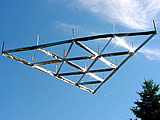

Some years time ago, whilst I was working as a programmer, a software engineer who was aware of my physics background approached me and asked if I knew anything about LCR circuits. The outcome of the ensuing conversation was that I promised I would give him some information on the theory of these circuits, and subsequently I provided him with a couple of sheets of equations. He never did tell me just why he wanted this information. I knew him to be accomplished in both hardware and software engineering and I guessed he was engaged on some private hardware project. In time he left the company, but that was not the last I heard of him. Some years later I happened across an engineering magazine containing an article where he was being hailed as an inventor of a new device. The device? - A dimmer switch for fluorescent lighting. That’s a bit like managing to invent a tin of stripped paint. The magazine article claimed that my friend had been told that such a device was against the laws of physics.


Although I don’t think there really was any contravention of the laws of physics here, this engineer's attitude is in many ways typical of his class. He now has a consultancy and in his publicity material we read of: “ ….our radical and positive attitude. Where others might say ‘it's not possible’, we'll take up the challenge to inquire, improve and innovate.” As a theorist I like to keep an eye on the practical inventors; if anyone is going to test the laws of physics to breaking point it’s the engineers and inventors – their eye is on what they can actually achieve and not on what the laws of physics tells them they can’t do. They tinker around until they get what they want or stumble across something new, and if they manage to achieve this by dispensing with the laws of physics, so be it!

Perpetual motion has long been an interest of engineers and inventors, and the modern version of the perpetual motion aficionado can found amongst the “zero-point energy” web sites. The “zero-point energy” enthusiasts are not actually striving for perpetual motion as such, for their hope is now grounded in fundamental physics and they are seeking to harvest an inexhaustible supply of free energy by extracting it from the quantum fluctuations of space. These web sites are not for the girls – they don’t present sensitive green schemes that modestly gather energy from nature’s gentler and familiar forces of wind, wave and water, but instead these are very masculine projects that aim to hunt down and wrench energy from nature by exposing her deepest secrets. It is a boys story of daring do, a venture into the unknown for treasure, exceeding great treasure. And it’s not all amateurs: Professor Martin Fleishmann of cold fusion fame probably fits into this category.

However, my favourite cutting edge engineer-inventor web sites, for obvious reasons, are the antigravity sites. If there is such a thing as gravitational anomalies that break the mold of current gravitational theory then these men stand a good chance of finding them. Prominent among the antigravity workers is Tim Ventura. Dubbed as “The Linus Torvalds of Antigravity” he is the designer and constructor of the high voltage lifters popular amongst garage-based inventors (See leading picture accompanying this post). These ‘lifters’ are reckoned by some to demonstrate an antigravity effect, although it has to be said that the physics of these lifters looks suspiciously like the well-known ion wind effect rather than a true gravitational anomaly.

As well as constructing lifters Ventura spends a lot of time researching the background of antigravity, and he mixes with some colourful characters and tells some very colourful stories. One story he reports is so fantastic that it has provided material for film producers. It is a story of intrigue, misunderstood geniuses, secret Nazi projects, heroic refugee scientists, cover-ups, governmental conspiracies, sci-fi technology, flying saucers, you name it. It’s the physics version of The DaVinci Code, an admixture of all the ingredients of block-buster cinema. Does real life ever bring together all this in one convenient concentrate? It does in Tim's stories.

***

The story starts with that now legendary theoretical genius, Einstein. After developing his space-time curvature theory of gravity Einstein went on to attempt the development of a unified field theory that would incorporate electromagnetism; this much is well known. It is also well known that this had the effect of marginalizing Einstein from the mainstream of physics as the new kids on the block went on to develop quantum theory, a theory toward which Einstein expressed diffidence. Hence, the picture of Einstein in his later years is that of solitary genius working by himself into old age on a now forgotten project, a project that many today would regard as the work of a has-been. It is at this point that Ventura’s less substantiated narrative takes over. Taking up the testimony of some of his mysterious contacts Ventura hints that Einstein’s efforts to create a unified field theory were at least partly successful and when he escaped Nazi Germany and fled to America Einstein left a colleague in Germany who handed over the details of this theory to the Third Reich. The Nazis set up a research park under SS chief, Hans Kammler (pictured) where they endeavored to make use of Einstein’s unified field theory to develop new superiority weapons. Like "The DaVinci Code" Ventura’s story has real sites that you can actually visit and ponder the mystery. The research park is in Poland and you can enter its dank underground workshops. Above these workshops on the surface is a strange concrete construction (pictured), which, provided you have flying-saucers in mind, looks suggestively like a flying-saucer launch pad. In fact it looks like a modern-day Stonehenge and thereby accrues all the associated mystique of that much debated ancient structure.


The Nazis, it seems, did not succeed in bringing about a practical result. Instead the research park was overrun by the Russians, but not before one of the top scientists escaped to America. This scientist then provided vital input toward secret American military projects of which the most notorious was the infamous Philadelphia Experiment

So, what was the Philadelphia Experiment? It was an experiment that, like all promethium tamperings with the fundamentals of nature, went horribly wrong. It was intended that via an application of Einstein’s unified field theory rays of light would be bent round an object in such a way as to give it a cloak of invisibility. However, instead of merely providing a cloak of invisibility the experiment succeeded in teleporting the test object! And what was the test object? Was it an experimentally controlled carefully quantified block of metal? No. Was it a fly that accidentally got trapped in the apparatus? No. Was it a laboratory rat? No. Was it a tank? No. Was it some brave volunteer? No. It was nothing less than a whole battleship, crew and all! (USS Eldridge – pictured) Today there is a cast of colorful characters flitting in and out of the shade who are supposed to have some sort of connection with and/or knowledge of this experiment and know a lot more than they are letting on. Tim Ventura, of course, has had contact with some of these actors and like a modern day Tintin he is helping to bust the Governmental cover up and conspiracy surrounding the experiment.

I like Tim Ventura; he’s ambitious, he’s bright, he’s freelance, he’s fair-minded and he thinks big, but he has, perhaps, taken the male hankering after the Boys own adventure just a little too far. I recommend Tim's site, if like me, you find fiction rather tame compared to stuff that adds an extra twist by inextricably tangling fact with, let’s just say, some creative interpretations (a bit like the Jack the Ripper Dairies!) and thus presents the investigator with the interesting challenge of trying to extract the true story. Unfortunately, although I am a gravity investigator myself, I can’t come anywhere near matching this kind of drama, and this may be why I have to tell you about other people's adventures rather than my own. The story of my own encounter with the romantic force of gravity is utterly commonplace and banal. That story would include those holidays spent on the beach at the Norfolk seaside resort of Hemsby as I reflected on the problem of gravity, a problem that I increasingly felt was coming my way. Whilst the Children played in sand and sea I, between sips of tea from a vacuum flask, spent many hours with binoculars looking out to sea, pondering with amazement the bulging curvature of the planet Earth that becomes so apparent when good binoculars are used. I have always found that sight breath taking. To see the Earth as a planet from a height of just a few feet above sea level added a palpability to Arthur C Clarke’s technically competent 2001 trilogy of interplanetary travel, a trilogy I read through on more than one occasion during those Hemsby beach holidays. That’s about as near I got to intrigue and high adventure during my forays into Gravitational theory. Boring? No doubt, but then I can only tell it as it is.

Wednesday, August 17, 2022

The Riddle of The Sphinx

"It chanced that the face was toward me; the sightless eyes seemed to watch me; there was the faint shadow of a smile  on its lips. It was greatly weather worn, and that imparted an unpleasant suggestion of disease." The Time Machine by H. G. Wells 


 I once watched a lecture by historian Tom Holland where he expressed his view that Western culture is saturated in Christian values, even when it is at its most secular. He contrasted these values with those of the classical world of pre-New Testament civilizations such as Greece and Rome. Western secularism thinks of itself as having outgrown the "superstitious" beliefs of core Christianity, beliefs which affirm Jesus as a co-equal member of the Trinity & the Resurrected Savior of a humankind mired in Sin. But according to Holland even in the absence of this supernatural kernel, faith in Christ's teaching about humanity's moral duties still informs Western thinking. 

In a similar vein I was intrigued to see an article in the June 2022 edition of Premier Christianity magazine by a Glen Scrivener. In this article Scrivener picks up on a theme similar to Holland's and runs with it; in fact he has written a book on the subject called "The Air We Breathe", the same title of his Christianity article. The book got a good review in the same copy of Christianity. 

In his article Scrivener lists the values of equality, compassion, consent, science, freedom and progress as ostensibly an axiomatic part of Western moral mores. These mores all have their roots in what he calls "The Jesus Revolution". Above all, concern for the poor, the weak and the victimized, a stance which at least gets lip-service in Western humanist thought, was very much part of Christ's teachings.   

However, we should bear in mind that there was a long gestation-period before these Christian values  surfaced substantially into social discourse and subverted the status quo.  It was only during the slow demise of the aristocracy and serfdom that we start hearing that familiar "freedom and human rights" language (e.g. The 1381 peasants revolt) and see a drive to advance science (e.g. Francis Bacon). But having said that we nevertheless find Christian values embedded in Western history going a long way back before the peasants revolt and Bacon: That very peculiar tendency of Christianity to glorify courage and service in the face of vulnerability was there all along: e.g. Many of the churches of Norwich celebrate martyrs who like Jesus himself submitted themselves to those who would kill them for their faith. Examples  are  St, Edmund, St. Peter, St. Clement, St. Laurence, St Stephen and St John all of whom have at least one ancient church in Norwich memorializing their life and heroic deaths. A sacrificial life is the epitome of heroism in the Christian play book and these churches glorifying sacrifice come right out of the depths of the aristocratic middle ages. Christ's teaching had so sunk into the consciousness of the war-like Germanic tribes of Angles, Saxons, Danes and Normans et. al. that they started to perceive a romantic heroism in a life of serene vulnerability.***

Humanly speaking it's a strange paradox that Christianity celebrated submission unto death  This was surely a revolution and an inversion of the old might is right ethos that dominated civilizations such as Egypt, Assyria and Rome; these civilizations glorified, above all, victory in war and in the building of empires, their despotic rulers claiming a large slice of the glory. Set that against Philippians 2:1-11

But when contemplating Holland's and Scrivener's theses we should also bear in mind that many latter day interpretations of Christianity are regressive and repressive and have become the receptacles of ugly attitudes and false beliefs such as European empire building, fundamentalism, brutal certitudes, anti-science thinking, young earthism, flat earthism, fideism, gnosticism, heavy shepherding, spiritual intimidation & abuse, demagogic leaders, conspiracy theorism, Christian dominionism and the like. Our understanding of the effects of "The Jesus Revolution" must have built-in qualifiers: Typically of the human predicament, progress is a backwards and forwards motion, a zigzagging to and fro somewhere between the good, the bad and the ugly.

But then Christianity itself has an explanation for this very mixed picture: Human beings, Christian and otherwise are moral shades of grey and always face the challenges and uncertainties of an imperfect epistemology: But that's why Christ came; He came to not only reveal Himself but to also save us from the ultimate consequences of human sin. But without that supernatural centre around which those important values of humility, serenity, meekness and service orbit, the way to hell is paved with good intentions: The French revolution and Marxism all made claim to laudable Christian humanist values about liberty, fraternity and equality but human beings are apt to corrupt those values beyond recognition. As Sir Kenneth Clark said in an episode of his epic "Civilization"* series, the leaders of the French revolution....

              ....suffered from the most terrible of all delusions: They believed themselves to be virtuous. 

...and may I add believed themselves to be the sole supplier of veracity, the only truth tellers. Such attitudes, it seems, can be found among those with triumphalist visions of utter certitude: From Marxists, through Christian sects, to Islamic fundamentalists** they see themselves as the last word for mankind,  But Scrivener, as a good Christian should be, is well aware of the failings that also plague churches: "I could go on. Criticisms of the church abound and many of them are entirely valid", he says. But he then says that such criticisms are actually using Christ's moral compass as the standard against which a flawed church is measured.  I feel that Scrivener and Holland are very much on the right track.....Christianity has had a very humanizing effect on us very flawed humans. Christ's teachings not only act like salt & light halting the rot somewhat but also, in places, reverses that rot. 

Finally, I would like to draw attention to one very profound observation that Scrivener makes. Viz:

The deepest clash between "belief" and a purely secular worldview does not occur between Christians and non-Christians. It occurs within the Western secularist, because the secularist is a believer too. They navigate their life by roughly the same stars we do - equality, compassion, consent and so on. On a daily basis, they walk according to these convictions, and yet as they look up to such supernatural values they insist that they are standing on purely natural ground. They claim to have a (practically) atheist account of the world, even as they live by (basically) Christian assumptions. 

Scrivener then goes on to make further observations that I would identify as the secular paradox: Viz: Christ's teachings so obviously give meaning and purpose to life and yet when they are seen through the lens of a purely secular interpretation of the cosmic perspective there seems to be an overwhelming disconnect: Where do those Western moral values we aspire to come from given the wider context of what to the secularist looks to be at first sight a huge impersonal universe apparently guided only by a ruthless survival ethic and which will eventually end in oblivion? There is an apparent mismatch of incommensurables here more stultify than the mismatch between gravitational theory and quantum mechanics.  Atheism teeters on the brink of the nihilist abyss..... This is the Riddle of the Sphinx for today's secular milieu.


Footnotes

* See the episode "The Fallacies of Hope"

** Critical Theory, which tries to trace (all?) human problems back to the observable conditions of the cultural, economic and political milieu, is likely to fall short of the mark if it fails to acknowledge that individuals, which are the seat of the first person conscious perspective, will naturally enough be tempted to look after self first under any circumstances.

*** It is possible that other religious leaders at one time or another preached similar values, but it seems that it is Jesus who is the almost exclusive source of these values in the modern world.

Sunday, August 16, 2020

Teetering on the Brink of the Nihilist Abyss.


Implausible monsters emerged from Lovecraft's id; the worst of them was racism. 


As I've said before; the move from atheism to postmodern nihilism is one short step for man but one giant cultural leap for humankind. Take this post by my favourite atheist PZ Myers where he remarks on generalised Copernicanism and contemporary authors who are bringing us a postmodern cosmic dread such as we see in an HBO production called Lovercraft Country....

Science has been spending a few centuries working to move the center of the universe away from us, so it fits with an ongoing trend. Now we just have to dislodge that center from white people, which is proving to be the hardest step of them all. Lovecraft Country, though, does its part in the decentering. Don’t read Lovecraft, read the more recent authors that have been bringing us cosmic dread without the petty racism. (Another author I’d recommend: the work of Ruthanna Emrys, who takes on the perspective of the fish men of Innsmouth.)

Hey, can we pretend Skepticon is taking place in Lovecraft country?

There is no need to pretend if you are as good as in Lovecraft country already.  Myers calls Lovecraft a horrible racist (which no doubt he was!) but the monster of racism feels very Lovecraftian to me and of a piece with Lovecraft's id inspired cosmic dread. Like the monster from the id racism inhabits our subconscious and we inadvertently reify it into our social surroundings. In any case Lovecraft had such a jaundiced view of what he believed to be an utterly indifferent cosmos that race supremacism wouldn't be out of place in it and in fact in his mind would likely be a natural outcome of inter-species competition. Lovecraft's vision of the cosmos was so misanthropic that who knows what horrible things it could throw up.

I have a little knowledge of Lovecraft because one of my sons studied Lovecraft for his MA: I think he wanted a grindstone to sharpen up his faith!  The LA Times, as quoted by Myers, tells us a bit more about H P Lovecraft:

Lovecraft helped create a genre now known as “cosmic horror,” stories filled with dread and terror at the knowledge that humans are not the most important things in the universe.

He was beginning to write at a time when science was making vast and profound discoveries,” says Klinger. “What he came to believe, I think deeply and honestly, was that human beings were insignificant little dust motes in this enormous universe and that eventually we would discover that we were not particularly significant.

No question that science in stages, starting with Copernicus through particulate theory, deep time, evolution, and deep space etc has left the old Christian order with a mighty lot to ponder; not that that's a bad thing, although as counter-reactions Christian young earthism and flat earthism are the rearguard actions of an incompetent, run-down and bankrupt religious culture. But let's not give up hope and faith yet, else, as the irony of  satirical  Christian artist Steve Taylor would put it: 

Life unwinds like a cheap sweater

But since I gave up hope I feel a lot better

And the truth gets blurred like a wet letter

But since I gave up hope I feel a lot better

And let's not forget that even on evolutionary logic we find that science is telling us that we never left the centre. Or a better way of putting it: The die was heavily loaded in favour of life from the outset and therefore by implication loaded in our favour as well. 

http://quantumnonlinearity.blogspot.com/2019/09/evolution-naked-chance.html


Relevant links:

http://viewsnewsandpews.blogspot.com/2019/05/teetering-on-brink-of-nihilist-abyss.html

http://quantumnonlinearity.blogspot.com/2019/09/many-worlds-theory-theory-devoid-of.html

https://quantumnonlinearity.blogspot.com/2017/05/whats-gone-wrong.html

https://quantumnonlinearity.blogspot.com/2015/08/deep-internal-contradiction.html

https://quantumnonlinearity.blogspot.com/2011/06/2001-spaced-out-odyssey.html

https://quantumnonlinearity.blogspot.com/2008/08/how-to-know-you-know-you-know-it.html

https://drive.google.com/file/d/0BzLwnl6qE_yed05ld0xhcGJwaDQ/view

https://docs.google.com/file/d/0BzLwnl6qE_yeVXVQRVRPVFRaM1E/edit?pli=1

Friday, March 09, 2018

New Ager Capitalizes on Spiritual Thirst and Disaffection with the Science Establishment

The false assumptions of science according to New Ager Gregg Braden
Personally I don't know what he's talking about. 

This post fits into my series on New-Ageism of which there have only been two other posts so far. That is:


The above picture was posted on Facebook by my New Age friend I identified as "Frank Saucepan" in the first of the above links. It appears that he had photographed his screen whilst looking at the website of a New Age guru (More about him later). Frank's accompanying comment to the above picture was:

I trust science to keep me in a safe plane, heat my house and let me communicate via a telephone.
When I was at school 20 years ago these 5 assumptions were taught as scientific fact- now disproved
This is why I don't trust science for the more mystical questions of life - it fails

What I think Frank is trying to tell us is that although he trusts science when it comes to putting his life in its hands when he flies he nevertheless feels let down, even lied to, by established science's failure to address his spiritual need for meaning, purpose and sacred mystery.

But Frank is inconsistent. Frank has a history of interest in conspiracy theorism and as my first link above shows, the flat earth conspiracy theory is something that has attracted him. It seems, therefore, he has ambivalent feelings toward science. On the one hand he trusts science when he uses an aircraft, a technology that necessarily, by the way, depends on the global model of the Earth and yet on the other hand he distrusts science's spherical Earth theory. This model, in fact, ties into a coherent intelligible whole a myriad evidences. Some of those evidences are even apparent to the man in the street if he cares to look; from views across the sea to celestial observations. But the trouble is that the global model, except for the minority that journey a long way into space, cannot be taken in with one sweep of the eye: For the Earth bound the evidences of the global model are joined together by what to the suspicious science-alienated laymen can appear as beguiling, convoluted and complex logic.

I could take Frank in hand and say, "Look Frank, what quantified sense to do you make of these evidences?".  But I may as well go herding cats and than channel Frank's thoughts into a rigorous scientific line of inquiry. He wants clear and obvious answers: He will simply say "Spherical Earth? Show it to me!" And I can't do that without reference to the data provided by various scientific authorities, authorities he would distrust. Moreover, he would probably have little patience in being guided through the logic which links all this data into a coherent and elegant whole; to him it could all be sleight of hand with me as a stooge whose mind has been manipulated by the Illuminati.

It is striking how similar all this is to Christian fundamentalist diffidence toward science and  like Frank these fundamentalists have ambivalent feelings about society's scientific authorities. On the one hand they oppose so many conclusions of science and on the other hand they don't want to look like anti-intellectual rubes. So they invent the distinction between "observational" science and "historical science"; the former they think of as rigorous & respectable evidence based science whereas the latter is regarded as dubious speculative science based on presuppositions driven by an a priori worldview, perhaps even a product of a conspiracy. Certainly, the Christian fundamentalist flat earthers have to resort to conspiracy theorism as part and parcel with their theory of cosmology.

But as I have said before all science is at once both observational & historical, and non-trivial scientific objects seldom, if ever, classify as directly observational.  This is really far too subtle a point for the average fundamentalist who is looking for a pretext to do away with science which contradicts his world view fundamentalism. (I've posted on this subject many times before. See here for example)

***

The screen shot above actually comes from a New Ager called Gregg Braden. It is clear that he has set up a straw man that he can then knock down in front of his gullible fans. Let me comment on each point:

1. Evolution: explains life/human life. Evolution, in its most basic sense of being natural history, that is a history of change,  is "settled science" although just what mechanism drives evolution is not quite so settled - see herehere and here. So exactly what concept of evolution is Braden claiming to be false? 

2. Civilization began about 5000 years ago: In as much as this idea is the best construction that can be placed on the evidence it still holds good in my opinion. Both written history and archaeology point in this direction. However, I have always had a reservation at the back of my mind that perhaps the end of the ice age flooded continental shelves which hosted civilized societies - although if the continental shelves did host such societies they weren't big enough and/or civilized enough to leave a strong global trace in the archaeological and historical records.

3. Consciousness is separate from the physical world. This seems to be an allusion to the so-called "ghost-in-the-machine", a concept that  isn't readily testable and so not likely to classify as the object of formal science. If anything I would have said that scientific opinion and especially philosophical opinions attached to scientific culture are rather diffident about such an idea. In fact I myself have long since come to the conclusion that consciousness cannot be divorced from some kind of material nexus which expresses it. So Braden seems to have got this wrong; science doesn't dogmatically teach a clear distinction between consciousness and the physical world.  The jury seems to be out on this one. 

4.The space between things is empty: My scientific background has never lead me to this view. Initially, in geometry, space was taken to be a set of relations between points, relations that had all sorts of interesting mathematical properties; that hardly classifies as "empty" to my mind. And of course since the advent of quantum  mechanics space seems anything but empty! So once again I don't know what Braden is talking about. It's just a straw man. 

5. Nature is based on the survival of the strongest. If you modify this statement to include something to the effect that "Nature is based on the survival of the luckiest" then Braden's accusation might be approximately right! But therein lies the rub: It is this kind of statement which spiritual (wo)man finds difficult to swallow because it seems to entail an empty, meaningless, purposeless world teetering on the edge of the nihilistic chasm.  To many people this seems morally repugnant and so it is no surprise that those who offer spiritual hope get a hearing.

***

It is true that the modern cosmological picture is a big intellectual challenge to those (like myself) who wish to make anthropic sense and purpose of the cosmos (but I find it a welcome challenge because I like mysteries).  New Agers and Fundamentalists are trying to do this in their inimitable, emphatic and suave way, devoid of self-doubt as they exploit disaffection with the scientific establishment. They attempt to give reality a spiritual gloss and if science gets in their way then so much the worse for science.

It is ironic that New Agers and Christian Fundies have so much in common. Whimsical it may be but it is appropriate, then, that Gregg Braden has a passing resemblance to Christian fundamentalist Ray Comfort! As a Christian myself, however, I can understand the appeal of both: They head up a reaction against the current scientific establishment which either leaves one with a sense of abandonment at the edge of thecosmos, facing an existential crisis and postmodern nihilism or having to interpret life with a teeth gritting atheism determined to make the best of a bad job. 


Is it just me or does Gregg Braden bear a resemblance to Ray Comfort?
Suave and persuasive they lead their flocks into spiritual vistas 

Friday, August 18, 2017

New Agers and Fundamentalists


 Two anti-establishment, anti-science publicists: David Wolfe and Ken Ham both challenge the establishment with their radically different version of "science". 


I have recently become acquainted with the name David "Avocado" Wolfe, a new age alternative concepts salesman and pundit. According to his Wiki page his ideas revolve around the following subject areas (most of  which I quote directly from Wiki):

1. Nutrition, in particular organic food and raw foodism
2. Kirlian photography
3. He promotes a variety of conspiracy theories
3 . He promotes a diet based on raw plants, stating that this has a "detoxification" effect.
4. He advocates that people with cancer take dietary supplements instead of getting medical treatment, which he describes as “largely a fraud".
5. He believes that "chemtrails" exist and are harmful to people and animals.
6. He has considered cocoa to be one of several "superfoods"
7. He says that deer antler spray is "levitational" and an "androgenic force", which he promotes and sells.
8. He claims that mushrooms have an "advanced intelligence and consciousness". He has stated that mushroom spores can "levitate off the planet" and believes they are trying to "get to the center of the sun". He has stated that mushroom spores originally came from "distant planets" and were "carried by cosmic winds or meteors into the Earth's atmosphere", stating "the preliminary work develops as the mushroom mycelium sets itself up to network and nourish multi-celled carbohydrate-forming organisms". He has also stated that the mushrooms that grow in trees are "medicinal mushrooms".
9. He believes vaccines are dangerous and may not work.
10. He believes that the Earth is flat and that gravity is a hoax. (see also here for this one)

It has only recently become clear to me that these new agers have a lot in common with Christian fundamentalists, not only in their attitude to the scientific establishment but also in some of the theories they promulgate. The list above has an overlap with ideas that do the rounds among Christian fundamentalists Viz: Nutrition and supplements as the right way to treat cancer, conspiracy theories such as the chem-trail conspiracy, anti vaccination concepts and flat earthism are all alternative "theories" I have seen promoted by Christian fundamentalists.  In particular, one fundamentalist of my acquaintance has, on one occasion or another, promoted the millennium bug conspiracy, the chem-trail conspiracy, anti-vaxing, young earthism and also proclaims that the standard medical treatment of cancer is fraud and should be replaced by treatment using diet and supplements. Significantly this same person was a one time new ager who promoted new age ideas and new age diets.  

The common theme running through both subcultures seems to be disaffection with and rejection of the academic establishment, in particular the scientific establishment. But in spite of this overlap it is ironic that Christian fundamentalists and new agers would otherwise not see eye to eye; far from it in fact. 

An important question is this; how do these fundamentalists and new agers know all this alternative stuff? Do they have alternative research departments scientifically testing their ideas and remedies? More likely, however, is that they have conspiracy theory generating pundits who join the data dots in bizarre and convoluted ways. These constructions may seem arbitrary but they primarily serve an important purpose for the disaffected and alienated; they furnish an argued platform on which the deep disillusionment with established authority can find a home and provide the pretexts needed to espouse an opposing world view to challenge the  powers that be. 

The take home lesson here is that whatever is at the bottom of the malaise afflicting people as diverse as new agers and Christian fundies there are, nevertheless, significant commonalities*.  I am not really sure what  it is about our society that causes of this general disaffection; perhaps it's a rebellion against the apparent demystification and desanctification of the cosmos. After all, H. G. Wells once wrote:

Science is a match that man has just got alight. He thought he was in a room - in moments of devotion, a temple - and that this light would be reflected from and display walls inscribed with wonderful secrets and pillars carved with philosophical systems wrought into harmony. It is a curious sensation, now that the preliminary splutter is over and the flame burns up clear, to see his hands lit and just a glimpse of himself and the patch he stands on visible, and around him, in place of all that human comfort and beauty he anticipated - darkness still

On that basis it is no surprise there is a reaction against a science that is easy to interpret in nihilistic and post modern terms (See also here). But in the final analysis this nihilism and postmodernism undermines the very science on which nihilistic and postmodern claims are based (See here).

Footnote:
* An interesting question arises in connection with climate change: Christian fundies tend to see climate change science, as they do old earth theory, as a conspiracy of establishment control, whereas in contrast, I would expect new agers to be pro green energy. But either way both use the subject as a stick with which to beat the establishment: Fundamentalists will accuse the establishment of lying over it and the new agers will accuse the techno-industrial establishment  as being the cause of it. 

Monday, May 22, 2017

What's Gone Wrong?

The Copernican cosmos as promoted by Thomas Digges in the 16th Century

During a BBC Horizon program on the Stars historian of science Stephen Pumphrey of Lancaster University said that the Copernican Solar System was the beginning of both a scientific and social revolution in as much as it heralded a profound shift in humanity's perception of its place in the universe. To support his point Pumphrey quoted  two lines of a poem by John Donne (1573-1631). This poem was called An Anatomy of the World. Below I quote the latter quarter of the poem and this contains the quotes used by the Pumphrey; these I have emphasized in bold

Be more than man, or thou'rt less than an ant.
Then, as mankind, so is the world's whole frame
Quite out of joint, almost created lame,
For, before God had made up all the rest,
Corruption ent'red, and deprav'd the best;
It seiz'd the angels, and then first of all
The world did in her cradle take a fall,
And turn'd her brains, and took a general maim,
Wronging each joint of th'universal frame.
The noblest part, man, felt it first; and then
Both beasts and plants, curs'd in the curse of man.
So did the world from the first hour decay,
That evening was beginning of the day,
And now the springs and summers which we see,
Like sons of women after fifty be.
And new philosophy calls all in doubt,
The element of fire is quite put out,
The sun is lost, and th'earth, and no man's wit
Can well direct him where to look for it.
And freely men confess that this world's spent,
When in the planets and the firmament
They seek so many new; they see that this
Is crumbled out again to his atomies.
'Tis all in pieces, all coherence gone,
All just supply, and all relation;
Prince, subject, father, son, are things forgot,
For every man alone thinks he hath got
To be a phoenix, and that then can be
None of that kind, of which he is, but he.
This is the world's condition now, and now
She that should all parts to reunion bow,
She that had all magnetic force alone,
To draw, and fasten sund'red parts in one;
She whom wise nature had invented then
When she observ'd that every sort of men
Did in their voyage in this world's sea stray,
And needed a new compass for their way;
She that was best and first original
Of all fair copies, and the general
Steward to fate; she whose rich eyes and breast
Gilt the West Indies, and perfum'd the East;
Whose having breath'd in this world, did bestow
Spice on those Isles, and bade them still smell so,
And that rich India which doth gold inter,
Is but as single money, coin'd from her;
She to whom this world must it self refer,
As suburbs or the microcosm of her,
She, she is dead; she's dead: when thou know'st this, 

Pumphrey puts his quotes firmly in the context the Copernican revolution,  I have to confess that I find poetry difficult to read and so I'll have to take Pumphrey's word for it that these lines are allusions to the Copernican revolution, for revolution it definitely was. Pumphrey also implies that the medieval thought form "As-above-so-below" meant that Copernicus had help clear the way for a social revolution and not just a scientific one. It was the start of a history of scientific endeavor that in stages removed humanity from its Ptolemaic place of being centre stage, the focus of the Cosmos, to apparently - and I stress "apparently" - a mere incidental side show in the great Cosmic perspective.  For many the new philosophy no longer made sense and so in this context the lines: "And new philosophy calls all in doubt,...Tis all in pieces, all coherence gone,..." are very appropriate. 

My understanding of the final quarter of Donne's poem is that it starts by lamenting the fall of humanity and the consequent corruptions it lead to; if I'm reading Donne right then included in this wide ranging field of corruption is the discomfiture generated by the Copernican revolution; that is, he appears to see Copernicanism as an outcome of the fall!

One coping strategy, when faced with difficult truths, is, of course, to go into denial; We can see this in the anti-science of the Christian Fundamentalists who in some cases have gone so far as too revert to the cosy stage-set of a geocentric cosmos. (See also here, here, here and here)

But things are even worse than that; we've already seen on this blog how some Christian fundamentalists are going even further and are turning to flat earth theory. When this happens flat earthists necessarily explicitly employ conspiracy theorism in order to give account of how the scientific establishment could be so systematically deceived (or deceiving!). Now, what is interesting is that flat-earth conspiracy theorism is not the exclusive domain of Christian fundamentalists, but, it seems, it is part of much more general anti-establishment malaise. Evidence for this has recently come to light on my Facebook account where one of my friends leans toward new-age ideas. I have been vaguely aware that there are new-age conspiracy theorists out there and moreover I knew that my Facebook friend, if not and out and out conspiracy theorist, was drawn toward conspiracy theorism. This came apparent when he announced on Facebook that some flat earth postings had caught his interest. In his  subsequent FB posts which stimulated a lively debate, I was not sure whether he was trying to troll his friends or whether he was seriously countenancing flat earth theory: I came to the conclusion that he was rather intellectually blown-away by flat earth apologetics as he hadn't seen it before, but he kept up the demeanor of a troll in order to hedge his bets.

Below I publish  posts from my friend (whom I shall call "Frank Saucepan") and two other Facebook users who reacted to my friend's provocative posts and who also had new-age and conspiracy theorist sympathies:

Frank Saucepan: I have to say this 'flat earth' business has seriously got my attention!
Johnny Duckpond: There are no photos of a globe earth only composites no video footage from any of the supposed 25000 satellites I'm not a flat earther but you gotta question that shit! … I've decided to believe nothing until it's proved! I want to say it's round but then there's this 😏 not sure it's exactly the right one but check it out. Remember this deception has been going on for hundreds of years so well ingrained into popular culture. I'm just looking at all the evidence on everything & it's only becoming obvious that there are some major lies going on, I'm not sure of all the answers but I'd rather say I don't know than trust what I know to be bullshit!
Frank Saucepan: Yep! Flat earth, globe. Can't say I'm 100% on either. One thing I can say is I know we've been lied to on so many layers on many topics
Frank Saucepan: I believe the 'Truth' is ultimately defined by the level of acceptance that the individual is willing to adopt. For me, I'm on the journey of accepting that maybe, just perhaps my entire life has been lead by corrosive and corrupt minds of maniacs

In response to some video taken from the space station Johnny, who seems to be a full blown conspiracy theorist, responding as follows to critics of flat earth:

Johnny Duckpond: Like I said, prove that's real! My posts are tests you can do yourself. Don't know about you but I can only just afford a flight to Portugal this year. Get the point? It's total crap fabricated by idiots, NASA. If you sincerely believe that to be real Eta then I'm simply lost for words buddy!!!

Between them Frank and Johnny stimulated a large number of thread comments, by and large hostile to flat earthism, I'm glad to say. However, I couldn't quite dispel the feeling that Frank was pulling everyone's leg, but then again his leaning toward new-age antiestablishmentarianism and conspiracy theorism sets him up for a belief in flat-earthism.

I could't resist joining the fray by responding to one of Frank's threads which he apologetically headed as:

Frank Saucepan: All I did was say this flat earth business has caught my interest!
Timothy V Reeves It caught mine too, but it only works if you add huge dollops of conspiracy theorism. But conspiracy theorism has inner contradictions: Once you believe conspiracy theory A you can always find conspiracy theory B which explains conspiracy theory A as a product of a conspiracy of deception. In short conspiracy theorism completely phux-up any attempt to arrive at the truth. Any so called "truth" arrived at via conspiracy theory A is easily undermined by conspiracy theory B. Here's a video showing how easy it is to invent fanciful but plausible conspiracy theories : https://www.youtube.com/watch?v=cEPazLTGceI.  [This was a link to the clever Star Wars tongue in cheek conspiracy - unfortunately the sound track has been copyrighted]
Timothy V Reeves See also: http://quantumnonlinearity.blogspot.co.uk/2015/09/hovind-defends-science-against-flat.html
Timothy V Reeves And this:http://quantumnonlinearity.blogspot.co.uk/2017/03/the-anti-establishmentarian-malaise-and.html
Johnny Duckpond: Kent Hovind the Creationist? Anti Evolutionist?
Timothy V Reeves: Among fundamentalists irony piles on irony
Johnny Duckpond: I'm neither but simply looking for the truth & it certainly isn't in the mainstream! I don't think it's in scripture either but somewhere in between the lies of mainstream & metaphor of scriptures ( all scriptures ) as a lot can be contrived over several thousand years of indoctrination & tradition! Only a few have eyes to see...
Timothy V Reeves: So what's your take on "flat earth"?
Johnny Duckpond: It's an interesting concept personally I can't prove it either way but I don't ' Believe ' it is flat. I also don't believe what NASA showed us is real in fact I know it isn't real n that is a fact. What earth looks like I don't know.
Timothy V Reeves: So do you think that NASA, ESA, the Chinese, the Russians, map makers and numerous satellite operators etc etc are all lying in unison? That sounds like quite a sweeping catch all theory in itself! If you can't believe anything why even believe that?

In response to that I got some come-back from an all-out Flat-Earther and "NASA is fake news" conspiracy theorist:

Johnson Kaputski: I don't see flat earth as a conspiracy theory. Was Plato a conspiracy theorist?? Anything that doesn't confirm to the religion of science is conspiracy.. talk about anything not given in text books or presented by mainstream media and you are a crackpot. So many lies told to so many fools... me included...
Timothy V Reeves Plato didn't have satellites, aircraft, sophisticated navigation, radar etc etc all technologies that to work take into account the curvature of the earth. Moreover do you think that NASA, ESA, the Chinese, the Russians, map makers and numerous satellite operators, aircraft software writers etc etc are all lying in unison? If so then that sounds like quite a sweeping catch-all-theory in itself! To imagine that such organisational feats are possible is a highly theoretical stance that surpasses the relatively simple abstractions entailed in spherical Earth theory.
Timothy V Reeves PS: The Greeks were the first to propose a spherical Earth theory. So Plato likely believed in a spherical Earth.


Shortly afterwards Kaputski deleted his entry and my replies went with it. I've been in half a mind to reinstate it on Frank's thread, but perhaps that would be too nasty.

In someways Frank succinctly summed up his take on antiestablishmentarianism when he posted:

Frank Saucepan:  I believe the 'Truth' is ultimately defined by the level of acceptance that the individual is willing to adopt. For me, I'm on the journey of accepting that maybe, just perhaps my entire life has been lead by corrosive and corrupt minds of maniacs

I think Frank is serious! He has absolutely no trust or respect for the system that has educated him. But there may be an inconsistency in Frank's thinking: It is unlikely that the corrupt minds of a set of maniacs could be coherent, coordinated and disciplined enough to wrought such a huge systematic deception!

***

So just what has gone wrong with our Western education? Why do we have Christian fundies and new-agers  who  are so disaffected as to totally despise the educational institutions of their societies? The difficulties that the human spirit has with anchoring its soul in a post Ptolemaic cosmos probably has something to do with it, as Stephen Pumphrey has implied: Copernicanism had an inherent tendency to eventually subvert any notion that the cosmos is some kind of cosy stage set.  Thomas Digges (1546-1595) was among the first to start subverting the old order, although he retained a spiritual perspective on the meaning of it all:

"This orb of stars fixed infinitely up extends itself in altitude spherically, and therefore immovable the palace of felicity garnished with perpetual shining glorious lights innumerable, far excelling over [the] sun both in quantity and quality the very court of celestial angels, devoid of grief and replenished with perfect endless joy, the habitacle for the elect."

But I think the antiestablishmentarianism I'm talking about here is fairly recent. Whilst spiritual hope existed alongside post Ptolemaic science it seems that faith and trust remained largely intact. But now, of course Western societies teeter in the brink of noetic nihilism, a nihilism which in some cases even denies the reality of human consciousness and promotes the notion that life is ultimately empty of meaning apart from some self-defined fickle subjective goals.  If that is what some educators are trying to teach us it is no surprise that some reject the whole caboodle.*

Footnote:
* Let's assume we operate the epistemic filter I described here and in time arrive at a full law and disorder (L&D) description of the Cosmos. Could we then claim that the job of science is complete and has furnished us with a full solution as to the nature of the Cosmos? Very doubtful: Firstly it is conceivable that more than one L&D scheme will join the dots of data, or that further "data compression" could take place in terms of a more succinct L&D scheme. But more philosophically profound is the question as to whether L&D constitutes a complete explanation at all; after all, in the final analysis it's mere flat description; useful, yes, but it only addresses part of the intuitive sense of mystery.  For some mentalities, however, this may feel enough; full explanation in terms of L&D dispels all their curiosity; mystery solved! But for other mentalities (myself included) who feel that only purposeful, teleological and personality based explanation stands a chance of  addressing mystery the job of explanation is only just starting. 

Friday, August 14, 2015

Deep Internal Contradiction

Dream on:  No red pills for us in our cosmos I'm afraid! We just have to try and work it out for ourselves!

I was interested to see a quote from Paul Davies in a post on the ID web site Uncommon Descent. The post was entitled Physicist Paul Davies’ killer argument against the multiverse (Date August 14th)

“If you take seriously the theory of all possible universes, including all possible variations,” Davies said, “at least some of them must have intelligent civilizations with enough computing power to simulate entire fake worlds. Simulated universes are much cheaper to make than the real thing, and so the number of fake universes would proliferate and vastly outnumber the real ones. And assuming we’re just typical observers, then we’re overwhelmingly likely to find ourselves in a fake universe, not a real one.”

So far it’s the normal argument.

Then Davies makes his move. He claims that because the theoretical existence of multiple universes is based on the laws of physics in our universe, if this universe is simulated, then its laws of physics are also simulated, which would mean that this universe’s physics is a fake. Therefore, Davies reasoned, “We cannot use the argument that the physics in our universe leads to multiple universes, because it also leads to a fake universe with fake physics.” That undermines the whole argument that fundamental physics generates multiple universes, because the reasoning collapses in circularity.

Davies concluded, “While multiple universes seem almost inevitable given our understanding of the Big Bang, using them to explain all existence is a dangerous, slippery slope, leading to apparently absurd conclusions.”

This line of argument has been noted before. The rest of this post is an extract I have taken from a blog post I wrote in February 2007. (See here). The context is the question of how the simulation argument impacts the possibility of time travel:

***

PAUL DAVIES: “The better the simulation gets the harder it would to be able to tell whether or not you were in a simulation or in the real thing, whether you live in a fake universe or a real universe and indeed the distinction between what is real and what is fake would simply evaporate away…..Our investigation of the nature of time has lead inevitably to question the nature of reality and it would be a true irony if the culmination of this great scientific story was to undermine the very existence of the whole enterprise and indeed the existence of the rational universe.”

Let me broach some of the cluster of philosophical conundrums raised by this embarrassing debacle that physics now faces.

Why should our concept of a simulated reality be applicable to the deep future? Doesn’t it rather presume that the hypothetical super beings have any need for computers? The existence of computers is partly motivated by our own mental limitations – would a super intelligence have such limitations? Or perhaps these simulating computers ARE the super intelligences of the future. But then why would they want to think of us primitives from the past? Another problem: Doesn’t chaos and the absolute randomness of Quantum Mechanics render anything other than a general knowledge of the past impossible? In that case this means that any simulated beings would in fact be arbitrary creations, just one evolutionary scenario, a mere possible history, but not necessarily the actual history. And overlying the whole of this simulation argument is the ever-unsettling question of consciousness: Namely, does consciousness consist entirely in the formal relationships between the informational tokens in a machine?

But even if we assume that the right formal mental structures are sufficient condition for conscious sentience, the problems just get deeper. If physics is a science whose remit is to describe the underlying patterns that successfully embed our observations of the universe into an integrated mathematical structure, then physics is unable to deliver on anything about the “deeper” nature of the matrix on which those experiences and mathematical relations are realized. Thus, whatever the nature of this matrix, our experiences and the associated mathematical theories that integrate them ARE physics. If we surmise that our experiences and theories are a product of a simulation, physics cannot reach beyond itself and reveal anything about its simulating context. The ostensible aspects of the surmised simulation (that is, what the simulations delivers to our perceptions) IS our reality: As Paul Davies observed, “… indeed the distinction between what is real and what is fake would simply evaporate away”. Moreover, if physics is merely the experiences and underlying mathematical patterns delivered to us by a simulation how can we then reliably extrapolate using that “fake” physics to draw any conclusions about the hypothetical “real physics” of the computational matrix on which we and our ‘fake’ physics are being realized? In fact is it even meaningful to talk about this completely unknown simulating world? As far as we are concerned the nature of that world could be beyond comprehension and the whole caboodle of our ‘fake’ physical law, with its ‘fake’ evolutionary history and what have you, may simply not apply to the outer context that hosts our ‘fake’ world. That outer realm may as well be the realm of the gods. Did I just say “gods”? Could I have meant … ssshh … God?

The root of the problem here is, I believe, a deep potential contradiction in contemporary thinking that has at last surfaced. If the impersonal elementa of physics (spaces, particles, strings, laws and what have you) are conceived to be the ultimate/primary reality, then this philosophy, (a philosophy I refer to as elemental materialism) conceals a contradiction. For it imposes primary and ultimate reality on physical elementa and these stripped down entities carry no logical guarantee as to the correctness and completeness of human perceptions. Consequently there is no reason, on this view, why physical scenarios should not exist where human perceptions as to the real state of affairs are wholly misleading, thus calling into question our access to real physics. Hence, a contradictory self-referential loop develops as follows: The philosophy of elemental materialism interprets physics to mean that material elementa are primary, but this in turn has lead us to the conclusion that our conception of physics could well be misleading. But if that is true how can we be so sure that our conception of physics, which has lead us to this very conclusion, is itself correct?

There is one way of breaking this unstable conceptual feedback cycle. In my youthful idealistic days I was very attracted to positivism. It seemed to me a pure and unadulterated form of thinking because it doesn’t allow one to go beyond one’s observations and any associated integrating mathematical structures; it was a pristine philosophy uncontaminated by the exotic and arbitrary elaborations of metaphysics. For example, a simulated reality conveying a wholly misleading picture of reality cannot be constructed because in positivism reality is the sum of our observations and the mental interpretive structures in which we embed them - there is nothing beyond these other than speculative metaphysics. However, strict positivism is counterintuitive in the encounter with other minds, history, and even one’s own historical experiences. In any case those “interpretative structures”, as do the principles of positivism, look themselves rather metaphysical. Hence, I reluctantly abandoned positivism in its raw form. Moreover the positivism of Hume subtly subverts itself as a consequence of the centrality of the sentient observer in its scheme; if there is one observer, (namely one’s self) then clearly there may be other unobserved observers and perhaps even that ultimate observer, God Himself. Whatever the deficiencies of positivism I was nevertheless left with a feeling that somehow sentient agents of observation and their ability to interpret those observations have a primary cosmic role; for without them I just couldn’t make sense of the elementa of physics as these are abstractions and as such can only be hosted in the minds of the sentient beings that use them to make sense of experience. This in turn lead me into a kind of idealism where the elementa of science are seen as meaningless if isolated from a-priori thinking cognitive agents in whose minds they are constructed. In consequence, a complex mind of some all embracing kind is the a-priori feature that must be assumed to give elementa a full-blown cosmic existence. Reality demands the primacy of an up and running complex sentience in order to make sense of and underwrite the existence of its most simple parts; particles, spaces, fields etc – these are the small fish that swim in the rarefied ocean of mind. This philosophy, for me, ultimately leads into a self-affirming theism rather than a self-contradictory elemental materialism.

The popular mind is beginning to perceive that physics has lost its way: University physics departments are closing in step with the public’s perception of physics as the playground for brainy offbeat eccentrics. My own feeling is that physics has little chance of finding its way whilst it is cut adrift from theism, and science in general has become a victim of nihilism. The negative attitude toward science, which underlies this nihilism, is not really new. As H. G. Wells once wrote:

"Science is a match that man has just got alight. He thought he was in a room - in moments of devotion, a temple - and that this light would be reflected from and display walls inscribed with wonderful secrets and pillars carved with philosophical systems wrought into harmony. It is a curious sensation, now that the preliminary splutter is over and the flame burns up clear, to see his hands lit and just a glimpse of himself and the patch he stands on visible, and around him, in place of all that human comfort and beauty he anticipated - darkness still."

Wells tragically lost his faith and with it his hope and expectation: He no longer believed the Universe to be a Temple on the grandest of scales, but rather a place like Hell, a Morlockian underworld with walls of impenetrable blackness. In that blackness Lovecraftian monsters may lurk. Nightmares and waking life became inextricably mixed. And in this cognitive debacle science could not be trusted to reveal secrets or to be on our side. The seeds of postmodern pessimism go a long way back.

But we now have the final irony. The concluding words of the Horizon narrator were:

"Now we’re told we may not even be real. Instead we may merely be part of a computer program, our free will as Newton suggested is probably an illusion. And just to rub it in, we are being controlled by a super intelligent superior being, who is after all the master of time."

The notions that we are being simulated in the mind of some super intelligence, that a naïve concept of free will is illusory, that we can know nothing of this simulating sentience unless that super intelligence should deign to break in and reveal itself are all somehow very familiar old themes:

….indeed He is not far from each of us, for in Him we live and move and have our being…” (Acts 17:27-28)

My frame was not hidden from You when I was made in the secret place. When I was woven together in the depths of the earth., Your eyes saw my unformed body. All the days ordained for me were written in Your book before one of them came to be” (Ps 139:15&16)

“…no one knows the Father except the Son and those to whom the Son chooses to reveal Him.” (Mat 11:27)

Have those harmless but brainy eccentric scientists brought us back to God? If they have, then in a weird religious sort of way they have sacrificed the absolute status of physics in the process.

Relevant Link:
http://quantumnonlinearity.blogspot.co.uk/2007/01/goldilocks-enigma.html