Monday, March 06, 2023
The "Intellectual Dark Web" hoaxed?
Thursday, December 08, 2022
Tim Ventura, Anti-Gravity, and The Philadelphia Experiment
I ran the story below 18 years ago in 2006, back in the days before I had formed a conceptual framework for dealing with conspiracy theorism. The story is in fact my tongue-in-cheek retelling of the "Philadelphia Experiment" as told by Anti-gravity aficionado, Tim Ventura. Well, I call him an "Anti-gravity aficionado" because that was then when he ran a websitre called "American Anti-Gravity": Since, Tim's actually moved on, enhanced the gravitas of his image by wearing a tie & suit rather than T-shirts and now has a YouTube channel where he interviews investigators and technologists who work on, to put it nicely, risky avant-garde science; that is, science at the boundaries of the accepted mainstream; some might call it "fringe-science", still others would call it pseudo-science! It's risky because professional dabblers in these borderline paranormal connections are putting their reputations and careers at risk
Tim Ventura's original telling of the "Philadelphia Experiment" can be found here. I have to confess that the only Ventura interview I've watched was the one with Kevin Knuth whose fair-minded reasonableness actually did impress me.
Other relevant links:
Quantum Non-Linearity: The Anti Gravity Road Show. (quantumnonlinearity.blogspot.com)
Quantum Non-Linearity: An Identified Lying Object? (quantumnonlinearity.blogspot.com)
Quantum Non-Linearity: The Bizarre Case of Bob Lazar. (quantumnonlinearity.blogspot.com)
***

Some years time ago, whilst I was working as a programmer, a software engineer who was aware of my physics background approached me and asked if I knew anything about LCR circuits. The outcome of the ensuing conversation was that I promised I would give him some information on the theory of these circuits, and subsequently I provided him with a couple of sheets of equations. He never did tell me just why he wanted this information. I knew him to be accomplished in both hardware and software engineering and I guessed he was engaged on some private hardware project. In time he left the company, but that was not the last I heard of him. Some years later I happened across an engineering magazine containing an article where he was being hailed as an inventor of a new device. The device? - A dimmer switch for fluorescent lighting. That’s a bit like managing to invent a tin of stripped paint. The magazine article claimed that my friend had been told that such a device was against the laws of physics.
Although I don’t think there really was any contravention of the laws of physics here, this engineer's attitude is in many ways typical of his class. He now has a consultancy and in his publicity material we read of: “ ….our radical and positive attitude. Where others might say ‘it's not possible’, we'll take up the challenge to inquire, improve and innovate.” As a theorist I like to keep an eye on the practical inventors; if anyone is going to test the laws of physics to breaking point it’s the engineers and inventors – their eye is on what they can actually achieve and not on what the laws of physics tells them they can’t do. They tinker around until they get what they want or stumble across something new, and if they manage to achieve this by dispensing with the laws of physics, so be it!
Perpetual motion has long been an interest of engineers and inventors, and the modern version of the perpetual motion aficionado can found amongst the “zero-point energy” web sites. The “zero-point energy” enthusiasts are not actually striving for perpetual motion as such, for their hope is now grounded in fundamental physics and they are seeking to harvest an inexhaustible supply of free energy by extracting it from the quantum fluctuations of space. These web sites are not for the girls – they don’t present sensitive green schemes that modestly gather energy from nature’s gentler and familiar forces of wind, wave and water, but instead these are very masculine projects that aim to hunt down and wrench energy from nature by exposing her deepest secrets. It is a boys story of daring do, a venture into the unknown for treasure, exceeding great treasure. And it’s not all amateurs: Professor Martin Fleishmann of cold fusion fame probably fits into this category.
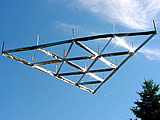
However, my favourite cutting edge engineer-inventor web sites, for obvious reasons, are the antigravity sites. If there is such a thing as gravitational anomalies that break the mold of current gravitational theory then these men stand a good chance of finding them. Prominent among the antigravity workers is Tim Ventura. Dubbed as “The Linus Torvalds of Antigravity” he is the designer and constructor of the high voltage lifters popular amongst garage-based inventors (See leading picture accompanying this post). These ‘lifters’ are reckoned by some to demonstrate an antigravity effect, although it has to be said that the physics of these lifters looks suspiciously like the well-known ion wind effect rather than a true gravitational anomaly.
As well as constructing lifters Ventura spends a lot of time researching the background of antigravity, and he mixes with some colourful characters and tells some very colourful stories. One story he reports is so fantastic that it has provided material for film producers. It is a story of intrigue, misunderstood geniuses, secret Nazi projects, heroic refugee scientists, cover-ups, governmental conspiracies, sci-fi technology, flying saucers, you name it. It’s the physics version of The DaVinci Code, an admixture of all the ingredients of block-buster cinema. Does real life ever bring together all this in one convenient concentrate? It does in Tim's stories.
The story starts with that now legendary theoretical genius, Einstein. After developing his space-time curvature theory of gravity Einstein went on to attempt the development of a unified field theory that would incorporate electromagnetism; this much is well known. It is also well known that this had the effect of marginalizing Einstein from the mainstream of physics as the new kids on the block went on to develop quantum theory, a theory toward which Einstein expressed diffidence. Hence, the picture of Einstein in his later years is that of solitary genius working by himself into old age on a now forgotten project, a project that many today would regard as the work of a has-been. It is at this point that Ventura’s less substantiated narrative takes over. Taking up the testimony of some of his mysterious contacts Ventura hints that Einstein’s efforts to create a unified field theory were at least partly successful and when he escaped Nazi Germany and fled to America Einstein left a colleague in Germany who handed over the details of this theory to the Third
Reich. The Nazis seThe Nazis, it seems, did not succeed in bringing about a practical result. Instead the research park was overrun by the Russians, but not before one of the top scientists escaped to America. This scientist then provided vital input toward secret American military projects of which the most notorious was the infamous Philadelphia Experiment.
of Einstein’s unified field theory rays of light would be bent round an object in such a way as to give it a cloak of invisibility. However, instead of merely providing a cloak of invisibility the experiment succeeded in teleporting the test object! And what was the test object? Was it an experimentally controlled carefully quantified block of metal? No. Was it a fly that accidentally got trapped in the apparatus? No. Was it a laboratory rat? No. Was it a tank? No. Was it some brave volunteer? No. It was nothing less than a whole battleship, crew and all! (USS Eldridge – pictured) Today there is a cast of colorful characters flitting in and out of the shade who are supposed to have some sort of connection with and/or knowledge of this experiment and know a lot more than they are letting on. Tim Ventura, of course, has had contact with some of these actors and like a modern day Tintin he is helping to bust the Governmental cover up and conspiracy surrounding the experiment.I like Tim Ventura; he’s ambitious, he’s bright, he’s freelance, he’s fair-minded and he thinks big, but he has, perhaps, taken the male hankering after the Boys own adventure just a little too far. I recommend Tim's site, if like me, you find fiction rather tame compared to stuff that adds an extra twist by inextricably tangling fact with, let’s just say, some creative interpretations (a bit like the Jack the Ripper Dairies!) and thus presents the investigator with the interesting challenge of trying to extract the true story. Unfortunately, although I am a gravity investigator myself, I can’t come anywhere near matching this kind of drama, and this may be why I have to tell you about other people's adventures rather than my own. The story of my own encounter with the romantic force of gravity is utterly commonplace and banal. That story would include those holidays spent on the beach at the Norfolk seaside resort of Hemsby as I reflected on the problem of gravity, a problem that I increasingly felt was coming my way. Whilst the Children played in sand and sea I, between sips of tea from a vacuum flask, spent many hours with binoculars looking out to sea, pondering with amazement the bulging curvature of the planet Earth that becomes so apparent when good binoculars are used. I have always found that sight breath taking. To see the Earth as a planet from a height of just a few feet above sea level added a palpability to Arthur C Clarke’s technically competent 2001 trilogy of interplanetary travel, a trilogy I read through on more than one occasion during those Hemsby beach holidays. That’s about as near I got to intrigue and high adventure during my forays into Gravitational theory. Boring? No doubt, but then I can only tell it as it is.
Saturday, June 22, 2019
Jottings on Reality, the Paranormal and Chaoskampf. Part I
My website/blog is a kind "Donald Crowhurst" log of my thinking on the meaning of life. It is a "pilgrim's" journal of philosophically inclined thoughts written down as life slips past; life is short and therefore one needs to capture one's thoughts in text, otherwise they are forgotten and disappear into oblivion. As Donald Crowhurst neared his end on his lonely journey he did his best to solve the riddle of the meaning of it all; it was his personal Riddle of the Sphinx and like H.G. Wells' Time Traveller he found himself in dire straits. His desperation, his loneliness, a very badly bruised ego and the pressure to make some sense of an apparently nonsensical situation unhinged Crowhurst and he became incoherent. Nevertheless, I'm happy to honour this flawed hero; he was only doing what countless humans have tried to do; probe the meaning of life and in Crowhurst's case use it as a means to dignify his predicament at the same time. Like Crowhurst I seek adventure in my own (small) way and I also know the pressing need to make sense of life as it flies by but fortunately not under quite so desperate and solitary circumstances!
If am I given the time perhaps one day I will organise my rather raw and haphazard journal notes into a systematic book form. But just at the moment there are still too many avenues to explore and when I abandon this latest exploration I'll be moving on. I see my endeavours as a kind of wrestling with reality in order to squeeze out its secrets. But perhaps as a Christian I should really characterise it as a wrestling with God himself (cf. Genesis 32:22-32); for through created reality God makes himself known. Unfortunately in comparison with contemporary Christian culture's blends of scriptural fundamentalism, fideism, ecstatic experiences, divine encounters, undamings of the emotions, hi-passion scenes, spiritual existential crises, spiritual pizzazz and holy star-dust my relatively dry endeavours are unlikely to register on the spiritual radar. But then that may be a good thing; I become self-conscious and distracted if I think I'm being noticed!
It is very tempting to take it for granted that the essence of reality is embodied in that heavy inertial stuff we perceive around us and call "matter"; sometimes it comes in lumpen homogeneous forms but at other times it appears in exquisitely organised forms such as we see in living organisms. But in both cases the underlying paradigm which dictates an interpretation of what we perceive is often the same: Viz: that is, it is taken to be self-evident that the third person perspective on matter is the absolute and objective grounds for anchoring "truth". In the material paradigm matter has an unambiguous existence; it can't have a partial existence; it's either there or it's not there. This is materialist dualism which in its strong form dichotomises mind and matter but is apt to regard mind and its concomitant of conscious cognition as at best a ghostly epi-phenomenon and at worst a complete illusion.
I have always had difficulty with the thesis that a posited "material reality" is somehow the ultimate unambiguous anchor point for reality and the standard by which reality is defined: For a start, quantum theory suggests that matter can exist in ambiguous states (more about that another time). Moreover, knowledge of so-called material reality can only ever come via our experience and our cognisance of it. As is so often pointed out in philosophical circles we really only see the world through our perceptions and therefore don't have any direct contact with some unambiguous well anchored "material-thing-in-itself"; as far as we are concerned the latter can only ever be evidenced by our experiences and then constructed by our cognition based on those evidences, almost as a kind of explanatory myth. Hence, I've always been inclined toward idealism as a philosophy; that is, the touchstone of reality is not "matter", whatever that is supposed mean, but the shades of grey we call mental life. On this view reality derives from conscious cognition, but because conscious cognition comes in degrees of rationality and completeness this means that deciding what is real is itself not a binary on/off decision, but as with mind it comes in degrees of reality.
To me the notion of a fixed "material" world absent of the existence of sensing conscious thinking, "myth" constructing agents, is simply not an intelligible idea. The concept of a "concrete material reality unambiguously out there" is, I suggest, a kind of illusion worked on us because of the integrity and rationality of our experience and perceptions. In the normal rational mode of consciousness incoming data is so well organised, coordinated and potentially complete, not just for a single cognating agent but also across a whole society of agents, that it facilitates the mental construction of coherent objects. The mutually harmonious responses of these agents is evidence of a shared rational reality of high observational integrity (in most cases). Registration of the senses of sight, sound and touch and also the observational registration between agents means that conscious cognition, especially a society of communicating cognating agents, can construct the consistent "myth" of a single coherent world of great harmony and meaning. Reality is its rationality, coherence and observational integrity. Without this integrating integrity reality is compromised. For me, then, the existence of a benevolent God who underwrites this rational integrity is all important.
The foregoing is what I call mathematical materialism. The physical model of fundamental particles with its fields of signals is a way of describing this world of harmonious registration between observers. For me the replete rationality of physics looks like an organising principle and medium for a world of communicating observers. In one sense we do have direct contact with the "thing-in-itself" because that thing-in-itself is not made of particles, but of organised "cognita"; the stuff of mind; a coherent world of organised experience and a thinking rational mind to apprehend it. "Particles" are a computational device for describing this world of communicating minds.
Using the Turing test as a kind of template I propose that the qualification for material reality is that it must hold up under the close scrutiny of an investigating rational sentient agent and provide a sufficient suite of evidence faultless enough in registration, harmony, and coherence between observers for it to qualify as real. As in the Turing test, the test for material reality has an implicit assumption of the preexistence of a sentient cognating interrogator without which the test becomes meaningless. This concept of reality posits an up and running complex sentience as an a priori feature; for an agent capable of carrying out a reality test, that agent must itself be sufficiently rational, complex and organised. In fact as it turns out human sentience is governed by the very same rational world of particulate order that is found in the world around us. Minds know what it feels like to be a mind and therefore because minds explain themselves in terms of a material paradigm minds are, in a sense, matter knowing what it feels like to be matter.
Therefore in probing that world of matter we are, in effect, probing the nature of our very selves: As I have said before, like a computer language compiler that is written in the self-same language it compiles, human beings can describe themselves in terms of their own physical concepts. But unlike the Turing test which unleashes controversies over whether mind is merely a facade or has a sentient-thing-in-itself behind the facade, there is for me no controversy of whether the material facade hides a particulate-thing-itself behind it; it simply doesn't: Rational reality is merely a highly organised facade: unless it be the mind of God himself who creates. organises and sustains this facade and underwrites its reality and rationality.
There are some things that do fail the "Turing" test for full reality. For example, our dreams, although sometimes feeling very real, do not return such a reality; the scenes and actors in dreams are not amenable to any closer scrutiny than the dream offers. In fact dreams have more the character of the scenes and actors in works of fiction such as films or computer simulations: those scenes and actors are bit parts with little or no background that can be investigated by oneself let alone share with other persons. Unlike much of the "material reality" we are familiar with, dreams do not allow their subject matter to get into the cross hairs of different perspectives and angles. In contrast in mathematical materialism the entities are not bit-parts; they have a background story and/or personalities worked out in full.
Wednesday, October 03, 2018
Tribal Britannia
Anyway, below is a sample of the aggressive anti-Europeanism, in particular anti-Germanic sentiment, that this squalid Facebook page incites in its commenters. I've changed names, of course.
I think I've had enough of all this, so let's finish with just two more examples of "Brexit" chauvinism (My emphases):
Below are some pictures of the people we really need to fear and you don' find them only in Germany or Europe. In fact you find them everywhere, unfortunately:
So, once again we find a worrying juxtaposition of Christian fundamentalism, hyper-nationalism bordering on fascism and conspiracy theorism. It is interesting to note that the "Intelligent Design" correspondent Denise O'leary who writes for the ID web site "Uncommon Descent" also had a similar view on Europe to the people I have quoted above; as with the above she conflated the war with Nazism with a war on the German people itself. See here:
Footnotes:
* Tina holds a romantizied and nostalgic view of the UK's past as a once "Great Nation". Viz: No one seems to remember that we were once a great country in the days before the Common Market turned Economic Community turned European Union. What a stupid comment! I think you will find that most people, even with a casual acquaintance of history, will remember when the small Kingdom of Britain had a vast empire and, unlike Tina, many have at least some inkling as to why things have changed for this relatively small country. What Tina doesn't grasp is that this country achieved its imperial "greatness" (not that it was always very "great" in the moral sense of the word) via a complex of circumstances that really no one understands; from the Anglo-Norman social ethos, through its isolated island status, to the confluence of the many factors which came together in the industrial revolution, a myriad conditions played their part in the rise & rise of Great Britain. But now that the advanced nations have industrialised or are industrialising the advantages of being a "first-in-nation" have run their course. You would think that being a Christian who subscribes to the apostolic authority of the book of Romans Tina would understand that fundamentally human beings are pretty much the same paradoxical mix of good and bad where ever you are.
** The Nazis weren't Christian: In fact underneath it they despised its apparent untermensch style "weakness" which contrasted to the "strength" of Nietzsche's Godless concept of the "ubermensch". However, Hitler exploited the conservative, tribal and authoritarian tendencies of the church in Germany to his advantage and that church bears some culpability for the outcome.
Saturday, February 01, 2014
The Paranormal Part 5: The Last Straw
See also:
http://www.youtube.com/watch?feature=endscreen&NR=1&v=ofNNwsNCB0g
Footnote:
* Due to a trial and error heuristic of "search, reject and select". Human minds necessarily use error feedback to learn.
Saturday, October 13, 2012
Through the Portal of Death and Beyond?
How PZ Myers habitually sees those who are less than enthusiastic about his ulterior ontology. (Dr Eben Alexander is pictured on the right)
EbenAlexander's neurosurgeon mates are queuing up to operate on PZ Myers' brain.
.jpg)