Thursday, April 14, 2011

Latest Gun Fight Debate: Craig vs. Harris.

I recently posted a blog entry giving the final “score” in a William Lane Craig vs Lawrence Krauss debate, where indications were that Craig had “won”. To be fair, then, I must report on this debate between Craig and Sam Harris entitled "Is good from God". According to Arni Zachariassen “they came out about even”. PZ Myers, on the other hand, thinks, it was a “total rout” in favour of Harris; *Methinks PZ exaggerateth too much*. This vehemently expressed opinion might just have something to do with the fact that Myers is obviously very much in agreement with Harris whatever the outcome of the debate. Therefore he is naturally going to be swayed by notoriously fickle predictors. Viz: “Craig lost on style”, “Harris….spoke thoughtfully and with sincerity…” and “...on body language and tone, Harris is engaging you and speaking from the heart, while Craig is stiff, strident, and running through the well-worn grooves of repetitive theological rationalizations.” If you really hate someone like Myers hates Craig their manner alone is going to cause irritation and leave you wide open to auto suggestive misinterpretations of their style and body language.

The result of debates like this is no doubt very much in the eyes of the beholder, but I think on balance Arni’s cool opinion “they came out about even” wins the day for me. But there is also this: I don’t agree with the view that PZ attributes to Craig: “If we don't ground our moral beliefs in a God, then we do not have a sound foundation for our morality”. After all, the good book itself says:

(Indeed, when Gentiles, who do not have the law, do by nature things required by the law, they are a law for themselves, even though they do not have the law. They show that the requirements of the law are written on their hearts, their consciences also bearing witness, and their thoughts sometimes accusing them and at other times even defending them.) This will take place on the day when God judges people’s secrets through Jesus Christ, as my gospel declares. (Romans 2:14-16)

So, although atheists (which I identify here with “gentiles”) may not be able to found a morality in an ontology of cosmic import, their hearts will provide a compelling witness as to what is right and they can, if they are inclined, successfully anchor their morality on this. (But anchoring a morality is one thing, following it is quite another; the latter may best prosper under Divine grace) My opinion, then, is that Craig should have “lost”. But the fact that Craig secured a “draw” when, in fact, he should have lost is a sign that he is a pretty smart operator!

Saturday, April 09, 2011

No News is Good News

The Good News is invisible to anti-evolutionists and anti-theists.

I’ve been talking with James Knight about why people find it so difficult to see that “law and disorder” science can never arrive at a final explanation in the deeper sense of providing aseity. There are probably several reasons for this, the “Luddite Effect” being one of them.

Other effects may have something to do with the abstruseness of scientific explanation which prevents people seeing what’s actually happening: The general “data compression” effect of physical explanation, if naively extrapolated, could wrongly be construed as showing that eventually it is possible to get something for nothing. Another possible effect making it look as though scientific explanation trivializes problems away may be down to the likely fact that human (and animal) perceptions are wired up to take most notice of interruptions in the status-quo i.e. a change is newsworthy, no change can be ignored. Thus no change in the status quo registers as "nothing there". We know, of course, that in an absolute sense something is there, something rather than nothing and we can see that reality entails an irreducible a logical discontinuity, the Grand Logical Hiatus as I call it. But it seems that people only see a discontinuity if it is plastered across the time axis as an explicit change in the temporal status quo. Change and difference is something which cries out for explanation, whereas it is tempting to feel that the uniform, the common place, and the boring, do not. Therefore if all change can be explained in terms of some sort of status quo such as unalterable Quantum Mechanical laws, then one might be tempted to think that the holy grail of science, a “complete explanation”, has been reached. However, what is more difficult to see is that even a static status quo has a discontinuity in "logical space" - discontinuities in time are easier to perceive than discontinuities in logical space.

The reason I raise this matter is not just because atheists like Richard Dawkins claim to be intellectually satisfied by scientific explanation and thus are responding to the array of factors I mention above. Ironically it is also the anti-evolutionists who think similarly; they too, I suggest, subliminally feel that evolution is in danger of providing intellectual satisfaction without God and thus as I have said before they cannot come to terms with evolution. This is something I have actually pointed out several times in this blog, but if you look here on Uncommon Descent you will find a fine example of it where you will read:

While there is little doubt about the desire of theistic evolutionists to maintain their commitment to theism, it is pertinent to ask what follows logically from the scientific acceptance of some forms of theistic evolution, especially those that claim that it must be understood within methodological naturalism where all evidence of God’s handiwork is excluded from science by definition……What follows logically is a silent God and a loud Darwin.

My guess is that what prompts this kind of response to “Darwinism” are the sort of effects I have identified above: Science has the psychological effect of masking the sheer unwarranted contingency of the cosmos; in particular evolution gives the impression that form and function are fully explained. And yet as I have said elsewhere, evolution, if it has occurred, is likely to require far from trivial mathematical preconditions. The trouble is that these preconditions are logically abstruse and not as “in yer face” as a God who poofs stuff into existence “as is, just like that”. These preconditions are likely to register as “no news” in the human psyche and therefore for the anti-evolutionists they are bad news.

Thursday, April 07, 2011

Cut Me Some Slack.

In this blog post atheist Larry Moran criticizes the Intelligent Design community for their negative evolution bashing and their failure to advance a positive science of Intelligent Design. He says:

Any objective view of the IDiot literature reveals that attacks on evolution constitute >99% of their activity. It's rare to find an article or book that presents a positive case for a creator design.

Given my experience of the anti-evolution movement I have to agree that that statement is a good approximation of the state of anti-evolutionist ID theory.

Larry Moran is responding to a blog post by Denise O’Leary on Uncommon Descent where she asks whether ID researchers are making positive progress:

That said, a legitimate question raised by thoughtful people is, why don’t ID-friendly researchers do positive research? Why do they just go on proving that Darwinism doesn’t work?

Guess who she blames for a lack of progress?......

I too look forward to the day that ID researchers are free to do positive work, but right now we are swamped in a Darwinism whose fraudulence is often unrecognized because it is so often ridiculous. . So, as with counterfeit money, the first goal is to demonstrate that much intellectual currency is bogus……So can good money ever drive out bad? Yes, but it is tough slogging.

“Darwinists” like Larry Moran, then, not only have to face a barrage of destructive criticism about their life’s work, but they also get the blame for ID theorist’s inability to do little else other than to engage in a science of negation. This, to my mind, is very unfair.

The lack of positive scientific progress amongst the anti-evolutionist community has, in my opinion, much more to do with the nature of Intelligent Design itself rather than “Darwinism”. 'Twere to consider too curiously, to consider so: For archeologists the existence of human beings that have long gone and done their stuff in the depths of time is a given: Archeology doesn’t seek to explain humanity; humanity is axiomatic in that discipline. Thus, given the highly complex and inscrutable causal agent that human culture is, it is no surprise that for archeologists artifacts such as Stonehenge, Silbury Hill, Avebury, Carnac and the like are going to be difficult to interpret and aspects of their purpose and methods of construction may forever remain a mystery, lost in the mists of time. In Theistic Design Theory it is God that is axiomatic and clearly we are postulating here a far more complex, mysterious, inaccessible and alien an object than even ancient human cultures. It follows, then, that if living things were directly engineered via some second creative dispensation over and above physics, it is likely that the exact processes involved will forever remain a mystery. Moreover, making predictions about what that Infinitely Strange Entity has done and for what purpose is also likely to be a very hazardous hit and miss affair: Who knows, He/She/It might even fancy splicing in a bit of “junk DNA” into the genome for inscrutable reasons; God, after all, moves in mysterious ways, as any faith worth its salt understands.

Therefore those who believe that life is a result of a second creative dispensation will just have to accept that like archeology it is in the nature of their discipline that that discipline is likely to make a lot less progress than even prehistoric archeology. It is therefore grossly unjust to blame evolutionists for the slow progress in ID.

I’ll confess that I am myself an Intelligent Design Creationist* and therefore I’m postulating  the existence of an  “Ultimate Origins” object (or entity) far more complex and in principle far more inaccessible, and therefore far more subject to the vagaries and foibles of imaginative construction than anything an evolutionist like Larry Moran might have to handle; he only deals in law and disorder. I have to deal with the Bible and as people who are in touch with reality know all too well, there are as many Bible interpretations as there are Christian sects.

So, I say, let’s leave Larry Moran and other gentleman atheists a little bit of slack shall we?

Footnote
* I actually favour a single dispensation creation paradigm (that is physics; but being a physics phanatic may make me a little biased, however) although I take the criticisms of sensible ID theorists like William Demsbki seriously and believe those criticisms need to be properly and dispassionately engaged.

Silbury Hill. Wiltshire, England.

Wednesday, April 06, 2011

William “Atheist’s Bane” Craig Shoots Down Another One.

Lawrence Krauss bails out over PZ Myer's blog

Looking at PZ Myers blog down beat posts here and here it seems that the atheists have “lost” another debate with William Lane Craig. OK I’ll accept that debate isn't the ideal medium in which to settle such profound questions as atheism or theism: Smart footwork and tactics may prevail over content. For example, there is the scatter shot tactic whereby one interlocutor fires off a myriad “small targets” in the form of a set superficial claims. Unless the opposing interlocutor has the information at his finger tips and fleetness of foot to intercept and refute each point in turn the impression may be left that he has lost ground. The YEC community, in particular, is adept at assembling a magazine of superficial and ultimately ineffectual points ready to blast off in one big firework display that awes and/or intimidates the simple minded.

I haven’t looked at the debate yet, but let me guess in advance where the atheists fall down: It’s their insistence that “evidence” is everything. No it isn’t; any more than one constructs and learns a language on the basis of the verbal evidence alone: A language can’t be learnt unless one has the preset mental categories and whatnot ready to act as “place holders” for the incoming data. Likewise we have little hope of understanding this Cosmos unless we have the mental prerequisites in place ready to theorize successfully about the data.

Of course, we can then turn the science of observation and theory onto our own mental faculties, but that leads to self referencing issues and atheists in my experience don’t like self-referencing because it’s too philosophical and slippery and it is remarkably free of "empirical handles" (of the "test tube precipitation" standard). But you can bet your bottom dollar that someone as smart as Craig has self-reference off pat and that gives him an edge.

Tuesday, April 05, 2011

Beyond Our Ken. On Mature Creation. Summing up

The YEC Cosmology: an unintelligible pastiche.

This is the summing up part of my previous posts in this series. The other parts can be found as follows: Part 1, Part 2, Part 3

In the first part of this series we saw how Ken Ham much prefers to talk about a “mature creation” or a “fully functioning creation” rather than a creation with the “appearance of age”. According to Ken age cannot be determined from an object. However, this nuancing is a piece of evasive chicanery on behalf of the “Answers in Genesis” supremo, because when all is said and done it becomes clear that Ken and AiG are forced to acknowledge that there is such a thing as an “appearance of history” if not an “appearance of age” and this leads to conflicts, contradictions even, within the YEC movement. For Ken and his friends want the imprimatur of doing some science and so when an object displays blatant evidence of having a history they are obliged to explain it - in terms of history, of course. History is a sequence of events and the structure of many objects - such as the layers we see in archeological and geological sedimentation, like the leaves of diary – are difficult to interpret in any other way than as a sequential assembly spaced out over time. YECs will, in many cases, admit this interpretation but it is then down to the YEC theorist to squeeze that sequence into less than 6000 years. For example, YECs have tried to cobble together “naturalistic” cosmological histories that avoid the “bogus history” accesses of some of the early YECs who claimed that star light was created en-route. They also admit that continental drift is a real phenomenon although of course they require it to take place much faster than in mainstream drift theory; similarly, for the cooling of magma intrusions and the formation of lake varves. All this is amounts to a getting away from naive “God made it just like that” beliefs.

An excursion into the science of origins has forced AiG theorists to make informal decisions as to which objects are historical (that is, objects which display evidence of having a historical sequence in their formation) and which objects are a-historical (that is objects which display no evidence of having a history): If AiG are to remain committed to a rational and coherent world they are obliged to explain historical objects, whereas a-historical objects can be claimed to have been created “as is” without violation of evidence of historical sequencing. In making such strenuous efforts to explain the evidence of star light, continental drift, magma intrusions and the like, AiG has effectively cut across Ken’s views: They are admitting that objects do betray at least evidence of history if not an evidence of age. AiG are courting a very basic contradiction within their organization: On the one hand they will deny the evidences of age and yet on the other AiG theorists are busting a gut to explain how blatant evidences of history are consistent with a 6000 year time scale. Their denial that there is such a thing as an “appearance of age” is a piece of self-deceiving sophistry that is belied by their efforts to mobilize AiG technical resources to explain historical objects. Yes, AiG certainly do care about an “appearance of history” in spite of what they may tell you. They care enough about it to have banned Adam’s belly button at AiG!

The AiG policy of making informal decisions about which objects show evidence of an historical sequence that needs interpretation and which do not, is particularly difficult to implement in cosmology. The trouble is AiG only has 6000 years to play with – in fact, probably a lot less than that in many cases. This creates big problems in the heavens where huge objects like galaxies have dimensions thousands of light years across. As we saw in the last part in this series ultra-fundamentalist John Byl betrays the problems his fellow YECs are facing. For example, Byl points out that galaxies appear to have distant parts apparently in gravitational interaction, but with only light speed signaling being available it is difficult to account for these objects without recourse to bogus history theory. But Byl tells his fellow YECs to relax and face the inevitable; some measure of bogus history theory will simply just have to be accepted by YECs, says Byl – it’s the only way to do it and besides its perfectly moral for God to create in this way: For, says Byl, God is using the heavens to justifiabley deceive unbelieving scientists into believing in an old Cosmos. According to Byl the whole cosmic shooting match is an intended sham and scientists have only got themselves to blame for not seeing through it. Byle’s vision is of an incoherent and irrational postmodern universe that ultimately undermines science. His religious devotion to his sect’s belief in a 6000 year old cosmos overrides all other consideration to the point of irrationality.

Deciding whether an object is truly a-historical is extraordinarily difficult given that form in our cosmos so often betrays evidence that is not easily interpreted as anything other than a sign of a sequential assembly. In fact the general AiG concept of a “fully functioning creation” is itself suggestive of history. For the physical algorithms of a functioning creation, when plainly interpreted, are easy to read as evidence of a cosmos that has existed as far back in time as the algorithm can be extended. But, and this is the important point, not all algorithms can be extended indefinitely into the past any more than halting algorithms can be indefinitely extended into the future: In the attempt to reverse an algorithm a point may be reached beyond which the behavior of the algorithm is undefined. At that point we really do have an object which is truly a-historical and has no bogus history that has to be brushed under the carpet; such an object can be created "as is" with creative integrity remaining intact. The alternative is that we follow the AiG line and simply wait on their decisional fiat as to what is a-historical and therefore can be created ex nihilo, and what is historical and therefore demands an historical theory in order to preserve the integrity of creation science.

But let me at least hand it to them: AiG are busting a gut to be scientific and as a result they are getting embroiled in some deep and difficult questions. To some extent I’ll give them credit for it; they are trying to be consistent. But I fancy you will find YECs out there who feel very uneasy about this engagement with science – these are Christians who sense the crypto-gnostic sentiment that authentic spirituality is naturally adverse to science of any kind because it is “man’s knowledge” and therefore profane. The fideists won’t like it: “ …the creationists have fallen into the trap of being Greeks looking for Wisdom and trying to compete wisdom vs. wisdom” I read on one Christian web site. As if to echo the fideist sentiments of Gnostic Christianity, John Byl, in his book “God and Cosmos” says:

In conclusion, while it is clear that various creationist cosmologies can be constructed, it must be acknowledged that most of these models are rather ad hoc, have not been worked out in much detail and often have few distinctive observational implications. As such they are unlikely to convince skeptics (You bet – ed) …..Almost all creationist models ultimately draw upon the concept of mature creation. While this notion may be logically, observationally and theologically unassailable (because God is allowed to deceive us in Byl’s view – ed) it does have one notable scientific deficiency. It offers very little in the way of detailed explanation for specific features of astronomical observation, other than affirming that that is just how God made things. In that sense Big-Bang cosmology, with all its shortcomings, at least attempts to develop a coherent explanation of many observational features. (p 201)

That is the nearest admission I’ve seen from a YEC that the “God did it, just like that” paradigm ultimately undermines the integrity, coherence, and intelligibility of the observational world; even to the point that it can be regarded as a form of divine deception. It is also an admission that Big Bang Theory is a lot better than YEC cosmologies, although he goes on the imply that modern Big Bang theory has “illusory explanatory powers” and is therefore effectively a simulacrum. He also talks about “divinely revealed facts” and yet fails to see that his undermining of the coherency and intelligibility of the cosmos ultimately undermines the integrity of all revelation whether that revelation is based on an interpretation of Biblical writ or the interpretation of any other part of the observed creation.

But like all YECs Byl’s religious egotism prevents him from identifying the nest of wood boring weevils in his own wood pile – namely, his sect’s interpretation of Genesis 1 which he presumes to call “the supremacy of God’s Word”. To hold close to their breast an insidious incoherence is the challenge that a teeth gritting faith sets before itself. It is the badge of an ostentatious piety that they shout from the roof tops. To sectarian minds this is taken as a sign that sets them apart as God’s privileged remnant.

Friday, April 01, 2011

Middlebrow Atheism. Part 4


Continuing my series on naïve atheism:

Video Item 07: Cosmic “Fine Tuning” is not necessarily as fine as theists think. It is conceivable that other very different environments could host (generate?) life. For example it is now thought that the goldilocks zone in the solar system is not the only possible environment for life: Tidal forces on Europa, Jupiter’s satellite, could produce the “black smoker” environment needed to sustain life well outside the goldilocks zone. Similarly, how do we know that changes in the “fine tuning” constants can’t produce a life permitting universe? Alan Guth says he is not impressed by the fine tuning coincidences: We have no way to deduce from a suite of laws whether or not life will occur.

My Comment: The video is at its best and most subtle on this point. There is a significant issue here.

We’ve seen from previous posts in this series that it is very unlikely the laws of physics are merely an artifact of a selective human perspective on a huge maximally disordered super-universe. In fact it looks as though our cosmos is intrinsically constrained to favour order, for whatever reason. Alan Guth says on the video that he has no idea why the laws of physics are what they are, but whatever they are it is clear that those laws support life. In fact the least we can say is this:

1. The laws of physics provide a construction kit of fundamental parts which, given a suitable environment, permit the assembly of complex ordered self perpetuating configurations.

I don’t think many people could disagree with that. It is patently obvious that self perpetuating configurations can exist under our regime of law and disorder (Those configurations are called “life”). The following assertions, however, are stronger, less obvious and more controversial:

2. Given a suitable environment the laws of physics imply the mathematical existence of a class of self perpetuating configurations forming a large connected region in configuration space – that is, any two configurations are separated by a series of incremental configurational changes which constitutes a path through configuration space where every point on that path is a self perpetuating structure.
3. The aforementioned region of configuration space contains some elementary configurations of realistic probability.

The latter two conditions are a requirement of evolution and for that reason they set alarm bells ringing amongst the anti-evolutionists; their commitment is to irreducible complexity which effectively negates assertions 2 and 3 above. Anti-evolutionists will, of course, accept that the cosmos is fined tuned to sustain life, but not that it is fine tuned to generate life. However, since most atheists are evolutionists I’m going to proceed by assuming these assertions are not problematical. I’m running with the atheist mindset here and seeing where it takes us. In order to get a handle on this matter I assume we are only dealing with physical laws covered by the Church-Turing thesis; that is, physical regimes whose functions can be rendered computationally. I also make the assumption that we are only dealing with suites of laws which can be specified using relatively few bits of information.

The video asks the question:

How do we know that changes in the fine tuning constants can’t produce a life permitting universe?

But why ask this question? What difference does its answer make to the atheist position? The answer to the latter questions is, I believe, answered in my last post on Cosmic Symmetry Viz: There is an implicit and instinctual theology at work here which intuits that if it can be shown our cosmos is not a particularly unique case then this helps support the atheist cause, or at least gives the theists a lot less to crow about. In contrast very special and singular conditions strengthen the theist case by giving the cosmos the touch and feel of intelligent contrivance. Hence if it can be shown that life sustaining/generating conditions are a consequence of most systems of physical laws, then it will be no surprise that our particular physics supports life and the problem of life’s existence seems less likely to be the result of intelligent selection.* On the other hand if amongst the possible suites of physical laws life supporting regimes are very rare then the case for intelligence selection (or a “put up job” as Paul Davies once put it) is intuitively strengthened. So, the pertinent question is this: Is our physical regime one of a very rare breed or is it in no way a special case amongst the possible systems of laws?

Trouble is, asking this question is one thing, answering it is quite another. In this connection Alan Guth makes a very apposite observation. He says that given a suite of physical laws nobody knows how to deduce whether or not life will exist as an outcome of those laws. In fact even given our own well known physical laws it is unlikely we could do this in advance. If evolution has occurred, I suspect that it is one of those computationally irreducible processes that Stephen Wolfram talks a lot about – that is, there is no shorter analytical way of showing that a given suite of laws implies evolution other than to simulate evolution in its entirety in a computation. If evolution is computationally irreducible it is no surprise then that Guth (or anyone else for that matter) has no idea how to do the calculation in a shorter number of steps than the process of evolution itself could do it. But it’s even worse than this: Above I have assumed that the suites of physical laws we are considering can be specified using relatively few bits of information; perhaps a few hundred Kbits of information. But even this relatively small number of bits creates a search space far too large to be humanly tractable; there are far too many suites of physical laws for us to find, let alone trial run to see if they generate life.

Given these difficulties it looks to me that the question of whether or not life supporting physical regimes are common place and passé is not going to be easy to answer; in fact it is probably, an intractable problem. So, my conclusion here is that no firm conclusions can be drawn on this subject; at least not at the moment. (But see footnote **)

However, the discussion so far does give us insight into human theological intuitions. If life is a result of the selection from a class of rare life supporting cases when all cases otherwise seem to be equally possible, this is usually taken to be grist to the mill by the ID theorist. By attempting to deny the very singular nature of a cosmic physical regime which clearly at least sustains life the video is effectively acknowledging that the ID theorist’s design detection algorithm has a certain persuasiveness about it; why else would they see the need to downplay the significance of life supporting conditions by proposing that other physical regimes might support life? I suspect that the atheists behind this video feel very uncomfortable with the idea that our universe may be fined tuned in the sense that it has been selected for reification from a remarkably unique class of life supporting scenerios. The atheist’s game here is to promote that idea that a life supporting cosmos is too common place to warrant the “fine tuning” epithet; in showing the need to classify “fine tuning” as “wrong” rather than “not even wrong” they are actually betraying how compelling “fine tuning” can be if and when we should stumble across it.

Footnotes:
* Although, of course, the problem of sheer existence remains open; that is, the old “why is there something rather than nothing?” type question.
**My guess is that if evolution is possible then the physical regimes that support it are very rare indeed. If this guess is correct and if life on planet Earth has evolved then it follows that our universe is governed by a very significant set of laws. This would mean that the cosmos is highly asymmetrical; that is amongst all the possible    physical regimes that seem to have an equal claim to existence our life supporting regime is the one that has, for some reason, been singled out for ontological reification.

Thursday, March 24, 2011

Cosmic Symmetry


Fundamentalists instinctively distrust scientific symmetry.

Christian Fundamentalists, by definition, believe they have a very direct connection with the Divine. Consequently they are very sure of their respective spiritual positions, positions which will be based on some blend of gnosis and Biblical legalism. Convinced of the divine authority of their own opinions they will presume to speak in the name of the Almighty, readily condemning those they perceive to be heretics. They are likely to feel uncomfortable with Harries Formula “Meaning = Text + Context”, because for them divine meaning is unambiguous and clear, demanding little in the way of interpretative context, a context which in any case they will probably identify as a corrupting influence. (And yet they themselves must make use of contextual resources in order to interpret texts!) For fundamentalists “compromise” is a dirty word and consequently when fundamentalists holding conflicting versions of “revelation” meet it is a meeting of the irresistible force and the immoveable object; the subsequent contention can be short, sharp and acrimonious.

The kind of altercation I speak of is exemplified in my “Fundamentalist Argument Clinic” series which I showcased on my Views, News and Pews blog (see here, here and here). However, fascinating as it is, this classic meeting of opposing fundamentalist minds is not what I want to focus on here. I actually would like to draw attention to the following comments by one of the contributors, “Geocentric Believer” (=GB). Viz:

Copernicanism is as evil as Darwinism. In fact Darwinism is just another type of Copernicanism applied to the animal Kingdom, making man insignificant, just like Copernicanism does. Copernicanism came before Darwinism and is the thin end of the wedge that takes us away from the Word of God. If you believe in Copernicanism you are compromising the clear Word of God.
As I keep trying to tell you g.s. Darwinism is linked to Copernicanism. In belittling God's created Earth Copernicanism paved the way for Darwinism.
Copernicanism came first. It demoted God's place for the Earth by removing it from the spatial origin of His Creation, just as the claimed billions of years removed the Earth from the temporal origin of Creation. Copernicanism paved the way for an Old Earth and Darwinism.
Copernicanism set us up for all this rot about us being just an accident in a remote and obscure corner of the universe with no special status to protect us from apocalyptic meteor impacts. And g.s. foolishly thinks it's unimportant.

There is a theme here that leads us into very deep waters indeed.
***

The advance of science has been marked by the progressive discovery of what may be referred to as “symmetries”. The symmetry I have in mind is of the mathematical kind; that is, the sort of object where operations like rotation, motion, displacement, and reflection etc. leave the object unchanged. For example, if you rotate a perfect circle by any number of degrees it remains exactly the same; it is infinitely symmetrical with respect to rotation. Roughly speaking I suppose “symmetry” translates as “sameness”. It is this concept of “sameness” that, I think, is at the bottom of GB’s deep theological misgivings about Copernicus.

You see, when Galileo famously and abrasively argued for Copernicanism he was endorsing a form of symmetry - the Earth now became “symmetrical” with respect to the other planets; it lost its special central place and became “just another planet”. Moreover, by the days of Newton gone was the planetary quintessence and the music of the spheres, to be replaced by a solar system described using very Earthy laws. Copernicanism, then, could be thought of as the thin end of the wedge of what is now the accepted history of intellectual progress: The Earth became just another planet. The Sun became just another star. The Solar System became just another solar system. The Galaxy become just another galaxy. And so on right up to the “Perfect Cosmological Principle” touted by Fred Hoyle, a principle stating that the universe looks everywhere the same in space and time. Hoyle’s ideas seemed at first to conflict with Big Bang Theory, but the essential concept behind the Perfect Cosmological Principle has since been revived in the eternal chaotic inflation theory, a theory I mentioned in my last blog post on middlebrow atheism. (see here) Moreover, what GB refers to as “Darwinism” can be construed as yet another theoretical imposition of a bland symmetry on the universe: In the evolutionary context Man is no longer seen as a vitalistic being but just another evolved configuration of matter, and who knows what other evolutions have taken place on other planets, thus making Earth just another pretty nondescript location even from a biological stand point. It is this progressive demotion of the once pinnacle of creation which, I submit, worries GB, a demotion which he expresses as “… making man insignificant, belittling God's created Earth with no special status”

In my last Middlebrow Atheism post I mentioned an even more extreme form of symmetry – that is, the disposing of all laws of physics and assigning probability as uniformly (in other words, symetrically) as possible over the whole configurational domain; in this cosmos of maximum disorder the laws of physics are purely a chance effect. This comprehensive super-universe is only topped by Max Tegmark’s Mathematical Universe Hypothesis: As the MUH Wiki page says: Tegmark has… formulated the 'Ultimate ensemble theory of everything', whose only postulate is that 'all structures that exist mathematically exist also physically' . Tegmark’s proposal is an attempt to get away from any idea that only one platonic construction (namely, our own cosmos) has been specially singled out amongst all the platonic possibilities and selected for reification by an unknown choosing agent, an agent that theists readily identify with deity. In Tegmark's super-universe, no mathematical structure has a preferred status; that is, they all have the same ontological status.

Science’s Law and Disorder paradigm cannot provide an answer to the age old question of why there is something rather than nothing, and without getting into a “turtles all the way down” regress, science ultimately goes little deeper than succinct description. A theist therefore might find the sheer existence of the universe meaningful, whatever its scientifically described configuration may be. On other hand, for atheists, brute existence is a poor proof of God and the ultimate meaninglessness of the cosmos is likely to be argued for using one these hyper-symmetric cosmic models where the probability spectrum is as uniform and bland as possible, with no outcomes appearing to be specially weighted. Our theological intuitions tells us that deity is unlikely to create an apparently meaningless universe like this. Those intuitions prefer the idea that a very particular cosmic configuration, amongst all the possible configurations, has been singled out by God, thus giving our cosmos special meaning. Set against the hyper-symmetric super-universes there seems to be an implicit theological expectation that God would create a highly asymmetrical universe, and especially a very singular universe that favours life. To GB’s instincts, then, the Copernican cosmos was the start of the slippery slope leading down to the symmetrical trivialisation of God’s pinnacle of creation of man and his immediate setting.

The fundamentalist finds himself fighting a rearguard action against science’s progress toward symmetry. GB and geocentrists like him are attempting to go back to a time before they see things starting to go wrong; back to pre-Copernicanism, in other words. There is, in fact, overwhelming evidence that our universe is fundamentally highly asymmetrical: In a universe where probabilities are symmetrically distributed, the persistence of order that we see in our own very particular cosmos is extremely improbable. Therefore it follows that our kind of ordered universe does have a special weighting. But this abstruse point is unlikely to cut much ice with the no-nonsense Christian fundamentalist who much prefers a cosmos more obviously punctuated with the asymmetries of an unambiguous creative fiat closer to home; so close to home, in fact, that according to GB it is right under our feet as we stand at the centre of a universe that rotates around the Earth in a single day!

Monday, March 21, 2011

To Fly in the Teeth of The Evidence II

I notice that PZ Myers has recently posted the video below. PZ and his "raiders" are no doubt having a jolly good chuckle.


I first posted briefly on this subject here. These Young Earth Creationists really have succeeded in making fools of themselves. OK so we can laugh, but don't forget that about 40% (last figure I heard) of Americans are supposed to believe in this YEC stuff. I am wondering what impact this forcing of science into a preconceived YEC mold has on American science.  It's a little worrying that America is the leader of the Western World. Is this one of the signs that The West is History? No laughing matter really.

The underlying fundamentalist malaise seems to be one of priding itself in demonstrating faith via a kind of  fideist based self flagellation of the intellect. The more one makes an unnecessary fool of oneself in the name of faith the greater the sense of spiritual achievement. Bit by bit one is broken into assenting to increasingly bizarre and irrational beliefs/practices and before long one finds oneself on all fours barking like a dog and yet being proud of it - or should I say "pretending to be proud of it with a teeth gritting faith". This is thought of as being what "fools for Christ" and "Kingdom thinking" is all about; namely, suspending the rational mind in favour of the opinions of some jumped up religious wallah who thinks he is in touch with God. The resultant "group think" creates a peer pressure which helps ensure nobody dare dissent as that would be regarded as the thin end of the Satanic wedge. Everyone is minding everyone else's faith and keeping it in line with the group status-quo.

At least somebody around here really likes ham.

Saturday, March 19, 2011

Middlebrow Atheism. Part 3


Continuing my series on naive atheism:

Video Item 06: The Wmap satellite data is consistent with inflation. Inflation implies an infinite number of pocket universes are created in an eternal process. If lots of universes are created each with different "constant" values, one of them is bound to have the right values for life. The collisions of other “bubble” universes with our own universe might show up on Wmap data making it a testable theory. Alternatively the constants (like “alpha”) could vary randomly across a large universe and eventually hit the required fine tuning values.

My Comment: The idea here is that the universe (or multiverse) is far larger in space and/or time than the observed universe; in fact so large that the universe will have available to it enough trials to make inevitable the appearance of the right fine tuning values in at least one sub-universe. The essential feature of this argument is that the fine tuning values are the result of random selection over a much larger universe than can be seen by Earth based observers. The essence of this idea can, in fact, be taken much further: Why should the values of the constants remain constant within our sub-universal region? In fact why should even the form of the laws of physics remain uniform within one sub-universal domain? If we are going to moot the idea of a super-universe that is immensely large compared to our own tiny universe we don’t actually require any laws at all: Viz: Why not resort to that classic notion of a universe simply running at maximum disorder all of the time? If so then this will mean, of course, that any selected outcome, given enough time and/or space, will make an appearance. In this context the postulated high disorder implies no configurations have a probability weighted above random expectations.

Assuming that our universe is a (very) small and unrepresentative domain in a maximally disordered super-universe the question remains as to why it should make any difference theologically speaking. The difference seems to stem from the underlying theological expectation that any God worth His salt would not create a universe where probability is spread so thinly over the space of possibilities that configurations we consider to be anthropologically significant and meaningful have no special weighting. This theology expects a God created universe to be weighted in favour of life, and this is regarded as the signature of Divine contrivance. This, I think, is the implicit theological assumptions shared by both sides.

But having said that, on further reflection it turns out that it is very unlikely that our particular universe is just a very small part of a super-universe where complete disorder reigns. You see, if our universe, with its remarkable laws and constants was one of these unrepresentative patterns in a sea of maximum disorder, then that would mean the laws physics are, in fact, an “illusion of chance”. Our sub-universe, being a highly unrepresentative ordered pattern, would mean that probability would not favour its persistence and therefore the longer it hangs around the more likely it is that our universe is not just a highly improbable fluke, but intrinsically constrained to be patterned in an ordered way. It follows then that the visible universe, whatever those fine tuning variables are doing elsewhere, is still showing an unwarranted level of order; whatever way you spin it, it’s a mysterious free lunch. Thus the cosmos presents us with two non-trivial problems. 1) Why should there be any patterned substrate at all – that is “why is there something rather than nothing”? and 2) Why is our sub-universe so persistently ordered? In short we are faced with a non-trivial Grand Logical Hiatus that is with us day by day, moment by moment, place by place. So the Wmap data, whatever it shows, takes us back to square one.

Tuesday, March 15, 2011

Gob Smacked

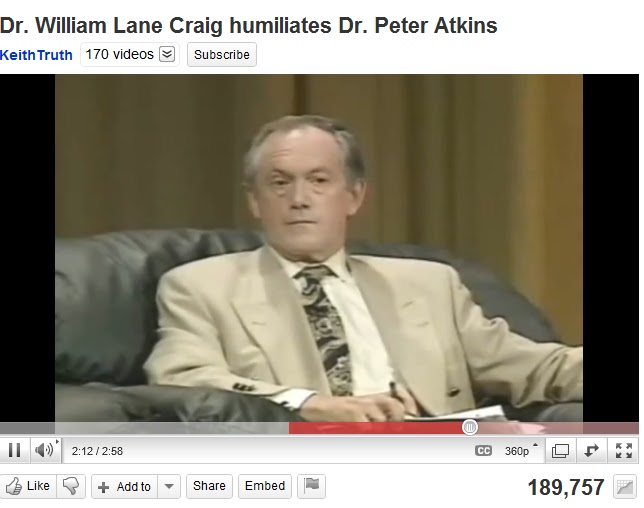
The video below was embedded by William Dembski on Uncommon Descent (See here). It shows a snippet taken from a debate that includes theologian and philosopher William Lane Craig and atheist scientist Peter Atkins.


Principally the snippet is Craig’s response to Atkins’ scientism, a scientism which Atkins expresses well in the following terms:

“…It [science] alone is adequate…. the fact that science is omnipotent… Do you [Craig] deny that science can’t account for everything?...”

In answer William Lane Craig gives the following list of “rational beliefs that cannot be proven by science”.
1. Logical and mathematical truth.
2. Metaphysical truths, like the existence of other minds the reality of the external world, and the belief that the past wasn’t created five minutes ago with an appearance of age,
3. Ethical beliefs are not accessible to science. For example it can’t show by science that the Nazis were unethical.
4. Aesthetic judgments can’t be scientifically proven
5. Science can’t be justified by the scientific method. Science is permeated with assumptions that cannot be proven – e.g. the one way speed of light.

If I get time I might look at some of these items. (In fact I once looked at item 5 here). In the meantime if you are wondering what it means “to be gob-smacked” just have a look at Atkins’ face.

Atkins looks to be one of those people who has a totalizing take on reality; at least in sense that he regards science as epistemologically complete …adequate…omnipotent… everything. He is therefore unlikely to favour the idea that as far as we humans are concerned reality is epistemologically, as well as ontologically, open ended; for him science is the last word in knowing. One can’t help but wonder if Atkins wanting to draw a line round the whole of reality in the sense of thinking it to be comprehensively amenable to particular epistemic methods and assumptions, is as much a comfort blanket to Atkins as he claims a belief in God is for theists. Totalizing agendas of this kind often go together with totalitarianism (cf Marxism) because totalizers are usually so confident in their views that they are unlikely to accept that there are objects out there that their views and methods don’t cover. In particular, they may dislike the idea that some questions present ambiguities that admit more than one interpretation.

There is a very general contention between theory and experience that occurs as we attempt to theorise about reality, but this contention is far from what can be called formal science: We try to fit the dots of experience with an overall world view (see my sidebar), but let’s face it experience differs from person to person. Moreover, one experience set may admit more than one sense-making-world-view and therefore even two people with similar experience may disagree on the big questions. Evaluating which world view is best fit is often difficult. As each of us faces the challenge of unlocking the riddles of our cosmos we certainly don’t use formal science - rather we use the texts of our society, hopefully an open society, to synthesize our best shot at ontology. Our solutions to those riddles are often quick and dirty, but “quick and dirty” doesn't necessarily equate to wrong. But whatever, we must hold those views with humility. Atkins, of course, doesn’t do epistemic humility; he’s quite sure he has found the answer, to epistemology at least.

Let’s get one thing straight. This isn’t just about theism. One doesn’t have to be a theist to see that Atkins totalising sentiments are flawed. This is less about theism than it is about pundits who wish to plug all the openings and close off reality so that they can declare epistemology and ontology they don’t like as off-limits and irrational. At stake is an intellectual democracy. As is so often the case with totalisers they are not at all keen on epistemic outsiders as those outsiders are an implicit challenge to their totalizing views: As the sectarian saying goes “If you are not with us you are against us and if you are against us you are against the truth” . Because they believe their views to be so obviously true they are suspicious of the motives of those who don’t agree with them. Those “outside the truth” are suspected of having compromised consciences and thus are liable to be morally impugned in some way: For example Larry Moran, who believes his view of science to be the exclusive way of knowing, is not convinced of William Lane Craig’s integrity; he accuses Craig of typical "anti-science trickery" and "cheap shots". He tells us that “It's not that these five things are devastating arguments against the power of science, it's that each one would take at least an hour to explain”. And are we supposed to believe that an hour’s explanation would be the definitive last word simply because it comes from the lips of someone who espouses scientism? I suspect Craig could give us two hours explanation and probably a lot more. When is Larry going to learn that reality is open ended?

STOP PRESS. 15/03/11
Here are some of the comments that have appeared on Larry Moran’s blog in response to the video:

DK: Of course there are things that science can't adequately deal with. So what? Who cares? Was anyone stupid enough to suggest that science is everything? It's just a tool and immensely useful one. Is that not enough?


My Comment. That’s a very reasonable statement DK. However, some of us do care. Do you have a problem with that?

Arabiflora: I also would not stake the latter claim [of omnipotence] and merely agree with DK that the utilitarian value of science is enough to justify its status as the most effective "way of knowing".


My Comment: That’s reasonable as well

PZ Myers: Arabiflora got the gist of it. It isn't just justifying, because we can do that adequately; Craig shifts the goalposts and demands that a lot of metaphysics and speculative philosophy must beproven, and science doesn't deal in proofs. So sure, I can't prove I'm not a brain in a vat that was created 5 minutes ago with memories of the past 50+ years. So? That is not a useful hypothesis.


My Comment: Come on PZ, I’m sure you know that Craig is smart enough to have used “proven” in a relative sense, just as you mean “evolution is a fact” in a relative sense.

Mike D: I'm a bit mystified by Peter Atkins' statement that science is "omnipotent"…


My Comment: So I am.

Ian H: Debating is as much a performance art as anything else and, like it or not, Craig comes across as a better speaker than Peter Atkins - certainly more glib and facile and a better tactician. It is also tactically inept to gift your opponent easy targets by making wildly extravagant claims about science being "omnipotent" and able to "explain everything".

My Comment: Another very reasonable response.

Anonymous: The five points:
1) Logical and mathematical truths
2) Metaphysical truths
3) Ethical beliefs (moral absolutes)
4) Aesthetic judgments
5) Science itself
I would deny the existence of 3) and 4) beyond what can be scientifically demonstrated to exists and thus be explained. 5) can be split up into 1) and 2) and these two things can probably not be justified by science.

My Comment: I might agree with much of that.


Summing Up: Not a bad set of comments at all. I am gratified to see that Atkins “totalizing” sentiments are not echoed here. One hopes that Atkins himself in retrospect might regret his over statement. Philosophically, then, I'm satisfied with most of the above comments. But what I really think is at the bottom of this has less to do with the sweet reasonableness of philosophy than it does the fact that Craig made Atkins look so stupid. For a community that prides itself on its reasonableness this hurts. So not surprisingly we also see the following comments:

Ian H: People underestimate Craig. He is very good at what he does and it takes more then being a crusty old curmudgeon or gnu atheist to beat him.


Mike D: Craig is such a charlatan


Anonymous: Craig is a one trick pony and a cheap confidence trickster. You fight him by keeping him off balance and ripping off his mask to expose his fraudulent self.


DK: This is why debating religious nuts is a waste of time. They should simply be ignored.


As you can see suspicion is rife and relationships have broken down completely. In spite of what the above are saying Craig isn't a sewer rat and I’m sure he has many worthwhile things to say but the above community won’t be listening to him. In this context debate is a gladiatorial activity and spectator sport where tactics count; all's fair in love and war and killing your opponent is what it's all about. No one is taking prisoners and the two sides are intent on gutting one another.


Peter Atkins looks gutted.

Friday, March 11, 2011

The Fate of Man, by William Shakespeare

It’s debatable whether or not Shakespeare was an atheist. Sir Kenneth Clark, in his TV series Civilisation, referred to him as sceptical and free of dogma. An episode of Sir Ken’s series included two pieces of Shakespeare that might be relevant to Shakespeare’s views and I post them below. The first is from Hamlet:

HAMLET: How long will a man lie i' the earth ere he rot?
GRAVE DIGGER: I' faith, if he be not rotten before he die--as we have many pocky corses now-a-days, that will scarce hold the laying in--he will last you some eight year or nine year: a tanner will last you nine year
HAMLET: Why he more than another?
GRAVE DIGGER: Why, sir, his hide is so tanned with his trade, that he will keep out water a great while; and your water is a sore decayer of your whoreson dead body. Here's a skull now; this skull has lain in the earth three and twenty years.
HAMLET: Whose was it?
GRAVE DIGGER: A whoreson mad fellow's it was: whose do you think it was?
HAMLET: Nay, I know not.
GRAVE DIGGER: A pestilence on him for a mad rogue! a' poured a flagon of Rhenish on m head once. This same skull, sir, was Yorick's skull, the king's jester.
HAMLET: This?
GRAVE DIGGER: E'en that.
HAMLET: Let me see. (Takes the skull) Alas, poor Yorick! I knew him, Horatio: a fellow of infinite jest, of most excellent fancy: he hath borne me on his back a thousand times; and now, how abhorred in my imagination it is! my gorge rims at it. Here hung those lips that I have kissed I know not how oft. Where be your gibes now? Your gambols? your songs? your flashes of merriment, that were wont to set the table on a roar? Not one now, to mock your own grinning? quite chap-fallen? Now get you to my lady's chamber, and tell her, let her paint an inch thick, to this favour she must come; make her laugh at that. Prithee, Horatio, tell me one thing.
HORATIO: What's that, my lord?
HAMLET: Dost thou think Alexander looked o' this fashion i' the earth?
HORATIO: E'en so.
HAMLET: And smelt so? pah! (Puts down the skull)
HORATIO: E'en so, my lord.
HAMLET: To what base uses we may return, Horatio! Why may not imagination trace the noble dust of Alexander, till he find it stopping a bung-hole?
HORATIO: 'Twere to consider too curiously, to consider so.
HAMLET: No, faith, not a jot; but to follow him thither with modesty enough, and likelihood to lead it: as thus: Alexander died, Alexander was buried, Alexander returneth into dust; the dust is earth; of earth we make loam; and why of that loam, whereto he was converted, might they not stop a beer-barrel? Imperious Caesar, dead and turn'd to clay, Might stop a hole to keep the wind away: O, that that earth, which kept the world in awe, Should patch a wall to expel the winter flaw!

My Comment: As I mentioned in my last post, when we interact with people we don’t think about then in behaviorist terms; neither do we think about them as the dynamics (or behavior) of their constituent particles (or “dust” as Hamlet’s sixteenth century mind would have it), instead we think about humans in para-phenomenological terms – that is we understand their behavior as the outward manifestation of conscious cognition, and its concomitants of intention, purpose and meaning. Matter, humble matter, appears to host this para-phenomenon for a season and then it returns to disorganized dust. Hamlet ponders the paradox and irony of how matter once so exalted can, in due course, become so banal; where has it all gone? Can it really all evaporate so easily and so inconsequentially? 'Twere to consider too curiously, to consider so.

And now a piece from Macbeth.

MACBETH: To-morrow, and to-morrow, and to-morrow,
Creeps in this petty pace from day to day
To the last syllable of recorded time,
And all our yesterdays have lighted fools
The way to dusty death. Out, out, brief candle!
Life's but a walking shadow, a poor player
That struts and frets his hour upon the stage
And then is heard no more: it is a tale
Told by an idiot, full of sound and fury,
Signifying nothing.

My Comment: If we define hell as a place where God is so remote that he may as well not exist, a place without hope, meaning, purpose, significance and utterly pointless, then it seems that the self serving Macbeth has found that place.

Wednesday, March 09, 2011

Middlebrow Atheism. Part 2.


Continuing my series on naive atheism:

Video Item 04: An apologetic which makes use of Cosmic Fine-tuning as an argument for God is an argument from ignorance. When religion can’t explain something (like fine tuning) it gives up and says “A magic man done it!” The complaint here is, I think, against a style of argument such as “We can’t explain fine tuning; therefore God….” Conversely, “We can explain fine tuning; therefore God is not needed…”

My Comments: The video considers the example of the “finely tuned” flatness of space, a feature which Alan Guth’s inflationary theory provides a possible in explanation (along with the horizon problem). In contrast the video tells us of theists who prefer to believe that this particular kind of fine tuning is down to direct Divine contrivance. It is ironic that the mindset of these theists is commensurate enough with the video producers for them both to agree that if one succeeds in finding a law and disorder mechanism to do a job then that makes the occasional intrusion of Divine intervention redundant. The underlying theology here takes it for granted that there is a conflict between Divine agency and the agency of Law and Disorder. The upshot of this kind of theology is that atheists want to maximise the role of law and disorder and theists want to minimize it. The underlying thinking here is subliminally deistical: The thought is that if deity can create mechanisms that manage and run themselves this sets a subversive precedent for theists that ultimately puts a squeeze on theism: The “God of the gaps” deity conjured up by this common vision of God would not be needed at all if mechanisms can be found capable of creating mechanisms thus filling in all the gaps.

We must concede that it is at least conceivable that Law and Disorder mechanisms could, in principle, return a complete description of the Universe, but as I pointed out in my last post this either leaves us ultimately with an irreducible Grand Logical Hiatus or if we proceed to explain the explanations with law and disorder we get caught in a kind of “turtles all the way down” regress – or another way of looking at it, a “contexts all the way up” regress, of which multiverse theories may well be a practical manifestation of this principle at work. Either way it seems inconceivable that law and disorder science will ever obviate contingency and provide us with self necessity. Law and disorder are too elementary as mathematical objects to provide aseity.

The constructs of law and disorder science, no matter how successful as a source of information about the patterns of our cosmos, are destined to leave us with an enigmatic status quo. Thus, in an absolute sense science has taken us little further forward than the pre-Neolithic hunter gatherers who, in their own way, were also very accomplished in the art of comprehending the ways of their environment; although, of course, they didn’t achieve this understanding using formal and institutionalized science. Traditionally, the role of religion was less about the description of the status quo, than it was getting behind this status quo often by imagining the activity of the cosmos to be the manifestation of personified agents. The religious imagination, which sees the world of phenomenon as the interface to the numinous, is not unlike the folk understanding of conscious cognition, an understanding that looks beyond behaviorism and sees consciousness, purpose, intention and meaning behind observable human activity. Likewise, the role of deity goes deeper than the mere description of the phenomenal status quo and, as in the analogous case of human behaviour, it imputes intelligence, purpose, intention, and meaning to the cosmos. Divine conscious cognition is thought of as running in parallel with phenomenal reality and supplying it with a deeper reason than is possible with mechanistic explanation. The “reason” referred to here is not the mechanical reason constituted by the logical operations of low level elemental objects but rather the purposes and intentions of the a-priori complex construct of sentience, a construct understood in terms of consciousness, intention and meaning. Human beings have no idea what it is like to be a fundamental elemental like a particle, but they do know what it is like to be a causative sentient agent and therefore they better connect with paraphenomenal explanations grounded in the personal rather than in the elemental.

Whether the religious ontology of personification has a status that goes beyond mythology is not the issue here; rather at issue is the naivety of the video in placing the numinous on the level of the phenomenal and treating it as in competition with law and disorder explanation. The video, then, no more engages the ontology of God as it is properly conceived, than behaviorism engages how one person actually thinks about another person in person to person interaction; in those interactions people are not thought in behaviorist terms but instead ostensive behavior is regarded as the interface to a first person perspective of conscious cognition. But just as there are philosophical doubts about whether irreducible first person ontology is real, so there are analogous doubts about the reality of God.

That religious thinking constructs a paraphenomenal world may help explain why it remains unchallenged by the deistical theology that sees God as an auxiliary explanatory device resorted to when law and disorder explanation fails. In a more sophisticated theology God is conceived of as an entity of an entirely different genus to law and disorder manifestations. Therefore it is no surprise that religion is impervious to the challenge of the deistical God of the gaps theology we see in this video.

Thursday, March 03, 2011

To Fly in the Teeth of The Evidence


James Knight, who has well and truly slagged off the nonsense of Young Earth Creationism on his blog, got a comment from Henry Morris-Junior-Junior, the grandson of Henry Morris-senior-senior, one of the authors of the seminal YEC volume “The Genesis Flood”. In his own comment James points out that pathological factors are probably at the bottom of the thinking of YEC scientists. I pick up this theme up in my own comment on James’ blog, which I reproduce here:

Hi James,

One of the pathological factors you refer to may be vested interest – in fact to the tune of many millions of dollars of vested interest. Money has been poured into the Young Earth Project and you’re not going to easily convince those who have so much to lose financially, not to mention loss of face. With this emotional and financial investment at stake, it is likely to be an exercise in utter futility to attempt to open up a discussion with a fully paid up YEC clan member. They are desperate and perhaps even desperate and dangerous!

Moreover, Henry Morris-Junior-Junior is misleading us over the soundness of YEC research: e.g. We currently have two contradictory star light “solutions” on offer at AiG - the latest in a series of abortive “solutions” starting with Henry Morris-senior-senior’s mooting the concept of a virtual universe bathed in a sea of bogus light messages created en-route!. The latest “solutions” I’m thinking of are from Russ Humphreys and Jason Lisle respectively. The former has a theory which suggests that the distant galaxies are millions if not billions of years old and the latter has another theory which suggest they are only 6000 years old – quite a bit of community dissonance there I think.

In any case questions of both theology and science are invariably open ended and subject to possible revision as new data and new interpretations come to light. In the YEC community we see some quite drastic revisions going on (re: start light) which raises doubts over the soundness of their mental processes. But one thing the YECs just won’t do – no, make that “can’t do” - is revise their interpretation of the meaning of Genesis 1 & 2. On this issue they really have built themselves into a corner! For them it’s a desperate fight to the death with everything to lose! People this desperate just can’t do objective science because they are incapable of the dispassionate judgments needed in science. Best leave them to their own extremist devices and the applause of their ignorant followers, an applause which gives them the confidence and the feel good factor they so desperately need.

This desperado is in need of the feel good factor!

***

Laughing Stock
It is difficult to believe that YECs really do believe that the carnivorous bi-pedal dinosaurs were originally designed to be herbivorous, so I had a quick look on Answers in Genesis to see if I could find such an admission. The best I found was here where we read that “We know that both dinosaurs and humans were vegetarian in the beginning.” (Incidentally the AiG article I’ve just linked to admits that no humans remains have ever been found with dinosaur fossils and tries to explain this awkward fact away). In this connection it is also interesting to note that in their children’s section on animals AiG make the appalling claim that the following fauna were originally vegetarian: Tiger, cheetah, Jackal, great horned owl, peregrine falcon, boa constrictor, bald eagle, black tip reef shark and crocodile. (However I don’t understand why some of the sea going carnivores like the octopus and the blacktip reef shark weren’t given an “originally vegetarian” status)

Given the foregoing it is no wonder that AiG are a laughing stock. Set against the findings of AiG there is, I hardly need say, a wide scientific and international consensus across disparate and independently funded scientific communities between which there are often some healthy rivalries and arguments. In contrast AiG is part of a relatively tight knit religious community who will put this consensus down to the manipulation of Satan and therefore they a very ready to use religious intimidation and the threat of Divine displeasure to propagate their cause.  - 05/03/11

Tuesday, March 01, 2011

Musical Interlude: Is it a Dream?


For Classix Nouveaux fans here is what claims to be a rare low budget original: http://www.youtube.com/watch?v=eAiKC1FEc-A&feature=related

Middlebrow Atheism. Part 1.


The video above was posted on PZ Myers’ blog under the heading “When will that fine tuning argument evaporate?” In this series of postings I will be working my way through the issues it raises. But before I do we should recall that the “hard” science of physics uses two main kinds of explanatory object to describe our world:

a) Functions (or laws) capable of generating patterns which putatively describe the configurations of our world. These functions by and large come under the Church-Turing thesis which conjectures that all such functions can be rendered computationally.
b) Disordered configurations that can be treated statistically.

Using my own short hand I refer to these two kinds of explanatory object as “Law and Disorder”. Given this pair of explanatory objects I’m mindful of three caveats:

a) Although physics has successfully used Law and Disorder to describe large swathes of reality there is no obvious reason why objects which do not come under the heading of either law or disorder should not exist.
b) Even if physics can successfully explain the whole Cosmos it is clearly impractical for all the patterns in our world to be reduced to physics. For example, history has no practical way of using “Law and Disorder” explanations in the thoroughgoing sense that physics attempts to use them. Thus history is likely to remain a very narrative intense discipline. In short history is practically, if not theoretically, irreducible too Law and Disorder.
c) Law and Disorder explanations, no matter how successful, are destined to leave an inevitable Grand Logical Hiatus, an irreducible kernel of brute fact. Attempts to explain a given law and disorder regime using law and disorder is liable to lead to a kind of “turtles all the way down” regress. It may well be that multiverse explanations are sign of this logical/mathematical barrier as attempts are made to explain the cosmic context by embedding it within higher contexts (a kind of “contexts all the way up” explanation)

Now to deal with the video item by item:

Video Item 01: Given that the overwhelming majority of the Universe in space and time is clearly sterile it is hardly appropriate to suggest that the Universe is finely tuned for life.

My Comment: The video comes up with a rough upper limit on the cosmic ratio of life to non-life in the order of 1 to 10 to the power of 100. The implicit conclusion is that given the presence of life in terms of space-time occupied is so trivial, then life has too small a representation to claim the universe is finely tuned for it. But this calculation gives a false impression: We should not be looking at physical space and time but combinatorial space, the space of possibilities unconstrained by an apparently arbitrary set of laws and constants. Amongst the class of all possibilities the overwhelming number of configurations is disordered. Inside that class the complex ordered configurations of life has a representation as negligible as 1 in 10 to the power of many trillions (and I’m probably understating it). Thus, even if there should be only a single planet in the whole visible Cosmos that contains a few replicating cells, this seems an unwarranted over representation of an otherwise very unrepresentative class of configuration. Therefore, from the perspective of the visible universe it seems that the cosmos (presumably, as a result of its particular L&R regime) is highly skewed toward life. It follows that the existence of life cannot be trivialized away as a non-problem – we clearly have a non-trivial question of why the visible Universe is overwhelmingly biased toward life. So in this sense, contrary to the claim of the video, the visible Universe is fine tuned.

Video Item 02: Since we don’t know what space of possibilities the universe has been taken from we can’t work out any probabilities in regard to its apparent fine tuning. Probabilities in this connection are meaningless.

My Comment: Yes and No. “Yes”, because we don’t know the engine that has generated our Cosmos, a Cosmos with its particular laws and constants which favour life. Thus we can’t assign a probability in the way that we can assign a probability to patterns generated by tossing a coin. We simply don’t yet have a well understood generating context for the Universe. In any case who knows whether the “universe generator” is a multiple trial system like a kind of cosmic tossing machine that creates universes?  Positing such rather makes the assumption that some kind of disorder mechanism akin to coin tossing is at work. In particular perhaps the mechanism that has generated our Cosmos lies between the extremes of disorder and the high order of physical laws, in which case the concept of probability may be meaningless.

And “No” because in spite of the fact that the probabilities of a configuration of fine tuned parameters cannot be meaningfully quantified, we are still left with the extreme rarity of the visible Universe in the space of all possibilities. Given that we don’t know why one possibility should be chosen over another, each possibility seems to be of equal weight. Given that disorder far outweighs order then it is clear that our universe is taken from a very a-typical class, thus leaving us with the non-trivial question of its selection. So contrary to the suggestion of the video we can still have an appreciation of the remarkable singularity, if not the improbability, of the visible universe

Video Item 03: The probability of a particular configuration generated by the tosses of a coin or the cards withdrawn from a shuffled pack has a vanishingly small probability and yet nobody claims it is miracle of creation given that these configurations arise routinely in gambling casinos.

My Comment: The reason why nobody bats an eyelid when a particular sequence of, say, coin tosses arises is to do with the class of the outcome. Disordered configurations have an overwhelming representation in the class of possibility. Hence, if a random process generates disordered configurations this is to be expected as such configurations are selected from an overwhelmingly large class and therefore the selection of an item from this class is overwhelmingly probable. However, if a process generates ordered configurations, especially the complex ordered configurations of life, this presents us with a non-trivial problem as these configurations are taken from a class that has a vanishingly small representation in the class of possibility. Thus, given that compared to the huge space of platonic possibility the visible Universe is in fact quite a small cosy place, we are left with a non-trivial question of why such a unique class is so favoured as to make an appearance in our tiny universe. Contrary to the suggestion of the video, then, the structures of the Universe are startling rather than banal

…to be continued…