Wednesday, April 28, 2010

Polkinghorne: A Creationist and ID Theorist.

Last night I was at Norwich Cathedral where John Polkinghorne was giving a talk. I have published some pics to convey the atmosphere. Their quality is not good as my “point and snap” photographic technique struggles under poor conditions.

One of Polkinghorne’s theme (as usual) was of a universe “endowed with the potentiality” to generate life via evolution. During the Q&A session he described himself as a creationist who believes in Intelligent Design. This claim is entirely intelligible given that Polkinghorne believes the universe to have been deliberately “fine tuned” in order to be fruitful in its production of life.

However, what worries Polkinghorne about the term “intelligent design” also worries me: It has become (especially in North America) synonymous with anti-evolutionism. Thus, the insinuation is that theorists like Polkinghorne who are standard evolutionists must be advocating a life creating processes that is unconditional upon Divine Design. As Polkinghorne himself said, somehow the anti-evolutionists have posited “natural” processes in which God has no hand; that is, their objection to physics as the source of life is based on a subliminal feeling that physics is a “mechanical” or “natural” process that minds itself without the hand of God.

The contention here is not whether evolution is supported by common physics or not, but just who can consider themselves to be flying the flag of “intelligent design”. The anti-evolutionists think that they alone are flying that flag and that everyone else should come on side for God. The insinuation is that those who don’t are somehow in bed with “naturalism” and atheism.

The anti-evolution/evolution debate is an emotionally charged war zone where combatants need to know who to shoot at and who not to shoot at. As far as the anti-evolutionists are concerned Polkinghorne is on the wrong side and cannot be regarded as an ID supporter. It is therefore no surprise that in this polarized environment people like Polkinghorne tell us that they have little sympathy with the anti-evolutionist ID community.

But the category division between "goodies and baddies" is based on quite subtle criteria. In this post on Uncommon Descent a correspondent moots the idea that common descent with genetic front loading can be identified as an ID candidate even though the correspondent doesn’t hold this view himself. Why then can’t Polkinghorne’s evolutionary views, which if they are valid would inevitably entail a biased front loading, also be identified as an ID candidate? I suspect this has something to do with the side of the battle field he identifies with.


Christian flock: some think ID sorts out the sheep from the goats
and that Polkinghorne is a nave knave


JOHN POLKINGHORNE LECTURE NOTES
These are the notes I made on the evening of 27/4/2010
Qualia vs Formalism. Meta questions beyond science
  1. Why is science possible? Why can we render it using equations? Why do we have a rationally transparent world? The Creator: A concept that makes intelligible the intelligibility of the world.
  2. Why is the universe so special? For example the Carbon resonance. Dark energy has been fine tuned to a very small value.
Polkinghorne believes in one universe – the multi universe is speculative and unintelligible.
The universe is endowed with potentiality. The universe is designed to be fruitful. It is not a puppet theatre. Life can make itself.  Mutation needed for evolution tradesoff against cancer. Can not easily separate the benevolent from the malign – inextricably bound up. Hence a universe with ragged edges and blind alleys.

Question & Answer Session
Polkinghorne says he believe in creation and ID.
The IC concept – postulates isolated structures.
American “ID” drives a wedge between the “natural” and God: posits processes where God didn’t have  hand.
The Fall: Down to the self limitng act of God – he gives gifts of free will. Creature make themselves vs puppets. The good has to be balanced against the evil.

Monday, April 26, 2010

Creationism, Interventionism and Deism.

A rather anthropomorphic view of God's activity

In this post on Sandwalk Larry Moran adopts a new term for that category of evolutionist normally referred to as “theistic evolutionists”. The term, borrowed from a blog post by Jerry Coyne , is “New Creationist”. Although I wouldn’t quibble with the use of the word “creationist” here, I would question the appropriateness of the qualifier “new”. In this post on my church blog I submit some historical evidence indicating that the established prewar church was not inclined to question the findings of science, but rather to integrate those findings into its world view. In contrast contemporary Young Earth Creationism is a recent recrudescent phenomenon that started at around the time of the publication of “The Genesis Flood” by Whitcomb and Morris in 1961. So, in actual fact Young Earth Creationism may better qualify for the name “New Creationism”. A more appropriate name for the theistic evolutionists may actually be “establishment creationists” thus describing their identification with mainstream and established science.

In his “new creationist” post Coyne is responding to his antagonist Ervin Lazlo, a philosopher and system theorist. Laszlo must surely understand this subject and yet he is quoted by Coyne as appearing to promote “Hoyles fallacy”, a fallacy which estimates minuscule OOL probabilities by concatenating a set of assumed independent probabilities into a long product series. Naturally Coyne (and myself) would find fault with this kind of procedure. But in a further quote Laszlo appears to show an understanding that evolution requires peculiar preconditions in order to raise its probability to realistic levels – a point of view with which I would concur; if evolution and abiogenesis are facts then the improbability is not to be found in the way suggested by Hoyle’s fallacy, but instead can be traced back to the “one-off” prerequisite mathematical conditions grounded in the physics required by evolution. This “one-off-ness” is, as I have propounded elsewhere, a special case of a more general and abstract thesis that tells us that in the final analysis a great irreducible Logical Hiatus lies at the heart of all finite human theoretical schemes. However, it is the import and interpretation of this inevitable logical hiatus that causes the vexation between atheists and theists. For example, Lazlo effectively waves a red rag to the bull when after noting that evolution is conditional upon particular (and surprising) preconditions he goes on to say:


In the final count the evolution of life presupposes intelligent design. But the design it presupposes is not the design of the products of evolution; it’s the design of its preconditions. Given the right preconditions, nature comes up with the products on her own.

And:

Design is a necessary assumption, because chance doesn’t explain the facts.

Using his own words Coyne renders this sort of argument as follows:

…the evidence for all this is that life is complex, humans evolved, and the “fine tuning” of physical constants of the universe testify to the great improbability of our being here—ergo God.

Evolution started off simple and now many organisms are quite complex. Therefore God.

Here, Coyne is objecting to the God of the gaps argument, an argument whose general form is: “Logical Hiatus, ergo God”. I would concede that given a logical hiatus then an intelligent designer does not necessarily and obviously follow. The atheist has at least some room to play with other ideas in an attempt to “fill the gap” with a non-sentient and elemental cause before he gets to the divine “designer”: For example he might attempt to remove the ultimate improbability of the preconditions needed by evolution with the huge probabilistic resources found in some kind of multiverse model, although this model still inevitably has to make recourse to peculiar preconditions. In fact no matter how one tries to cut it, all human theories have an embedded logical hiatus in the form of given and particular preconditions. This truism leads me to commit myself to the view that logical necessity can only be found in the a priori complex rather than in the simple and elemental algorithmic laws of physics. The elemental is too simple and lacking in degrees of freedom to hide logical self-sufficiency. Therefore I conclude that infinite a priori complexity is the only place left in which Aseity is going to be found, if it can be found at all. Once one takes this conceptual step the possibility of Deity appears at once on one’s conceptual radar.

Although I agree with Laszlo’s theism I would not claim that theism is an obvious inductive leap that automatically follows from the Logical Hiatus that necessarily resides in all finite human theories. The step to theism is less inductive than it is deductive, although it would probably be better to describe theism as a totalizing world view, an all inclusive sense making framework that embraces a wide interdisciplinary experience of life from science, history, philosophy, metaphysics, and personal anecdote - even temperament may have a bearing. In the face of evidence that is sourced so comprehensively, arguments for and against theism will necessarily be narrative intense, absent of killer one-liners and inescapably idiosyncratic; least of all will these arguments meet the strict formal standards of proof that can be demanded of the simple objects dealt with by “test tube precipitating” science. For this reason belief in an intelligent designer is never going to be an obliging, authoritative and publicly shared conclusion. The latter is the preserve of the physical sciences where simplicity of ontology entails greater epistemological tractability.

Although I have some sympathy with Coyne’s objection to the “Logical Haitus, ergo God” type argument, I very much disagree with Coyne’s theology: He portrays the “new creationist” God as a part time deity who occasionally “intervenes”, perhaps only once at the beginning of things:

New Creationism differs from intelligent design because it rejects God’s constant intervention in the process of evolution in favor of a Big, One-Time Intervention,

In fact Laszlo himself encourages this view:

Given the right preconditions, nature comes up with the products of her own. (My emphasis)

The picture is anthropomorphic: The subliminal idea is that God creates in much the same way that a human creator constructs something by configuring elements capable of independent existence. He can then, to a lesser or greater degree, leave His creations to their own devices, perhaps occasionally returning from time to time to “intervene” in the operation of this quasi-autonomous creation. It is ironic that those Christian believers like Robert Sheldon who make a big deal of believing in divine “interventions” are not so far removed from Coyne’s portrayal of the deist’s God: The difference is that Sheldon believes not in a “Big, One-Time Intervention” but “Many-Time Interventions”. Deism lurks threateningly in the background of the Christian interventionist’s philosophy of God.

My concept of God is that of a God who “interrupts” the flow of normalcy rather than “intervenes”; that is, he interrupts or changes His mode of working, a working that in actual fact never ceases: “for in Him we live and move and have our being” (Acts 17:28). When we develop physical theories such as Gravitation or Quantum Mechanics, we do not picture such schemes as doing their work by “intervening” but rather see their action as relentless across all time and space. Likewise, if the ultimate underlying ontology of this universe is the Aseity of deity then I don’t expect that Deity to have the occasional role of the interventionist God, but instead to be a present tense continuous agent. As the sustainer of the cosmic order His role is relentless in time and space, interrupting the normal flow as and when He pleases.


Addendum: 29/4/10
Unfinished Business.
When I wrote about the concept of "divine intervention" here the following comment appeared:

Well it could be worse, we could be dealing with Pandeism, which proposes a God that is a quite logical and scientific entity which engineered a Universe that is truly random, and lacking in any of that unacceptable tinkering....

Clearly the person concerned never got to grips with the difference between "tinkering" and "interruptions". That person never turned up when challenged in a subsequent post and remains on my "unfinished business" list. It is ironic that those who are so vocal about believing in "interventions" support a philosophy that has a close relation with deism: "N interventions" very easily turns into "Zero interventions" when faith falls away and N slides toward zero.


Friday, April 23, 2010

Right Wing Celebrity Death Match

Michelle Malkin: The 5-foot-2-inch, 100-pound mom

VERSUS


Alex Jones: The bug-eyed hulk


As a bit of light relief I have recently been dipping my finger into the hot bath of passionate politics that immerses the evolution vs. anti-evolutionist fracas debate. This has partly been encouraged by watching my Xmas DVD collection of Adam Curtis documentaries and partly because in order to comment on Robert Sheldon’s blog I had to sign up to Townhall.com, an American right wing webmagazine. After signing up I subsequently started receiving Townhall.com’s headline email-shots. One these emails advertised the May edition of their paper magazine that was running a feature article on a lady called Michelle Malkin described by Townhall as:

Most people know her as a conservative firebrand who has written best-selling books, including "Culture of Corruption," which dealt with the shady characters that have populated the Obama administration, and "Unhinged," which exposed the lunacy of the Left. She has been a regular analyst and contributor on Fox News for years. Week in and week out, her columns are always among the most read on Townhall.com. And her eponymous blog reaches millions of readers.


  • And adds:

    Her impassioned opposition to Barack Obama has certainly stoked more outrage on the Left…..

    But what caught my attention in this email was not so much the outrage from the left, but rather the outrage from a very different quarter altogether:


    Not all of the threats come from the Left. Michelle covered the 2008 Democratic Convention in Denver and expected to get challenged, but the most disturbing experience involved an altercation with conspiracy-theory extremist radio host Alex Jones. While attending a demonstration of "anarchist loons trying to levitate the Denver Mint," Jones charged out of the crowd toward Michelle.

    "This bug-eyed hulk came stalking up and screaming at me about how I was a threat to his First Amendment rights," Michelle recalls. "He was spoiling for a fight with a 5-foot-2-inch, 100-pound mom; his clenched fists, bulging neck veins and spittle-flecked face were, I must say, rather disturbing."

    Yes, that’s right good old right winger Alex Jones! Jones calls himself a Christian, but he does not believe in Young Earth Creationism and instead is an Intelligent Design anti-evolutionist. (See here)


    I must admit I am bemused by this altercation and I don’t think I have made full sense of the sharpness of this right vs. right embroilment. The best sense I can make of it at the moment is that Jones identifies himself with the old school “patrician”* right wing, whereas the new republican right represented by townhall.com (and perhaps Uncommon Descent, also) think of themselves as the radical right advocates of free market democracy.

    When I was contributing to this thread on Uncommon Descent a correspondent called “Jerry” helpfully gave me the following insights into the relevant politics:

    Most atheist reside in the Democrat party which is highly secularist. However, many atheist are free market advocates and anti big government so they reside mostly on the conservative side except for social issues when they are often in favor of such things as choice in abortion, euthanasia and same sex marriage. TE’s tend to be liberal Christians and reside mostly in the Democrat Party. Those that adhere to traditional religion will mostly be Republicans because of the secular nature of the Democrats. I have no firm information about YEC’s but suspect they are mostly Republican due to the highly secular and anti Christian nature of the Democrat Party.


    ....so I’ll throw that into the melting pot as well and see if anything clear emerges.

    Footnote:
    * I have picked up this term “patrician” from Adam Curtis.

  • Tuesday, April 13, 2010

    Sounds like something PZ Myers would say…. Really?

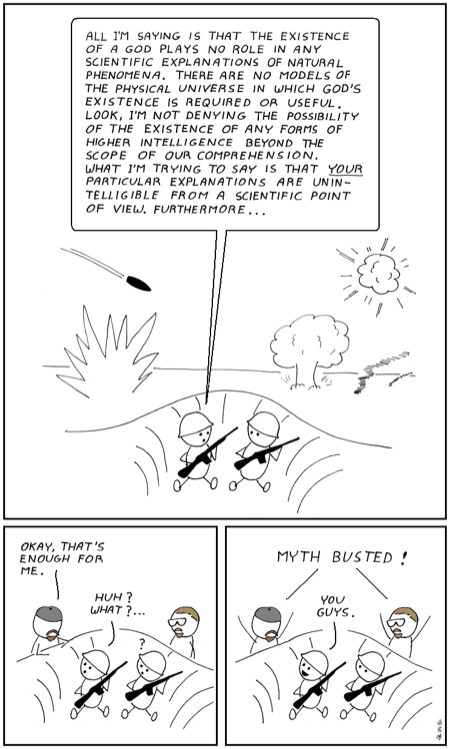
    In this post on his blog “Pharyngula” PZ Myers publishes the following cartoon with the comment “Sounds like something I would say except that you wouldn’t find me in a foxhole”.

    (Click to enlarge)


    The most natural interpretation here is that PZ is referring to the large speech bubble in the cartoon. But this is extraordinary! Would PZ really say: “I’m not denying the possibility of the existence of any forms of higher intelligence beyond the scope of our comprehension”? Is this the PZ Myers we have come to know? I suppose “higher intelligence” could refer to evolved aliens, but if so then it might be claimed that beings who share origins similar to our own are not entirely beyond the scope of our comprehension! If such possible and yet unspecified "higher intelligence" is beyond our comprehension then perhaps that may include the origins of that intelligence; perhaps that intelligence always existed, or perhaps it has a necessary existence (Asiety)…. perhaps that unknown intelligence is the most natural candidate for that vexing appellation…..shhh!….God!


    For a long time now I have kept banging on about formal “test tube precipitating science” facing increasing epistemological problems as the ontology it deals with gets more complex. Accordingly we must develop what Nassim Nicholas Talib calls “epistemological humility”. For that reason the cartoon’s expression of science’s diffidence toward mysterious epistemologically intractable objects such as “forms of higher intelligence beyond our comprehension” is not at all untoward – in fact as a pensive theist I could almost say along with PZ “Sounds like something I would say”! This is encouraging – it may mean that PZ is not as sold out to “scientism” as I thought, but I don't think PZ will be setting up an altar "TO AN UNKNOWN GOD" just yet! (Acts 17:23)

    Roman altar to an unknown deity

    Wednesday, March 31, 2010

    Mixing with the Right People.

    Irony meter - sproing Pictures, Images and Photos

    My poor old irony meter seems to be taking a bashing at the moment. See here on Uncommon Descent where I commented on the very interesting work of Dr Robert Sheldon. See also here and here where I leave comments on Dr Sheldon’s blog on the conservative “Townhall.com” web site – a site endorsed by Anne Coulter….which gives me another excuse to publish a picture of this lovely looking lady:


    By the way: The only way I could sign up on “Town.com” was to pretend I was from an American state. I chose the Midwest’s Iowa as I have been there. Cedar Rapids, where I was based, with its rural hinterland, felt a bit like Norwich. I remember comparing notes with one of Cedar Rapids' citizen and we both agreed that we didn't like big cities. I think we were both rubes and would be well out of our depth at a New York republican convention (= heaven, according to Ann)

    Tuesday, March 30, 2010

    A God of Some Sort

    After my last post on the aspects of anti-evolution ID theory I feel unhappy about, it is very timely that William Dembski has published this post on Uncommon Descent illustrating just what I mean.

    Dembski starts by quoting Frank Zindler who expresses the view that a literal Adman and Eve, the fall, original sin and the need of salvation are all incompatible with evolution: Basically the sort of stuff one gets from many a Bible Belt fundamentalist, but with one minor difference: Frank Zindler is an atheist and to him this is all just so much counterfactual theology. It goes to show that there is such a thing as a “Bible Belt” atheist; that is, an atheist who shares Bible Belt mental categories and therefore subliminally reasons and thinks about deity just like a Bible Belter. (Albeit counterfactually)

    However, this is by the by. Dembski says of Zindler:

    But Zindler is not arguing for the mere compatibility of evolution with atheism; he is also claiming that evolution implies, as in rationally compels, atheism. This implication is widely touted by atheists. Richard Dawkins pushes it. Cornell historian of biology and atheist Will Provine will even call evolution “the greatest engine for atheism” ever devised. To claim that evolution implies atheism is, however, logically unsound (even though sociological data supports the loss of faith as a result of teaching evolution). Theistic evolutionists such as Francis Collins, Denis Alexander, and Kenneth Miller provide a clear counterexample, showing that at least some well-established biologists think it’s possible for the two to be compatible. Moreover, there’s no evident contradiction between an evolutionary process bringing about the complexity and diversity of life and a god of some sort (deistic, Stoic, etc.?) providing the physical backdrop for evolution to operate.

    With that I agree, but make note of this: The evolutionary beliefs of Collins, Alexander and Miller are, as Dembski generously concedes, apparently consistent with “a god of some sort”. It’s a good thing that these are New Testament days, because I think Dembski will find that in Old Testament times worshipping “a god of some sort” could attract the death penalty. Otherwise so far so good, but be warned things start to go downhill from now on. Dembski goes on to say:

    The reverse implication, however, does seem to hold: atheism implies evolution (a gradualist, materialist form of evolution, the prime example being Darwinian). Indeed, the atheist has no other rational options in explaining the diversity and complexity of life. The atheist may, in the face of reason, invoke pure chance to explain the emergence of life.

    Atheism implies evolution? In a synthetic and probabilistic sense this is certainly true in that if one is given a person who is an atheist there is a high chance he or she is an evolutionist. But Dembski suggests that atheists have no other “rational” options open to them. This is a bit too strong: There is a measure of subjectivity in gauging just what is rational: One man’s rationality is another man’s idiocy. Would atheists who invoked a multiverse in order explain abiogenesis as a “pure chance” leap classify as being rational or irrational? What about atheist Fred Hoyle’s panspermia and his foray into a kind “alien” intelligent design? And where do we position those who say we are part of a gigantic simulation? It is certainly not clear to me that Darwinian gradualism is the only option open to atheists; it just seems to be the only game in town that currently appeals to most atheists for reasons that I suggested in my last post.


    But Dembski then goes on to propose a necessary disjoint between intelligent design and evolution as per the following:

    The rationale here is a simple application of the logical rules modus ponens (If A, then B; A; therefore B) and modus tollens (If A, then B; not B; therefore not A). Thus,
    Premise 1: If atheism is true, then so is Darwinian evolution.
    Premise 2: But if ID is true, then Darwinian evolution is false.
    Premise 3: ID is true (the controversial premise).
    Conclus 1: Therefore Darwinian evolution is false (modus ponens applied to Premises 2 and 3)
    Conclus 2: Therefore atheism is false (modus tollens applied to Premise 1 and Conclus 1)

    Premise 1 is unclear. Does “If atheism is true” equate to “If there is no god”? Is Dembski saying “If there is no God then evolution follows”? Is he saying that in the absence of the Aseity of Deity evolution has the logical efficacy to create life and can make good the absence of a divine creator? If so atheist materialists would probably agree. If this is Dembski’s meaning then it goes to show that there is such a thing as a “materialist” Christian; that is, a Christian who shares “naturalist” categories and can thus subliminally reason and think about “naturalism” like a materialist. Or have I got Dembski’s meaning here completely wrong? Does he simply mean that if a person believes in atheism he will believe in evolution? After all “atheism” is a belief about an ontology and not the ontology itself; Dembski has not made clear the distinction between atheism as a belief and atheism as an ontology.

    Premise 2 is clearly false. If the cosmos is sourced in some kind of self-necessary intelligence it is not clear to me that it follows that Darwinian evolution is false: As I have indicated in this blog, if evolution is to work in a realistic time, it requires the right mathematical preconditions (if they exist), and those preconditions can be construed as an ID choice made by some super intelligence. However, it is very likely that the idea that an act of intelligent design is required to set up a working version of evolution is not consistent with Southern Baptist Bible Belt creation theology - Dembski’s Southern Baptist outlook would very likely see a conflict between evolution and Christian theism (as per atheist Frank Zindler). So perhaps premise 2 should read as follows:

    Premise2: “If Southern Baptist Bible Belt theology is true then Darwinian evolution is false”

    Premise 3: As a theist I would accept this premise, but not in the sense that Dembski defines ID (See the following). Clearly then on the proceeding basis Dembski’s conclusion 1 does not follow. But it seems that Dembski’s aim is to define both ID and “Darwinian” evolution in such a way as to drive a wedge between them; they are in his view mutually exclusive as this passage shows:

    When I got into this business 20 years ago, I thought that any Christian (and indeed any theist), given solid evidence against Darwinian evolution (as ID is now increasingly providing—see my book The Design of Life and Stephen Meyer’s Signature in the Cell) would be happy to trash it and move to some form of intelligent design (whether discrete creations or gradual guidance or information front-loading or whatever). But that has not happened. Theistic evolutionists have now baptized Darwinism. Thus, in the 2001 PBS evolution series, Brown University biologist Kenneth Miller referred to himself as an orthodox Catholic and an orthodox Darwinian.

    According to Dembski then conventional evolution is not a front loaded process. This is at variance with my own view that evolution, no matter how one defines it, or for that matter any process one constructs which is able to arrive at complex order in “fast time”, must necessarily be front loaded; a front loading that is easily construed by a theist as a gift of providence.

    In some respects Dembski well demonstrates what I suspect are subliminal commonalities of mindset between the Christian Right and the Militant atheists. As I said in my last post:

    If evolution has occurred then it clearly keeps its load of active information well hidden, so much so that neither the anti-evolutionists nor militant atheists are aware of it; or perhaps they just don’t want to acknowledge it. In the opinion of both parties evolution purports to be a process that can boot strap living configurations from next to nothing. Thus anti-evolutionists and atheists have very large stakes in the respective presence or absence of explicit information discontinuities in nature; in contrast evolution’s information discontinuity is very implicit and is not to be found in material reifications, like front loaded genetic information.

    Using Venn diagram notation the picture that Dembski is foisting on all theists is shown below:

    (Click to enlarge)

    Notice that in the above diagram ID and evolution do not overlap; they are mutually exclusive. In this diagram we see that according to Dembski all atheists are evolutionists and that a subset of theists find themselves (compromisingly) in the evolutionist camp. Needless to say this is where Dembski and I sharply part company. I would suggest that the true picture looks more like this:

    (Click to enlarge)

    This diagram indicates the logical impossibility of constructing processes that create complex order in “fast time” without a blatant “logical hiatus” or “information discontinuity” being present. I see no way out of this logical trap; evolution or any other process inevitably displays this logical discontinuity. Therefore I have presumptuously labeled this all inclusive set as “intelligent design” because being a theist I see this as the gift of providence. Moreover, the real picture is far more complicated than Dembski suggests: As my Venn diagram shows atheists are not necessarily evolutionists. In fact when constructing the above Venn diagram I contemplated drawing the atheist and evolution circles projecting partly beyond the “ID” circle in order to suggest an atheist attempt to escape the trap of a Logical Hiatus – although I personally can’t see how that can be achieved and so I have shown atheism to reside inside the ID circle; they (and evolution) are the unconscious benefactors of providence.

    Is it any surprise that Christian Darwinians have fallen out with Dembski and friends and will have nothing to do with a concept of ID exclusively defined in anti-evolution terms? As Dembski says:

    Ironically, theistic evolutionists now make common cause with atheistic evolutionists—specifically against ID. ID has become public enemy number one for both atheistic and theistic evolutionists (the recent spate of books by both sides confirms this point—atheist Jerry Coyne’s Why Evolution Is True as well as theist Kenneth Miller’s Only a Theory). Consequently, not just the mainstream academy but the mainstream Christian academy (Wheaton College, Calvin College, Seattle Pacific University, etc. — most schools in the CCCU) have now closed their doors to ID and to hiring faculty that explicitly support it.

    Well surprise, surprise. Little wonder that mainstream Christian academies are closing their doors to the Christian right’s anti-evolutionist rendering of ID. Dembski and his right wing friends have cast the debate in the mold of a polarised ID vs. evolution battle thus effectively accusing those Christians who defect from the Christian right’s concept of ID as crypto-naturalists; a charge that is tantamount to an accusation of blasphemy. As I said over two years ago when I first started looking at this whole debate:

    They frame the debate to look as though it is ‘naturalistic’ evolution vs. ‘supernatural’ creation by God with, of course, ID coming in on the side of God against those who, like myself, favour evolution. Ironically, many atheists would agree with this framing.

    So it seems I have come full circle. How can Christian Darwinians do business with Dembski and friends when the innuendo is that those who do not support Dembski’s version of ID must be crypto-materialists who worship “a god of some sort”? I’m the first to admit that conventional evolution, as far as I am concerned, is only a working hypothesis, a hypothesis that may need considerable modification in the light of the Creator’s providence, but the unwarranted polarization superimposed by Dembski on the subject makes a relationship with the right wing Christian culture he represents impossible. As I said in my last post:

    This ……. right wing reaction against evolution is now culturally locked into the contemporary ID movement to the extent that it is impossible for them to countenance “evilution” as one of the options by which divine intelligence may operate. The Christian right wants to undermine the atheist’s main support and therefore evolution must go at all costs.

    Dembski echoes precisely this point when he says:

    Christians in general need to consider this: The only thing theistic evolutionists have to say to a Richard Dawkins who uses evolution as a club to beat believers is that he’s making a category mistake, trying to get science to do the work of theology (to which Dawkins would respond “so much the worse for theology”). By contrast, ID takes the club out of Dawkins’ hands and breaks it, showing that the theory of evolution on which he relies is all washed up.

    What neither Dembski nor Dawkins seems to have spotted is that that club may already have “ID” (or at least “Logical Hiatus”) written all over it.

    Tuesday, March 23, 2010

    Darwin Bicentenary: Final Summing up.

    Bad Ben says "Evolution is a brilliant theory and Darwin was brilliant guy.” See here

    My 2009 blog series on the Darwin bicentenary was, from the start, a pretext to ponder some aspects of the ID community’s challenge to evolution. I stress some because I confined myself to those issues I thought I understood best. I am hoping that this will be the last post on the matter, thus keeping my New Year resolution to stop blogging on this subject and to start thinking about something else.

    In part 1 of this post I looked at those facets of the ID movement’s work I like best; in particular Dembski’s papers on active information and the very crucial challenge of irreducibly complexity. In this final part I will look at aspects I am less fond of. None of the following is to say that there is no case against evolution; it’s just that some areas of anti-evolutionist polemic are, in my view, technically inept. Most of the following points I have touched on in my series. They represent my personnel digest and impressions after nearly two years of contact with the anti-evolutionists on Uncommon Descent. It is therefore difficult to formally reference them against the movement’s work, so I’m taking a “if the hat fits, then wear it” approach here.


    ONE) Misunderstanding the second law of thermodynamics: Some anti-evolutionists still hold the erroneous view that the second law of thermodynamics contradicts evolution. (See this post). This fallacy, I think, is mostly prevalent amongst Young Earth Creationists: It is a fallacy they have repeated to themselves time, time and again and in the repeating they have become entrenched. The loss of face in going back on this entrenched position is unendurable. To challenge this fallacy is to face a desperate antagonist who will cling to it for all he’s worth.

    Entropy is defined as S = k Log Z, where Z is the statistical weight of a macrostate. The second law tells us that dS/dt > 0 for an isolated system. The equation for S alone ought to provide YECs with a big hint as to their error. Z is defined given the constraints of the laws of physics. Thus the quantity Z does not necessarily equate to our intuitive concept of disorder because conceivably the physical regime may so restrict possibilities that Z will include a relatively high proportion of states containing self-perpetuating complex ordered forms. Since physical laws transcend thermodynamic decay, our intuitive concept of what increasing Z entails may be completely awry.

    TWO) “Chance and necessity”: Another misunderstanding I see perpetuated amongst the anti-evolutionists is embodied in their use of the phrase “chance and necessity”. They identify “Necessity” with the laws of physics. Hence, they conclude that since “Necessity” must have a probability of 1 then it follows that physical laws have a probability of 1. Therefore they wrongly conclude that the patterns generated by physical laws can’t contain information.

    THREE) Conflating complexity with information: A very simple outcome with a very low probability will, by Dembski’s definition of information (-log [p]), have very high information content. But a more complex outcome with a high probability will contain less information than an improbable simple outcome. Ergo, the complexity of an outcome is not necessarily an indication of its information content; some anti-evolutionists seem confused about this distinction.

    FOUR) Denial that living complexity could conceivably be implicit in simple laws: As a rule anti-evolutionists don’t give much credence to the idea that life is implicit in our physical regime – from their misleading “chance and necessity” perspective they regard it as impossible for the complex information of life to be implicit in physics. Given this belief it is surely ironic that one of their most effective challenges to evolution, that is, irreducible complexity, depends on a very complex object being entailed by physics: Irreducible complexity requires living structures to populate morphospace* as isolated islands of self perpetuating functionality. This conjectured evolution blocking pattern in morphospace is itself a very complex object, potentially containing lots of information. It is an object that would necessarily have to be implicit in the physics that many anti-evolutionists claim “cannot create information”. Thus, the important challenge of irreducible complexity depends on physics entailing a very complex object. If elementary physics is conjectured to imply an intricate pattern that blocks evolution, it would seem that those who tender the opposite conjecture of self-perpetuating functionality forming a connected set in morphospace is not a position that can be criticised on the basis that physics cannot “create” the information required by this object.


    FIVE) The polarization of intelligence against evolution: The anti-evolutionists are apt to contrast intelligent agency with the “mindlessness” of evolution. But “intelligence” as we understand it in its human form at least, has a strong trial and error component suggesting that there are deep isomorphisms between evolution, intelligence and algorithmic searches. Moreover, it needs to be pointed out that human technological progress is only possible if “technological morphospace” is populated with functionality in such a way that it is possible for human intelligence to jump the gap from one technological development to the next; without this level of technological “reducible complexity” human technological advance is impossible.

    SIX) Intelligence polarized against “naturalism”: Consider this statement which I once read somewhere on Uncommon Descent:

    “The four fundamental forces must explain everything on earth if you don’t believe in intelligent design”

    So; does it follow that if one does believe in Intelligent Design then one doesn’t believe that the four fundamental forces “explain everything”? No, the above sentence doesn’t actually say that, but it leaves unsaid whether or not the four fundamental forces also constitute a candidate manifestation of intelligent design. If the four forces do “explain life” they would presumably have to be correctly selected in order to make evolution work. The question is, then: Which requires more intelligence: Creating life directly or via the selection of the right laws? Given that many anti-evolutionists are theists, it is ironic that they should set "intelligence" over and against “naturalism” when in fact it is clear that any thoroughgoing Christian theism sees “naturalism” as sourced in divine designs. If the “natural” is divinely sourced then why don’t the anti-evolutionists at least acknowledge evolution as an intelligent design option (albeit one they disagree with)? These matter need to be clarified amongst anti-evolutionists.


    SEVEN) Is “Intelligently Designed” the same as “Designed”? The use of the qualifier “Intelligent” may hint at the presence of a rather anthropomorphic valued judgment. I myself would prefer to just use the unqualified term “design” (or even “providence”) for two reasons:
    1. “Design” is a more neutral term that can be used to designate the abstract notion that our descriptions of the ontology of the cosmos will always contain an irreducible Logical Hiatus; that is, an apparent contingent giveness will always remain whether we think it to be “intelligently” sourced or not.
    2. It avoids the difficulties of trying to assess the motives and capabilities of a designer; for example assessing whether a work of art is intelligent is not so easy given that it is bound up with the artist’s motives, aims and personal complexes.
    Perhaps a more objective measure of intelligence could be arrived at in terms of the computational complexity required to arrive at a configuration. In this connection I don’t find Dembski’s concept of complex specified information very helpful. (See here)


    EIGHT) No acknowledgement of evolution as a possible design candidate:There are Christians such as Sir John Polkinghorne who believe evolution has occurred and yet who would claim that the propensity for the Universe to be so “fruitful” in evolutionary terms is down to God’s provision (or design). Ostensively, then, evolution too can be interpreted as a design candidate. Whether evolution has actually occurred is not the point here: One Uncommon Descent poster (See here) has acknowledged that genetic front loading is one way of explaining common descent. Although he himself doesn’t believe this has actually happened he allows such a view to be classified as a form of intelligent design. This act of classification raises the question why evolution itself, which as Dembski has shown must be necessarily be fueled by some kind of front loaded “active” information for it to work, can’t also be included in the ID fold!


    NINE) Contemporary ID: A theory-less movement: I have criticized the anti-evolutionists on the basis that they have no agreed working theory of natural history: Their theories of natural history may range from Young Earth Creationism to a form of genetically front loaded evolution, as we have seen. Hence their scientific endeavors are largely guided by an anti-science heuristic – that is, one of seeking out the weaknesses in the academic establishment’s edifice of evolution. Actually, I might be prepared to withdraw this criticism given that positing the involvement of super intelligence naturally introduces an entity that could work in quite mysterious ways and thus be scientifically intractable. But then if that intelligence is so inscrutable perhaps conventional evolution, with its burden of implicit active information, is that entity’s chosen method of working. Who knows?


    TEN) The politicization of science in a Christian right vs. atheist contention: Evolution has been portrayed by atheists as a process that from its inception to its conclusion is mindless, a process that in the words of Richard Dawkins allows him to become an intellectually satisfied atheist. Thus “evilution” has become the ogre of the Christian right, a rival to creation, an insentient chaos monster that purports to be able to create organized complexity from next to nothing. Evolution’s almost universal acceptance amongst left wing and liberal atheists only confirms to the Christian right that evolution can only ever be anti-intelligence and therefore anti-God. This consequent right wing reaction against evolution is now culturally locked into the contemporary ID movement to the extent that it is impossible for them to countenance “evilution” as one of the options by which divine intelligence may operate. The Christian right wants to undermine the atheist’s main support and therefore evolution must go at all costs. This anti-evolutionist opposition to the liberal academic establishment’s evolutionary world view also marries well with their opposition to that establishment’s views on global warming.

    If evolution has occurred then it clearly keeps its load of active information well hidden, so much so that neither the anti-evolutionists nor militant atheists are aware of it; or perhaps they just don’t want to acknowledge it. In the opinion of both parties evolution purports to be a process that can boot strap living configurations from next to nothing. Thus anti-evolutionists and atheists have very large stakes in the respective presence or absence of explicit information discontinuities in nature; in contrast evolution’s information discontinuity is very implicit and is not to be found in material reifications, like front loaded genetic information.

    The contemporary ID movement has fallen out badly with the evolutionists like Francis Collins and Ken Miller. Collins and Miller, like Polkinghorne, are theists and therefore they are very likely to attribute evolutionary fruitfulness to divine providence or design. So, why can’t Miller and Collins join forces with Uncommon Descent and their philosophical views on evolution be incorporated into a united ID front? In spite of at least one ID theorist allowing genetically front loaded common descent being identified as an ID candidate my guess is that this can never happen with conventional evolution even though it must also be a front loaded process. There are, I suspect, fundamental fault lines here bound up with political and vested interests making such a union impossible: The Christian right, the free market economists and those who are itching to identify President Obama as Mr. 666 may have something to do with it. It is beginning to look to me as if political identification counts for more than one’s belief in theism, Christianity, or even in intelligent design. According to her wiki page, Christian right winger Anne Coulter (pictured) has the following (tongue in cheek?) concept of the ideal world:

    "It would look like New York City during the Republican National Convention. In fact, that's what I think heaven is going to look like."

    I hope to scale the monumental irony introduced by the right wing connection on my blog Noumena, Cognita and Dreams.** (If there is any doubt about a right wing connection have a look at this post that has just popped up on Uncommon Descent)

    Heavenly Body: Ann Coulter is
    in Heaven whenever she goes
    to a republican convention.


    Footnotes
    * I must make one thing clear here: Morphospace, in the sense that I use it, refers to both microscopic as well as macroscopic configuration.


    ** The intended post was in fact published on this blog: See here

    Monday, March 08, 2010

    The God Computation.

    I was fascinated to read this post on Uncommon Descent by Barry Arrington. He gives us a link to an article claiming to have calculated that the probability of abiogenesis to be in the order of 10 to the power of -1018 (Presumably a “spontaneous” probability calculated without reference to the structure of morphospace). This figure, he says, has given some impetus to multiverse views because clearly only a multiverse can provide the probabilistic resources for the required “miracle” of spontaneous creation to take place. Barry then goes on to propose:

    But the theist can play this game too. “The existence of God is not logically impossible. In an infinite number of universes everything that is not logically impossible is in fact instantiated, and we just happen to live in one of those universes in which God is instantiated”

    Somebody in the comments thread takes Barry to task over the question of logical possibility: The multiverse, the correspondent says, doesn’t imply a carte blanche logical possibility because the multiverse itself is subject to laws (God knows what laws!). That comment seems true enough, but it reckons without Stephen Wolfram’s conjecture of computational equivalence: Viz: Any computation exceeding a certain threshold of complexity will, given enough time, exhibit computational universality – that is, it will compute any computable function and only God knows just what huge computations are out there in the platonic realm waiting to be reified as a real computation. So, if our multiverse is one of these universal computations it will, as it rings the changes of chaos, eventually come up with anything computationally possible. If, then, there is such a thing as a “god computation” or “god function” out there, somewhere sometime the multiverse will compute it! Therefore perhaps Barry Arrington’s point is valid after all!


    The irony is that it seems that a multiverse theorist has already arrived at the very juncture anticipated by Arrington. I am thinking of the “computer simulation” argument. This argument tells us that in a multiverse there is a very high probability we are part of some kind of huge computer simulation initiated and controlled by a being or beings who as far as we humans are concerned would have the sort of powers over the simulation that we traditionally associate with deity. See here for details. I once commented on this matter myself here!


    One version of the computer simulation theory suggests that it must be these guys who are simulating our universe.

    Wednesday, February 24, 2010

    Atheology

    In this post atheist Larry Moran criticizes attempts to “prove God” (sic; how can we expect to “prove God” if Larry can’t even expect to “prove evolution”?) from the appearance of design. In his opinion life shows signs of not being designed: He is probably thinking of some of those biological structures that look as though they have been cobbled together as a result of the accumulation of historical accidents. The end product is the kind of legacy architecture one sees in old towns where the next development is constrained by and has to work from the fiat of what has gone before. (If you ask Larry he could probably reel off a whole list of biological examples) In Larry Moran’s mind this concept of haphazard accumulative development is set against the notion of the intelligent planner who starts from a blank sheet and can therefore design a much more direct solution to a problem, a solution unencumbered by past random legacies.

    There is, needless to say, a hidden counterfactual theology in the atheism here; namely the assumption that God is a kind of technical whiz who sits down like a human engineer with a virgin drawing board in front of Him and designs his best solutions. (Ironically many anti-evolutionists conceive a similar concept of designer). But perhaps God is a story teller first and an engineer second? Clearly ours is a story, a cosmic story of change, evolution and contingency snatched from the platonic limbo land of possibility, that can and has been told. Perhaps like a human author Deity has sat down not in front of the engineer’s drawing board, but rather in an armchair beside a fire and told our story. If God is God, infinite and inscrutable, how can we be so sure (and naïve) about His motives?

    But whatever; at the end of the day we are always left with the Logical Hiatus of having something for nothing; why is there something rather than nothing? Where, if it exists, is the logical necessity to support the apparent contingency of our cosmos? So, in a more abstract sense than we find in the engineering metaphor we seem to have a design question, a question of, as Paul Davies puts it in the “Cosmic Jackpot”: Why this universe and not another? Is it all just random? But what is randomness other than a mathematical description of a particular class of pattern, a pattern that creaks under a huge burden of complex brute contingency. The big question then is who or what sources such complex patterns? Or is the source a hidden ontology that somehow reifies our notion of “chance” in the sense of being a source that can make choices mindlessly?* But to envisage such a source of mindless purposelessness working behind a facade of pattern is itself a perverse kind of theology; an “atheology” that makes the ontology of chance into a god and stultifies further questions because it believes there is neither point nor meaning in asking them. This is the theology of the absurdity of it all.

    Footnote
    * What does it mean to make choices without mind? It can’t be randomness because randomness is to do with pattern description and as such makes no necessary allusion to the mechanism of “choice” that sources the pattern. As human minds we can only empathize with mind as the source of choice, so it seems that an ontology of mindless “chance choices” is forever utterly beyond our understanding; we can no more understand what it is like to be a mindless “chance source” than we can understand what it is like to be an ant.

    Friday, February 12, 2010

    Thermodynamics and Evolution – Again.

    Is the relative statistical weight of life containing states great enough at some point in the history of the universe to give those states a realistic probability?

    (See also http://quantumnonlinearity.blogspot.com/2009/05/darwin-bicentenary-part-20-does.html)

    Whether or not abiogenesis and evolution are facts, there is one argument that the anti-evolution ID theorists are ill-advised to use: The argument that abiogenesis and evolution violate the second law of thermodynamics. In two posts on Uncommon Descent (here and here) we find Granville Sewell still publicizing this erroneous view. The line of argument used by Sewell is based on the observation that a local increase in order can only occur if negative entropy is transmitted across the boundary of a locality into a system (that’s the equivalent of saying positive entropy is exported out of the system). Sewell identifies this negative entropy (or “negentropy”) with the input of information across the boundary of the system. Therefore in his opinion it follows that some kind of information must be injected into the subsystem from without if the ordered structures of life have any chance of coming into existence. Ergo, since abiogenesis and evolution make no recourse to the input of information (or negentropy) beyond the confines of the Earth it follows that thermodynamics prohibits the formation of organic structures.


    The observation that local increases in order must be accompanied by the transmission of negentropy into the locality is, of course, correct, but Sewell seems to hold the erroneous view that this negentropy must be reified as explicit information crossing the boundary into that locality. In Sewell's view this explicit information is the only way of offsetting the extremely small probabilities associated with organic structures. He rightly observers that at the bottom of the second law are probabilities, but he neglects to say that these probabilities are conditional probabilities. True, living structures are such a tiny class of what is possible that it is clear they have a negligible absolute probability of formation. But in reality the development of living things is a conditional probability, a probability conditioned on the given physical regime of the cosmos. Given this regime here is the big question: Is the conditional probability of evolution and abiogenist raised to realistic levels by physical conditions alone? If so then the “information cost” of this high conditional probability must reside in the improbability of the physical regime that supports abiogenesis and evolution.

    Now consider two scenarios:

    ONE) Firstly crystallization. Speaking in absolute terms probabilities favour crystallization even less than they do biological structures; with respect to the huge mathematical space of platonic configurational possibility the high organization of crystals is very a unrepresentative arrangement of particles; the low statistical weight of crystal configurations, a lot lower, in fact, than even the statistical weight of living structures (which can be realized in enumerable ways) ensures that crystals have a very low absolute probability. However, in real physical terms the relatively tiny statistical weight of the class of crystals is more than compensated for by the constraint imposed by the laws of physics, a constraint which eliminates huge numbers of cases, thus considerably raising the conditional probability of crystallization. For under the right physical conditions crystals easily form: A solution with the right concentration, temperature and pressure results in a bit by bit construction of the crystal as atoms randomly find their place in the crystal lattice and are fixed into position. This considerable increase in local order is offset by the appropriate entropy transactions with the surroundings, thus preserving the overall upward trend in entropy.


    There is one important remark about crystallisation that I would want to make here. As I have just said entropy is exported out of the crystal locality thus preserving the second law. Another way of looking at this is to think of negentropy crossing over into the locality, increasing the order of this locality. But in fact if we look at the boundary of the locality closely we find nothing resembling the import across this boundary of instructions telling the atoms how to assemble; the assembly is inherent in the information contained in the laws of physics which constrain the locality sufficiently to render an absolutely improbable configuration very probable.

    TWO) Now consider the case of a seed landing in a locality and a plant consequently growing. The growth of the plant constitutes a local increase in order. As in the case of crystallization this local increase in order is offset by the appropriate entropy transactions with the surroundings thus preserving an overall upward trend in entropy. However, this system is very different from crystallization on two counts. Firstly, the plant is not a manifestation of simple order like a crystal; it is of course very ordered but it is a very complex form of order at the same time. Secondly, the elementary entropy transactions with the surroundings are not the only thing that crosses the boundary of the locality: From the outset there is the input of a seed which is a very complex piece of genetic machinery and information. Thus, this system is very much in line with Sewell’s expectation that the locality needs some fundamental informational input before a highly ordered yet very complex structure can be constructed.

    ****

    We have above then two scenarios where there is a local increase in order and yet no violation of the second law of thermodynamics. Both systems represent a generalized form of “crystallisation” in the sense that an ordered structure is built up atom by atom, molecule by molecule, as randomly jiggling particles find a place in the structure and then are locked into place. But, of course, there are obvious differences between these two forms of “crystallization”. For mineral crystallization the “information” present in the local laws of physics is sufficient to “instruct” the process, whereas for the “crystallization” of a living structure the complex machinery in the seed packet is needed. For mineral crystallization the very regular and simple order of the crystal is in absolute terms highly improbable, but that improbability need only be bought at the price of a relatively elementary set of physical equations; a scenario that presents no obvious intuitive problem to us. On the other hand the growth of complex flora requires the laws of physics to be supplemented by the input of the complex structure found in a seed; once again a scenario that presents no serious intuitive problems for us.


    In terms of absolute probabilities both mineral crystallization and the growth of an organism (in this case a plant) represent the appearance of highly improbable structures. But in terms of conditional probabilities both processes have high probabilities; for mineral crystallization a high conditional probability is bought at the price of the laws of physics and the given boundary conditions of the physical system. In the case of plant life the boundary conditions are supplemented by the complex seed packet that boot straps the growth of an organism. Taken together the laws of physics and the boundary conditions of these two systems have the effect of putting a very tight constraint on their respective systems, so tight in fact that in spite of the general trend of an overall increase in disorder there is a high (conditional) probability of a very unrepresentative, albeit localized, configuration making an appearance. The constraints on the systems have the effect of removing myriad mathematically possible scenarios so that amongst the remaining class of possibility, the statistical weight associated with the development of localised order is relatively high, thus considerably enhancing the probability of the formation of that local order.


    So given these two scenarios, is it at least conceivable that some combination of abiogenesis and evolution can result in the “crystallization” (metaphorically speaking) of living things and yet not violate the second law of thermodynamics? The trouble is that neither of the above two scenarios do exactly what is required of abiogenesis and evolution: Although mineral crystallization only buys order from the laws of physics and simple boundary conditions, the result is a very bland and dead form of order. In contrast the “crystallization” of actual living things, in all cases we observe, supplements the laws of physics with a complex boundary condition in the form of the input of an intricate genetic machine needed to seed the formation of life. If the concept of evolution and abiogenesis are to work as conventionally envisaged then they must work less like the concept of seed growth, and more like crystal growth, where the only information resources are some simple boundary conditions and the laws of physics. The question then is this: Can life originate without the boundary condition of an initial input of complex informational machinery? Can we get ordered complexity from simple laws and algorithms?

    If evolution and abiogenesis are the source of living complexity and diversity then on current theories they are a form of generalised “crystallization” resourced only by the inherent information present in some simple starting conditions and the laws of physics. It is this contention that sticks in the gullet of the anti-evolutionists; they do not believe that such is possible. Those anti-evolutionists who have followed the work of William Dembski have conflated Dembski’s otherwise valid conservation of information argument with a conservation of complexity and concluded that the complexity of life can’t come from simplicity. In contrast I hardly need point out that the militant atheists love the idea of complexity coming from simplicity, perhaps for two reasons: 1. The origin of life is then apparently sourced in “mindless simplicity” 2. The notion of complexity coming from simplicity can be extended and with a bit of imagination it might be mooted that complexity can come from simply nothing! Although the idea of getting something for nothing is very suspect it is not true that only complexity comes from complexity; as I have remarked many times in this blog, simple algorithms and laws can generate complexity, but the big question is: Can they generate living complexity?


    Crystallisation works because each stage in the crystal’s formation is a stable structure; if the current crystal contains N atoms and is stable, then so is the next crystal structure of N+1 atoms and so on in an inductive way. Each structure in this succession of structures is only separated by an atom or two and thus they effectively form a connected set of stable structures in morphospace; in other words crystals are reducibly complex. This connected object in morphospace is an implication of the laws of physics. These laws act as a constraint removing such an immense class of random possibilities that relative to this much reduced class the statistical weight of an outcome containing crystals is considerably raised. The second law of thermodynamics is an outcome of random thermal agitations ensuring that a system migrates towards macro states with the greatest number of microstates (that is, macro states with the greatest statistical weight); if because of the constraint of physics the macro states with the greatest statistical weight contain localized order then that localized order will actually be favoured. Thus crystal formation does not violate the second law of thermodynamics because the laws of physics eliminate so many mathematically possible micro states, that as the system moves toward the macro state with the greatest statistical weight, it moves toward a system that includes local ordering.

    Conventional abiogenesis and evolution do not assume the input of explicit information; rather the information is conjectured to be implicit in the laws of physics. Therefore the theoretical precondition of these processes is similar to that required by crystal formation; namely, a connected set of stable bio-structures in morphospace separated by gaps small enough to be jumped by random thermal agitation and/or random mutations; that is, the theoretical precondition for the “crystallization” of life is that bio-structures are reducibly complex. As for crystal formation this kind of evolution/abiogenesis does not violate the second law of thermodynamics because the physical regime is conjectured to eliminate so many mathematically possible micro states that scenarios where there is a local increase in order occupy a considerably larger relative proportion of the now constricted space of possibilities, thereby much enhancing their probability. If at this point it seems intuitively unlikely that the second law of thermodynamics would allow the formation of such complex ordered structures, we now recall the growth of a plant from a seed: Clearly thermodynamics does not prohibit the growth of a complex organism. As for crystal growth so it is for organic growth: The twin physical constraints of boundary conditions and the laws of physics eliminate so many mathematically possible micro states that the local increase in order entailed by organic growth becomes a considerably larger relative proportion of the now constricted space of possibilities, thereby much enhancing its probability. However, it is clear that plant growth depends on the boundary condition of the initial input of organized complexity in the form of a seed: But then abiogenesis and evolution also depend on an initial input of complexity; namely, a complex arrangement in morphospace whereby stable structures form a connected set, a structure that would have to be entailed by the laws of physics. This arrangement in morphospace serves a similar purpose to the complex genetic mechanisms found in a seed. This invisible mathematical structure (if it exists) tends to confound the anti-evolutionist’s expectation that the information needed to assemble complex objects can only be found reified in complex material objects.


    I must qualify the foregoing by admitting that it not at all clear that the conjectured structures in morphospace required by evolution and abiogenesis actually exist, or even can exist. Moreover, it is not at all clear that the laws of physics, as we currently understand them, imply that biological structures are reducibly complex. The anti-evolutionist’s contention that biological structures are in fact irreducibly complex may still be true. But the point I’m making here concerns the second law of thermodynamics and not (ir)reducible complexity. That point is this: If biological morphospace is populated by a set of reducibly complex stable structures (that is structures separated by small increments of change) then as in crystal formation abiogenesis and evolution would not violate the second law. Moreover, the “crystallization” of life would require no explicit information directing the process to pass through the boundary of an evolving locality in order to seed it. The information required for life would, on this conjecture, be implicit in the laws of physics in as much as that those laws entail the required arrangements in morphospace.

    That simple laws of physics are information laden and can potentially define something as complex as the arrangement of structures in morphospace is another concept that anti-evolutionists may find difficult accept. As I have remarked before anti-evolutionist’s often wrongly identify simple laws and algorithms with “necessity” and thus they wrongly conclude that equations can’t carry information. Moreover they tend to conflate the concepts of complexity and information. Thus they conclude that simple algorithms and laws can’t generate complexity – this is, of course, wrong as we know that simple algorithms can generate the complexity of fractals and pseudo random sequences. Even if we concede that the anti-evolutionists are right about the irreducible complexity of bio-morphs, one thing remains clear: Whether the layout in bio-morphospace entails either reducible complexity or irreducible complexity it is clear that this space of structures is itself an extremely complex object: therefore either way the physics of our world entails a morphospace with a very complex layout. So even taking on board the anti-evolutionist’s concept of irreducible complexity we find that we have to admit that simple physical laws can generate very complex objects, whether those objects favour or block evolution!

    Although it is clear that Granville Sewell’s opinion about the second law of thermodynamics are wrong I would want to concede that abiogeneiss and evolution are subject to a reasonable doubt on basis that as far as I am concerned the questions surrounding (ir)reducible complexity are not settled in my mind. It’s a good thing that I’m not a professional scientist because even this expressed uncertainty is likely to be regarded as the slippery slope to the "scientific heresy" of ID. But as I have remarked before, whatever the arrangement of biological structures in morphospace may be, I have a funny feeling that this arrangement is computationally irreducible; that is, the only way we have of acquiring analytical evidence about that arrangement is to actually carry out a very long computation and there are no other analytical short cuts. Hence, the burden of evidence is thrown back on the actual computation itself; in this case the actual workings of natural prehistory as manifested by the existence or nonexistence of paleontological evidence. If my mathematical intuitions are right then as I am not a paleontologist it doesn’t look as though I can make much further progress on this subject.

    Sunday, February 07, 2010

    Fuzzy after dinner thoughts one quiet Sunday afternoon.


    Brave Knight Sir Roger Penrose doesn’t know which way his Hilbert space vector is going to point next

    I am hoping to kick this habit of evolution vs. anti-evilution debate posting, an activity that I have engaged in for nearly two years now: I honestly don’t think I can make much further useful progress on the question. So, I plan to make only two more posts on the debate in order to wind it up. My mind is now turning (back) to other issues.

    With the authoritative and excellent help of Sir Roger Penrose’s books I have been pondering the vexed question of the evolution (“evolution” as in “change”, not as in “evilution”) of the quantum mechanical state vector. The following is a resume of my current thinking so far, thinking which I have to admit is rather at the impressionistic sketch stage. (There is no guarantee as to the correctness of the following; after all I’m not a “Sir”. Also, today was one of those days when, as H. G. Wells put it in "The Time Machine", I was experiencing "that luxurious after-dinner atmosphere, when thought runs gracefully free of the trammels of precision")

    The orientation of the QM state vector in Hilbert space changes in a smooth and deterministic way until a measuring system from without hits that vector and it then appears to undergo a random discontinuous jump according to probabilities calculated with the “projection hypothesis”. Ostensibly, Hilbert space is Mathematically Isotropic. Moreover, there seems to be a complementary symmetry between position and momentum (or time and energy) and this symmetry is especially clear with relativistic renditions of quantum mechanics. So given these symmetries, on the face of it there seems be no reason why we shouldn’t observe those strange mixtures of state that involve macroscopic objects occupying two positions at once, much as do photons in Young’s slits experiment; for given the isotropy of Hilbert space obviously spatially mixed macroscopic states are no less preferred than spatially unmixed states.

    It has to be admitted that decoherence theory may provide an excellent solution to this problem. Entanglement with “hot” macroscopic measuring tools will appear to collapse the wavefunction. Furthermore, thermodynamics and entanglement will ensure that for macroscopic objects some balance between a spread of momenta and distances is maintained, and this perhaps is precisely what we see in the seemingly unambiguous states of the macroscopic world. Decoherence theory still remains a very good candidate explaining the apparent random jumping of the state vector and the preference for certain kinds of macro-state. The big bonuses of this theory are that it preserves frame independence, other symmetries and above all that holy grail of reductionist science: An “in principle” determinism – the closed system. However, it has to be said that at the level of the outermost frame there are no outside “hot” measuring contexts which will help maintain the state vector in some balance between momentum and position.

    For reasons I have given here, I am inclined to favour the notion of real discontinuous random jumps in the state vector. Moreover, that the Schrödinger equation is not Lorentz invariant may hint that there is an actual asymmetry between space and momentum. In fact my own attempt at explaining gravity depends on a non-linear quantum equation that makes use of postulated underlying asymmetries in frame that are only partially compensated for by Einstein relativity. Gravity is something that operates in x-space and not in momentum space; hence there is an asymmetry between space and momentum. Thus gravity is implicated as a factor explaining why we only observe spatially unambiguous macro states. Penrose’s ideas about why the state vector jumps randomly may be right: It may jump to ensure that we don’t get quantum superpositions which imply spatially ambiguous macroscopic distributions of matter entailing gravitational energy divergences violating the allowed uncertainty in energy. Such a view entails the end of the reductionist's closed system.